
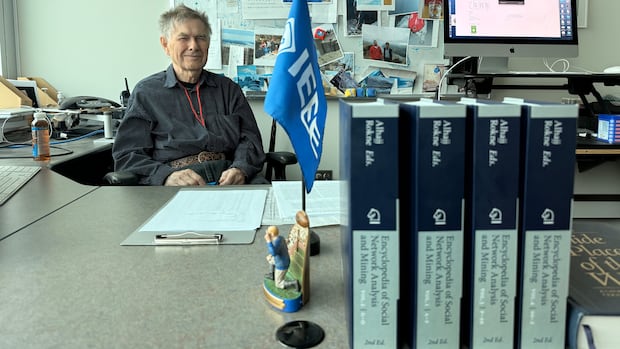
Sixty-two years after Jon Rokne stepped foot on campus, the computer science professor who brought the internet to the University of Calgary has retired — on paper.
There isn’t a chance the 85-year-old will stop working.
“I’m not going to retire intellectually,” said Rokne in an interview with CBC News.
The Norway-born academic continues to publish papers, mentor students and work with his longtime friend and collaborator Reda Alhajj on their next edition of the Encyclopedia of Social Network Analysis and Mining.
‘Worldwide’ influence
In the years and months leading to his retirement last week, Rokne showed no signs of slowing down. In fact, he published 25 papers last year — a feat Alhajj says “even groups cannot contribute.”
“He works like a young person,” said Alhajj.
Rokne’s influence is, as one former student described, “worldwide.”
“His contribution has laid the groundwork for a lot of advances in the field of computer science,” said Annette John, who graduated with a master’s earlier this year.
From mainframe computers to AI
Rokne’s contributions to the computer science world began when computers and the internet were in their infancy, and continue today with published research papers covering topics like the use of artificial intelligence in medicine and large language models.
This year, while the University of Calgary celebrated its 60th anniversary, Jon Rokne celebrated his 62nd year on campus.
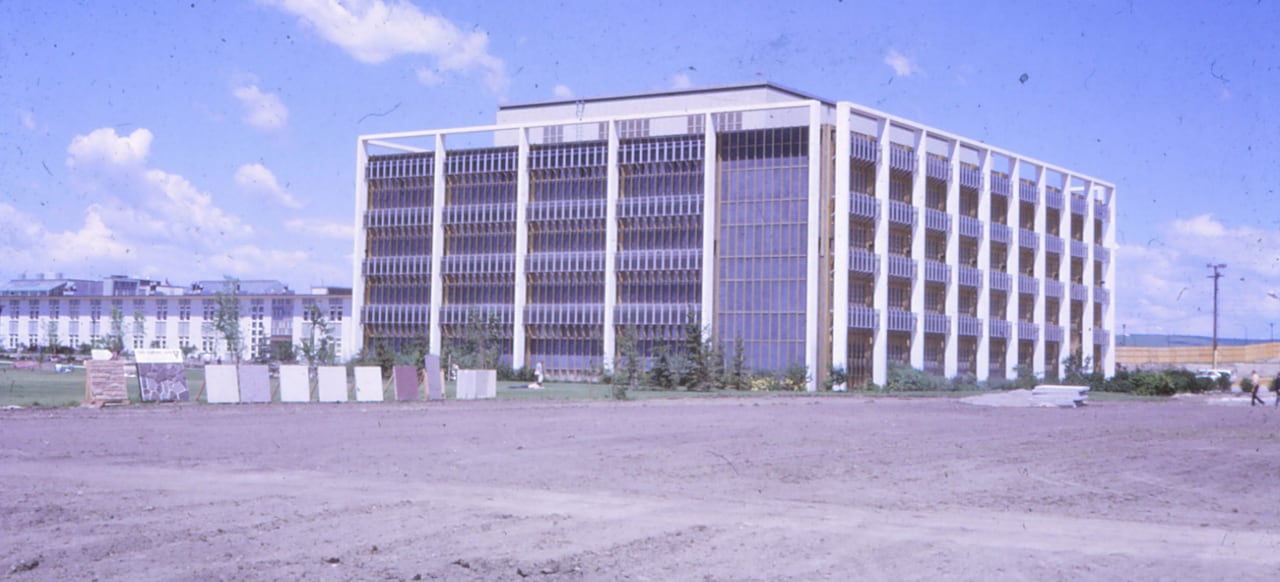 The University of Calgary campus started in the 1960s with two buildings and quickly grew. (Jon Rokne)
In 1964, a 23-year-old Rokne left Norway after accepting an offer to study at what was then known as the University of Alberta at Calgary. At the time, there were fewer than 300,000 people living in the city.
The western Canadian university outbid Stanford, attracting Rokne to a city that offered a mountainous backyard where he could continue to practise his home country’s obsession with cross-country skiing.
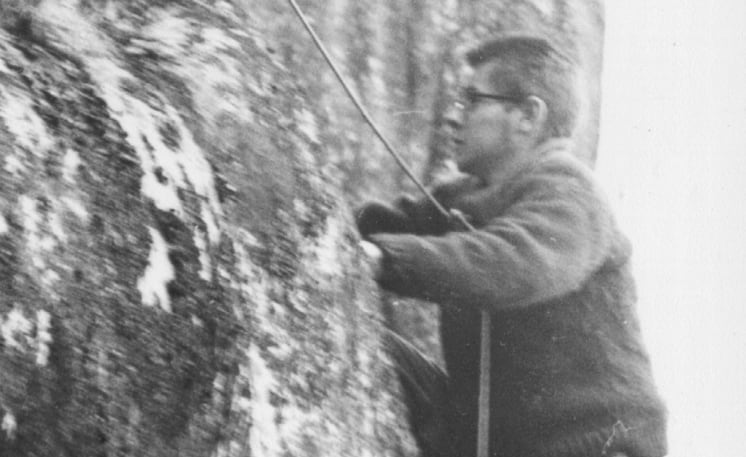 This image is of Jon Rokne climbing in Norway. Rokne says Calgary was a good fit for his love of climbing and cross-country skiing. (Submitted by Jon Rokne)
When Rokne arrived in Calgary, the university was comprised of only a few buildings, including one for arts and science and a brand new physical education building. Rokne’s mathematics department was on the top floor of the library block.
At the time, the school had a room-size mainframe computer. Rokne still has stacks of the punch cards that he brought to class to show his Gen Z students.
A fight for the worldwide web
Rokne completed a master’s in mathematics in 1966 and a PhD in 1969, followed by a year of post-doctoral work, which led to a teaching position at the University of Calgary in 1970.
In 1989, Rokne went to the university asking for a router to bring the internet to Calgary, but said the administration “wouldn’t have it; there was no interest.”
It took months of lobbying before the school finally caved.
“Now they can’t live without. It’s interesting, isn’t it?” said Rokne.
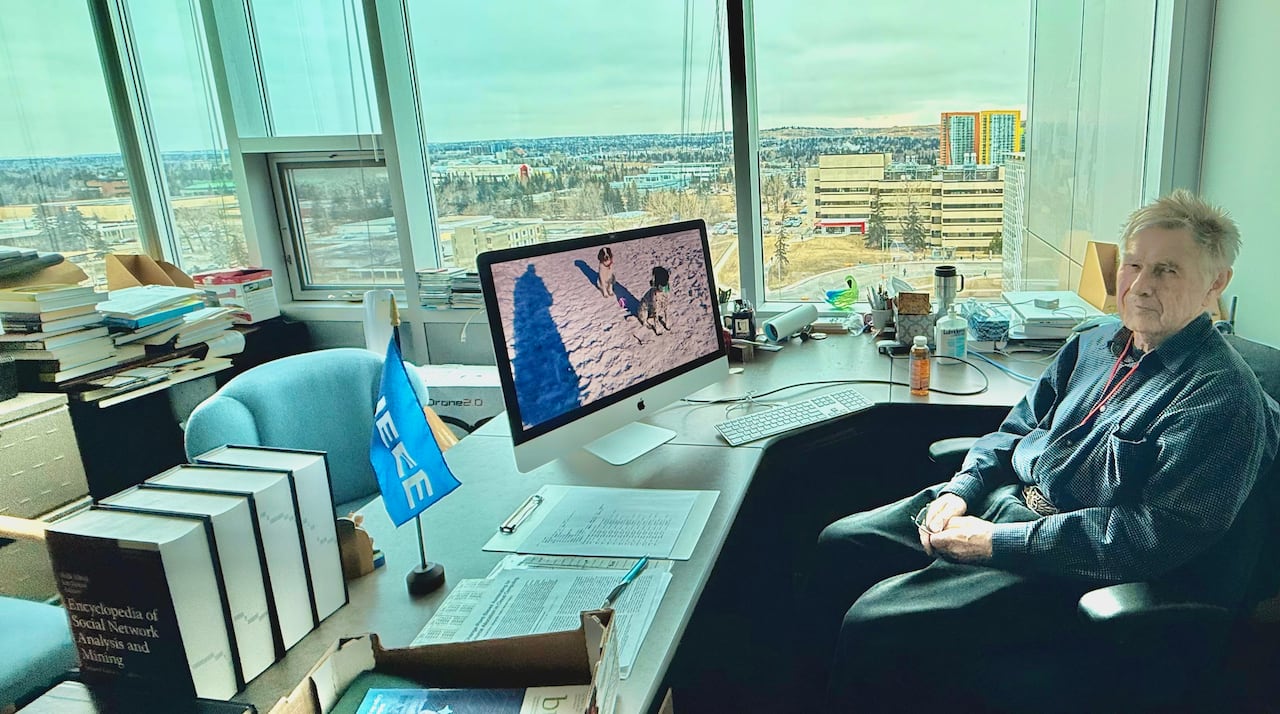 Jon Rokne, photographed in his U of C office in the months before his last day. Rokne retired on June 30, 2026. (Meghan Grant/CBC)
His email is probably one of, if not the first University of Calgary email addresses.
By 1990, Rokne had earned the position of head of the computer science department, a role he served in for the next seven years.
‘One of the foremost famous researchers’
When asked about his proudest or most significant accomplishments, Rokne describes his professional achievements as “many little ones,” but in reality, he is considered one of the leading scholars in his field.
Rokne has been extensively involved — as a fellow and having served twice as a vice-president of publications — with the Institute of Electrical and Electronics Engineers (IEEE), the world’s largest professional organization for engineering, computing and technology.
“He is considered to be one of the foremost famous researchers within the domain of computation geometry and, more recently, building social networks,” said Marina Gavrilova, whose doctoral research was supervised by Rokne.
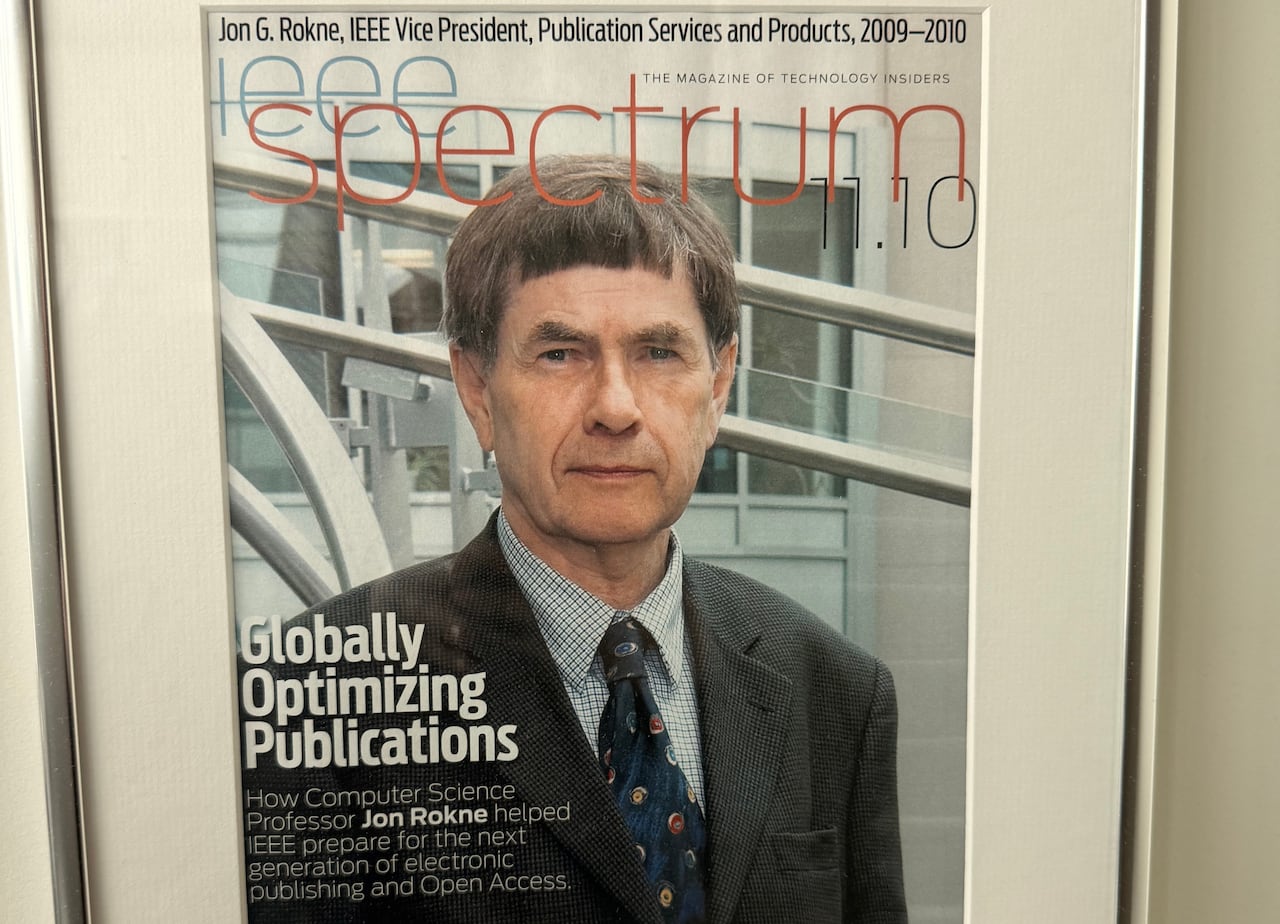 Jon Rokne has been extensively involved — as a fellow and having served twice as a vice-president of publications — with the Institute of Electrical and Electronics Engineers (IEEE), the world’s largest professional organization for engineering, computing and technology. (Meghan Grant/CBC)
Gavrilova, who now teaches at the University of Calgary in the computer science department and serves as director of the school’s Biometric Technologies Laboratory, completed her PhD under Rokne in 1999.
“[Jon Rokne] supported me in every way,” said Gavrilova. “He cared about his trainees, more than he cared about himself.”
‘Invested in the next generation’
Gavrilova says Rokne was “always very strongly invested in the next generation, young generation of researchers.”
Each time Rokne discusses his contributions and life’s work, he steers the conversation to his students.
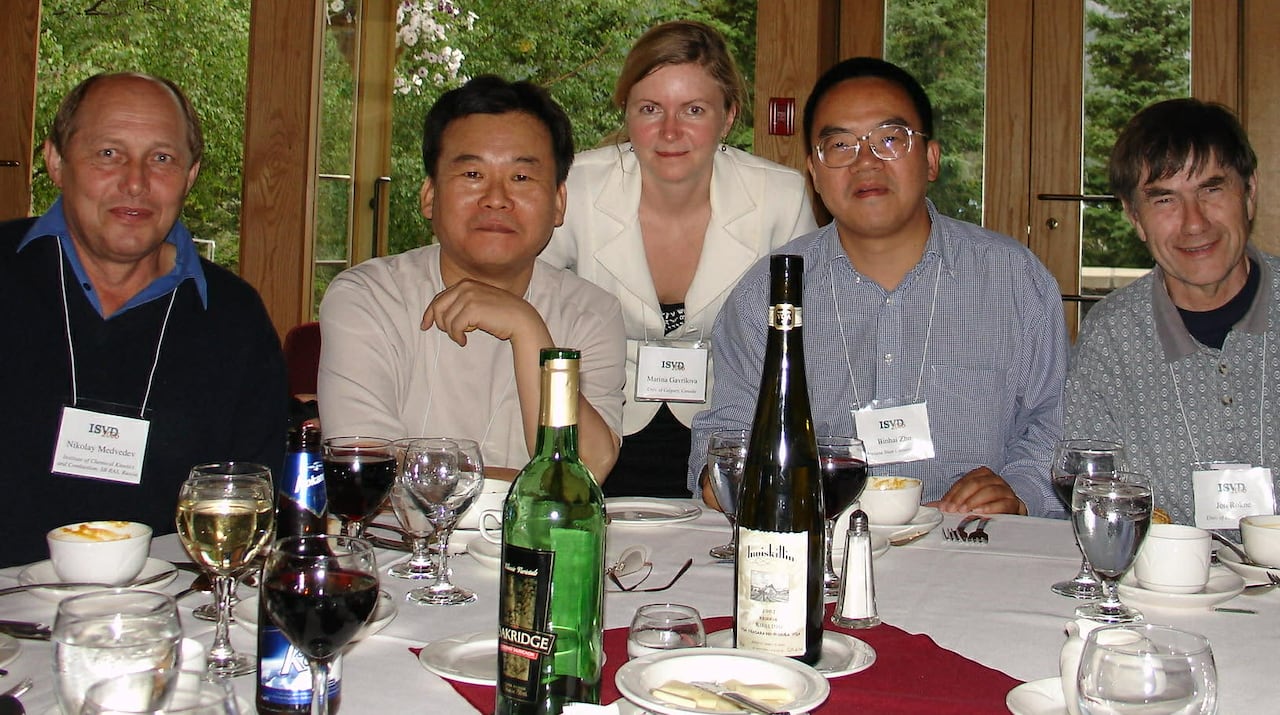 This photo was taken in 2006 in Banff, Alta., at the International Symposium on Voronoi Diagrams in Science and Engineering. Marina Gavrilova, middle, organized the conference and Jon Rokne, far right, was its keynote speaker. From left to right, the other professors are Nikolai Medvedev, Deo-Soo Kim and Binhai Zhu. (Submitted by Marina Gavrilova)
Rather than nudge students towards his own fields of interest, Rokne says he would “find out what they were really interested in” and support their development in that direction.
When Annette John came to Calgary from India to do her master’s in computer science, it was the first time she’d left her country.
Rokne knew this and showed up on Day 1 to tour John around campus and get her lab keys.
“I didn’t feel alone,” said John. “I think he’s so amazing. He just understands you.
“For me, he’s like a parent or grandparent looking after me.”
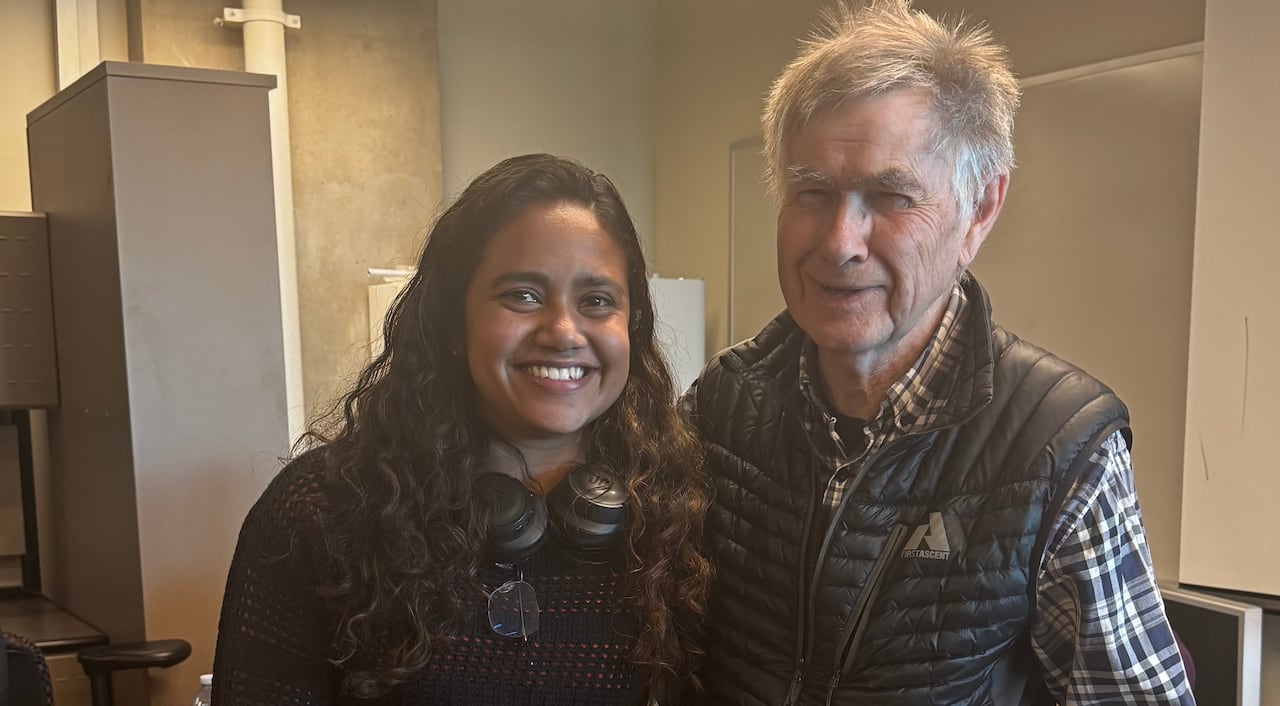 Annette John, left, completed her master’s in computer science under professor Jon Rokne, right. John says Rokne ‘laid the groundwork for a lot of advances in the field of computer science.’ (Submitted by Annette John)
John was supervised by both Rokne and Alhajj. She describes the two men as “yin and yang” and “essentially one person.”
A 25-year collaboration
Alhajj agrees.
“We are working like one body … we never did anything on our own.”
Rokne, says Alhajj, “has dedicated his time and his life to the academia.”
“Because he wants to help the community, he wants to help the students.”
 Computer science professors Jon Rokne and Reda Alhajj pose for a photo more than a decade ago. The pair have been collaborating for 25 years. They started an international conference together in 2009 and then published the Encyclopedia of Social Network Analysis and Mining. (Submitted by Reda Alhajj)
Alhajj’s arrival in Calgary in 2001 marked the beginning of a 25-year friendship and academic collaboration with Rokne.
In 2006, the pair were drinking coffee together, chatting and brainstorming when they got the idea to get into social networking, an area that Alhajj says “was booming at that time.”
In 2009, Alhajj and Rokne launched the International Conference on Advances in Social Network Analysis and Mining. The first conference was held in Athens.
It is considered the flagship conference for researchers from disciplines like computer science, statistics, biology and sociology, and was so successful after its first few years that Alhajj says he and Rokne were approached by academic publisher Springer to launch a journal.
The encyclopedia
So pleased with the journal, Springer returned with a bigger idea, and in 2014, Rokne and Alhajj published the first edition of their encyclopedia.
Alhajj estimates the third edition of their Encyclopedia of Social Network Analysis and Mining will be available in late 2026 or early 2027.
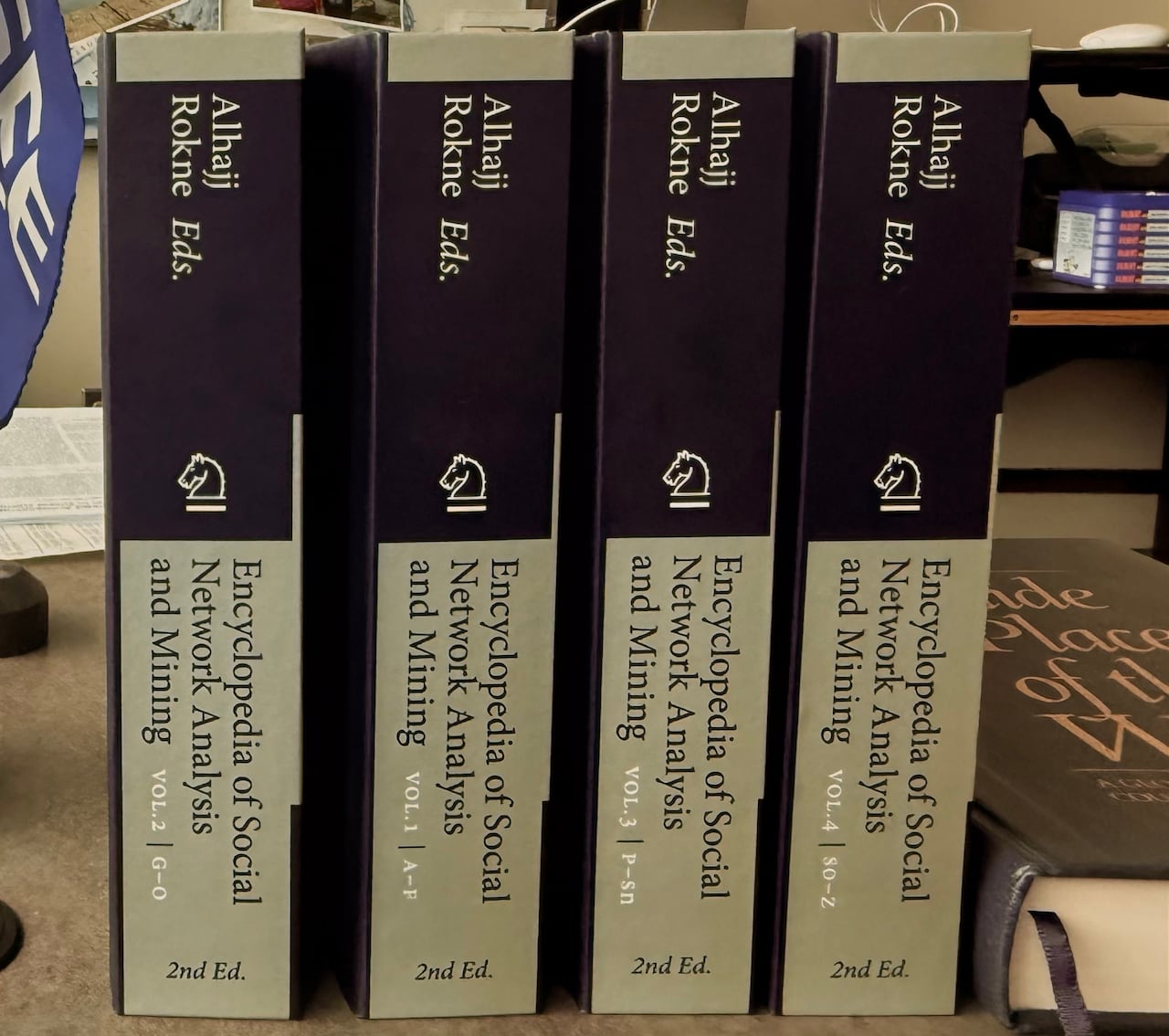 The Encyclopedia of Social Network Analysis and Mining will soon publish its third edition. (Meghan Grant/CBC)
The two men have also published many research papers, including collaborations with colleagues from the university’s school of medicine to examine the use of artificial intelligence machine learning techniques to predict how diseases will evolve over time.
One of their most recent published papers delves into the use of AI to assist with early Alzheimer’s detection.
An AI caution
In his six decades at the university, Rokne says the biggest game-changer in his field has been the availability of computers to the masses.
“[Computers] enable you to experiment with numbers in a way that was not possible before,” said Rokne.
“Science made a big jump: you can control things, you can simulate things, you can do all kinds of things that weren’t possible before.”
But he issues a caution about AI.
“It’s dangerous. I think it’s hard to see what will happen because AI is simply a huge mass of data,” says Rokne.
“Depending on how the data’s collected, you get different results. So in many ways the data is biased to whoever generates the most data.”
A famous math problem, football and the accordion
At his core, Rokne is still a math guy, which is why he says even in retirement he’ll continue to work on a famous unsolved math problem, the Collatz conjecture. (Rokne once met Lothar Collatz in Germany.)
“I’ll probably never be able to solve it, but at least I’m working on it,” he said.
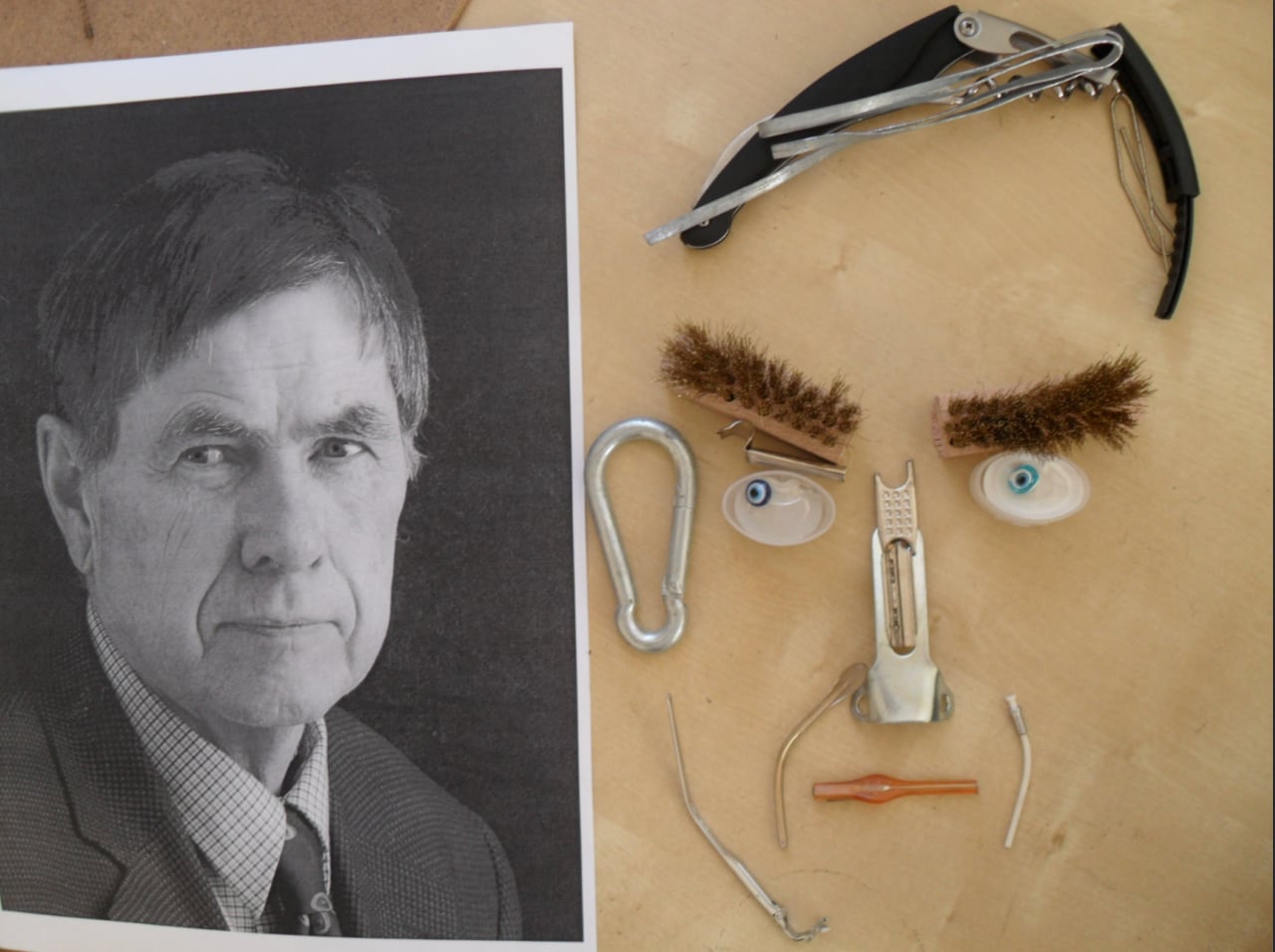 Turkish artist and academic Tayfun Akgül made this portrait of Jon Rokne. Akgül is an active contributor to the Institute of Electrical and Electronics Engineers (IEEE), as is Rokne. (Submitted by Jon Rokne, Tayfun Akgul)
As for his non-academic retirement plans, Rokne has been known to catch a soccer match at a pub with one of his two sons. His beloved Norway’s World Cup pursuit is threatened by Saturday’s game against England.
Perhaps, he says, he’ll pick up his long-neglected accordion.
“I was playing it and the dog would howl,” said Rokne. “It’s loud.”