
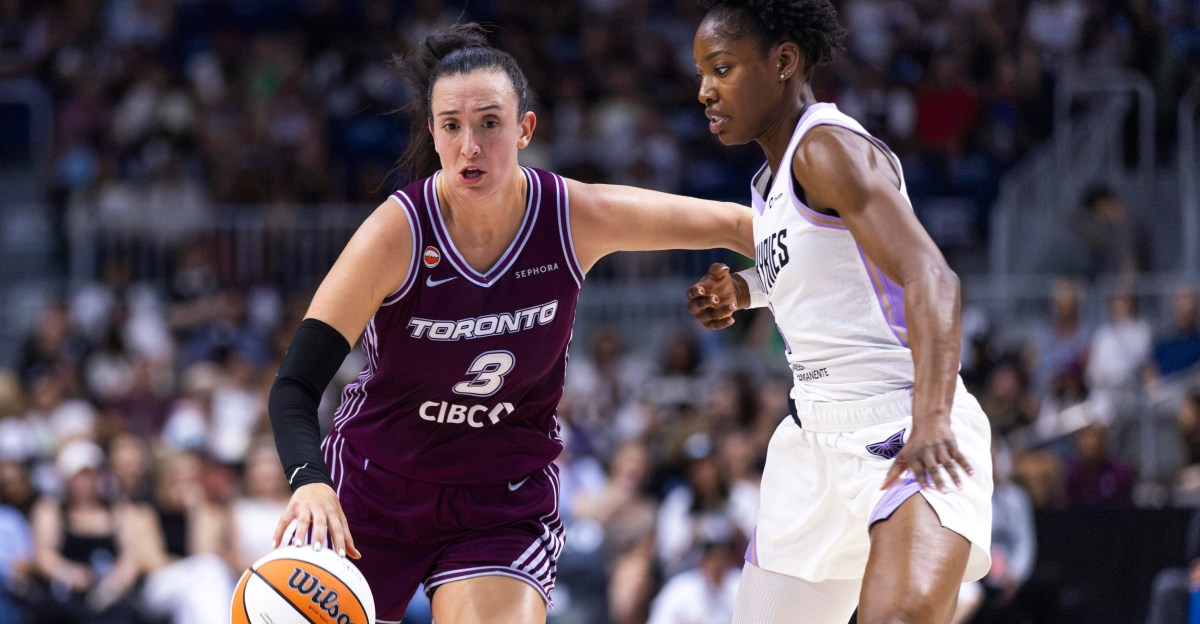
The Toronto Tempo fell to 9-12, 10th in the WNBA standings, with Sunday and Wednesday losses to the Dallas Wings (14-8) and Golden State Valkyries (16-7). Toronto continues to struggle against teams above .500 and incur injuries (Nyara Sabally exited Wednesday’s game with a knee injury) With two weekend games at Montréal’s Bell Centre upcoming, a rematch against the Wings and a Sunday matinee against head coach Sandy Brondello’s former team, the New York Liberty, let’s take a look at a key tactical point that could affect the weekend’s games on each side of the ball.
With 20.1 points-per-game scorer Brittney Sykes (and, to a lesser extent, Kiki Rice) injured, the Tempo’s offensive load rests squarely on the shoulders of Marina Mabrey. Her 30.3 per cent usage rate is a career high and a mark that ranks in the WNBA’s 98th percentile this season, per HerHoopStats. More specifically, without Sykes, Mabrey has had to create more for herself as opposed to working off the ball.
The Wings and Valkyries—arguably the best defence in the WNBA—noticed. Both Dallas and Golden State ran aggressive defensive coverages against Mabrey in ball screen actions (i.e. pick-and-roll), hard hedging or blitzing the Notre Dame product and forcing the ball out of her hands.
That sort of coverage forces Mabrey to turn into a playmaker. Held to 15 points per game against Dallas and Golden State, Mabrey, otherwise 20 point-per-game player, mustered 4.5 assists per game. While her season assist rate (24.3 per cent) is also at a career-best level, Toronto would much rather Mabrey be a scorer than a facilitator. Mabrey is averaging a strong 1.2 points per shot attempt, compared with just 1.02 points per possession.
The first read against such coverage is to find the roll quickly, flipping the 2-on-1 defensive advantage created by the blitz into the correspondingly created 4-on-3 offensive advantage. When Mabrey was able to anticipate the coverage and quickly touch the ball to the roller, either slipping or in space, or make the right read against the help, the Tempo offence was able to create good looks.
When the defence executed, either pressuring Mabrey at the level of the screen or rotating smoothly on the backend to negate the 4-on-3 advantage, the offence struggled. There were also moments when hitting the roller created good looks but jumpers didn’t fall, or the roller didn’t capitalize on the advantage.
Overall, the Wings and Valkyries were willing to live with getting the ball out of Mabrey’s hands even if it created a momentary advantage for the Tempo.
Mabrey and the Tempo weren’t without counters. She showed some increased patience against Golden State, keeping her dribble alive against the double and finding a great pass or hesitating her way to the rim. Toronto also had moments where it utilized Mabrey’s gravity to create looks for other teammates, either on or off the ball.
But the floor scoring counters were limited. Mabrey averaged just 4.5 field goals per game, down from 7.16 per game coming into the week, and got seven of her 11 points at the free throw line against the Valkyries. The field goals per game fell by three; the Tempo losing streak, in correlated fashion, extended to three.
The Tempo defence is still a work in progress, but Tima Pouye and other rotation players who have had to step up in the midst of all the injuries have played their role as defensive specialists.
One area of continued improvement is switching, which I’ll define here as changing defensive matchups mid-play to negate or minimize an offensive advantage (as opposed to fighting through/over screens and maintaining the original matchup). The Tempo don’t employ this defensive strategy as much as some teams, but occasionally switching is necessary, and it’s especially relevant against the Wings in Friday night’s game.
Toronto conceded several points to Dallas, including two of the early three-pointers that dug them into a hole early, with poor switching. They’ll have to be sharp to take away Dallas’ staple “delay” set (third clip), with All-Star starter Jessica Shepard facilitating, which has burned plenty of teams this season. More switching also entails more care in boxing out, as switching can create size mismatches that can come back to haunt defences on the glass (fourth clip).
The good this is that they have plenty of examples of getting it right, either in late-clock or “crisis” switch scenarios (wherein the only way to minimize an advantage is to switch, such as the last two clips).
Communication is vital, whether sorting out high-low switching to take away pick-and-pops or two-player off ball navigation (as against “delay” pindowns).
Splits don’t necessarily mean much (if you like fantasy sports or variance, this article on splits is for you). But the Tempo do have a pretty defined one, and it’s against teams above or below .500. Toronto doesn’t have a win over the former (they’re 0-9 against teams in playoff position), but the team is 9-3 against teams without a winning record.
The advanced team stats, both ratings (estimated points scored/allowed per 100 possessions) and Four Factors, paint the picture pretty clearly.
Toronto has been better against worse teams in all but one category, defensive free throw rate allowed. This isn’t necessarily surprising! Teams are usually better against worse teams (that’s what makes them worse, after all). But it’s going to be difficult to make the playoffs in a very competitive league if you can’t beat the teams in your echelon, and that’s a quest upon which the Tempo continue to embark on this homestand.
They’ll have two more chances to get their first win over a playoff team this weekend with the rematch against the Dallas Wings on Friday night and the Commissioner’s Cup Champion New York Liberty on Sunday.