
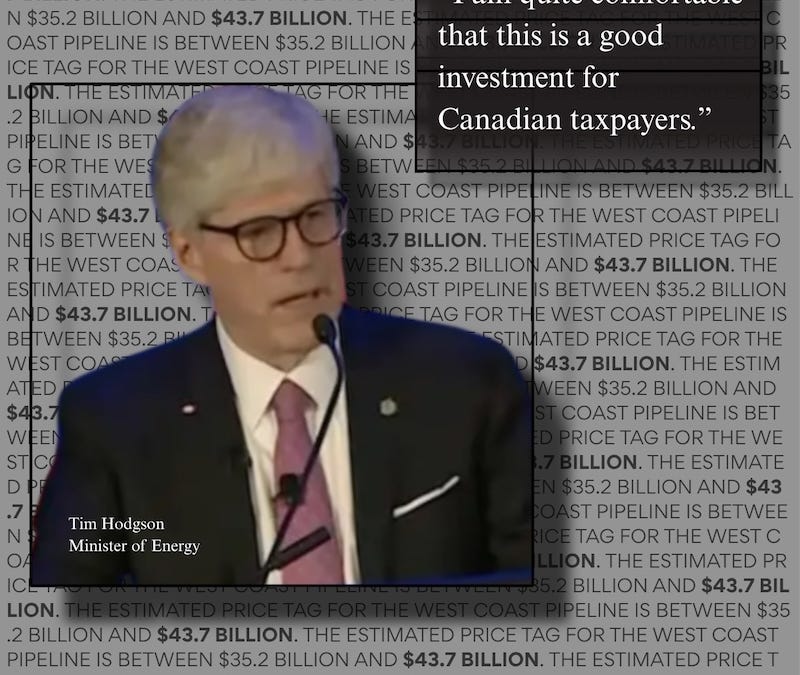
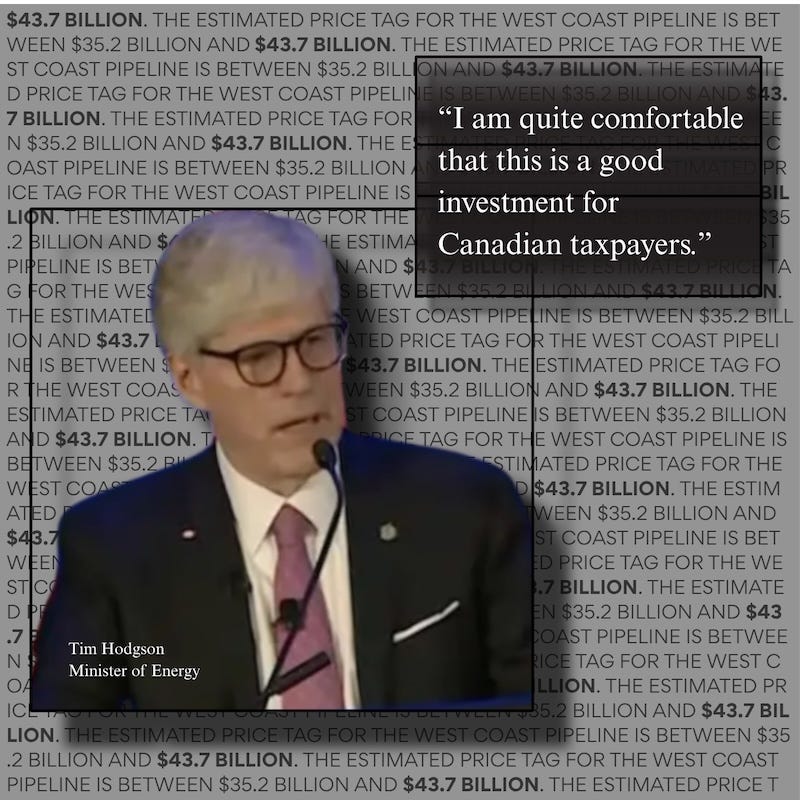
“I am quite comfortable that this is a good investment for Canadian taxpayers…This project is the most significant economic opportunity in the country today.”
— Energy Minister Tim Hodgson on CBC Power & Politics, discussing a proposed West Coast oil sands pipeline that will be 90% funded by taxpayers at an estimated cost of up to $43.7 billion (before inevitable cost overruns)
Aren’t you reassured that when Prime Minister Mark Carney and Energy and Natural Resources Minister Tim Hodgson propose a $43.7-billion government subsidy for another pipeline from Alberta to British Columbia, they’re doing it with a keen eye for your pocketbook? For your best interests as a taxpayer?
That was the pitch last week, when Hodgson dropped by CBC’s Power & Politics show to tout the excellent results we can all look forward to in Canada’s deal with Alberta to prioritize the West Coast Pipeline.
In 2026.
With climate change-induced heat waves, flooding, and wildfires running amok across the country.
After Carney apologized in Edmonton that what he described as “biblical” floods that kept his plane grounded before he could get to Alberta to celebrate Canada Day.
With demand for all three fossil fuels expected to peak this decade and even liquefied natural gas (LNG) demand set to decline this year, despite or perhaps because of the disruptions in the Strait of Hormuz, as energy-importing countries around the world scramble to free themselves from their dependence on fossil fuels, as fast as they can, once and for all.
After beating the bushes around the world for any private investor willing to risk another pipeline, only to find a single Calgary-based “proponent” using language so couched and conditional that it’ll be easy for them to abandon their measly 10% share in the deal as soon as it starts to go badly. Which history suggests it most certainly will.
It’s a good thing the PM, his minister, and the brain trust running the show from the Prime Minister’s Office have such a keen sense of what’s good for us. Such a blessed certainty that there would be any significant demand for new oil and gas exports by the time a new generation of oil pipelines and LNG terminals could go into operation in about a decade.
That that new infrastructure would continue operating for the couple of decades afterwards that would be needed to recover the initial investment…while the rest of the world rapidly abandons the oil, gas, and coal responsible for 75% of the world’s greenhouse gas emissions. And pivots fast to renewable alternatives that are cheaper, cleaner, quicker to deploy, steadier in extreme weather, far better at combatting energy poverty, and not subject to international price shocks or geopolitical stresses.
Because, surely, there couldn’t be a better way to invest $43.7 billion if it fell into our laps, with the only condition that we had to spend it in the energy space?
Oh, wait a minute….
What if there IS a better way??

Well, not quite a contest, in the sense that the prize is a chance to win a coveted, limited-edition, reusable Energy Mix tote bag.
Unless you’d rather receive a lifetime, free subscription to The Energy Mix! In which case the second prize would pretty much have to be two free subscriptions!! (Pro tip: Our subscriptions are always free.)
But, I mean, really—this is Canada. It’s the first half of July. How can the summer months ever be complete without another consultation or online discussion?
You’ve seen it all before, and you’ll see it all again: you’re scanning through your email or scrolling online and come across another Very Important Invite from a government agency giving you a three-week deadline in July or August to share your views.
If you didn’t know better, you’d think they had set the timing to make it nearly impossible to respond—because if they really wanted to hear from anyone, they had eight or nine other months to choose from, right? But, nah, that could never be.
The difference here is that we really do want to hear from everyone. So we’re running the discussion right through August 31 and making it as easy as possible to join in.
We’re promoting this on every channel available to us. We’d be thrilled if you could help us out by amplifying it in all directions.
We’ll be sharing what we hear from you over the next seven weeks, so be sure to follow us on LinkedIn and Bluesky.
We’ll be making it easy to tap into our archive of more than 31,000 energy and climate change stories dating back to May, 2014. If you’re looking for inspiration for your Next Big Idea, we can probably help you get started.
And we’ll continue telling new stories, all summer long and beyond.
Now it’s over to you. So enter early and enter often! $43.7 billion won’t be enough to complete Canada’s energy transition or meet our legislated emission goals. But it’s a big enough chunk of change that we should be investing it thoughtfully and strategically, not throwing it away.
When you start thinking along those lines, what would you see as the best way to invest 43.7 billion of your tax dollars?
Programming note: On Tuesday, July 14 at noon ET, the Climate Communications Alliance is hosting Beyond the Headlines: Climate News Trends and Communications Strategy, an hour-long panel discussion on how the climate story is changing in today’s media landscape. Panelists include political organizer and climate strategist (and sometimes Weekender columnist) Alex Cool-Fergus, environmental journalist Arno Kopecky, CBC Radio reporter Inayat Singh, and I’ll be on the panel as publisher of The Energy Mix. Click here for details and registration.

Mitchell Beer traces his background in renewable energy and energy efficiency back to 1977, in climate change to 1997. Now he and the rest of the Energy Mix team scan 1,200 news headlines a week to pull together The Energy Mix and The Energy Mix Weekender.
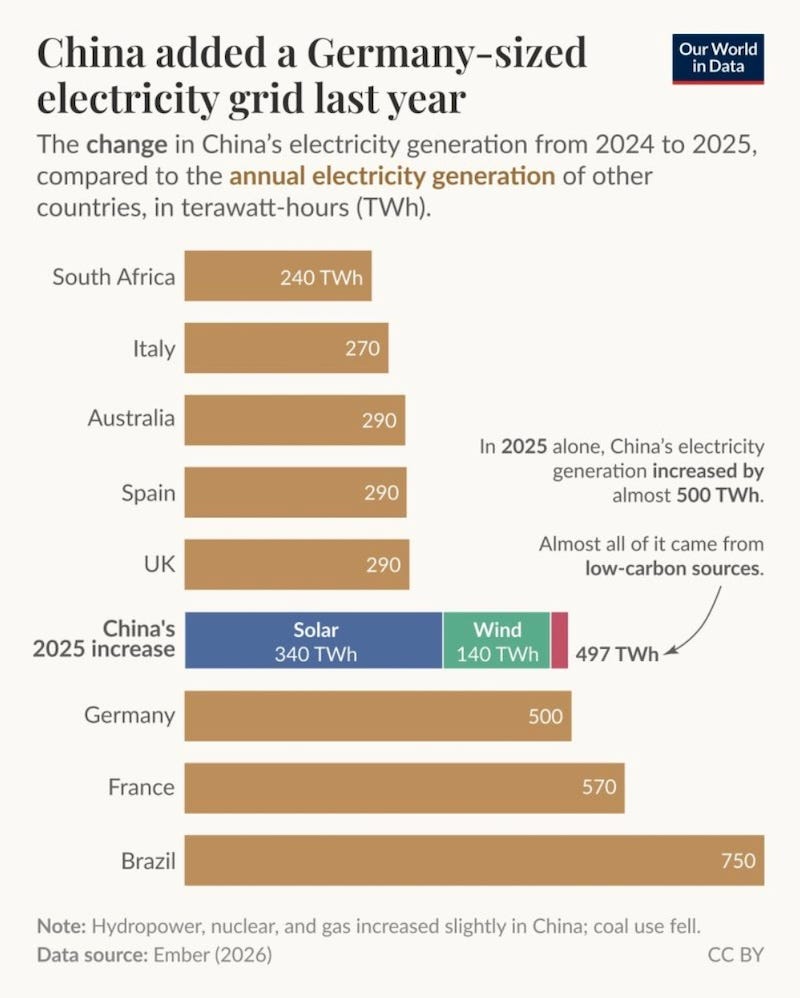 Our World In Data via LinkedIn
Temporary Grid Power for Data Centres Will Raise Electricity Bills, Alberta Grid Operator Admits
Advisory Group Weighs Including Fossil Investments in Sustainable Finance Taxonomy
New International GHG Rules Could Stall Momentum if Implemented Too Fast, BRC-Canada Warns
Unfathomably Huge Fungal Network Keeps Earth Cool and Green
‘Geopolitical Shock Absorbers’: Renewables Avoid $480B in Fossil Fuel Costs, IRENA Calculates
Anti-Coal Petition Lead Corb Lund Questions Elections Alberta’s Verification
Nova Scotia Approves Largest-Ever Wind Farm to Power Everwind’s Hydrogen Plans
World Bank Caves to U.S. ‘Voodoo Science’ Pressure, But Keeps Funding Clean Energy

Strong El Niño will develop rapidly over coming months, says UN weather agency (Reuters)
Europe Is Heating Up Again, Posing a Big Fire Risk (New York Times)
Germany Recorded 5,000 Excess Deaths in Late-June Heat Wave (Bloomberg)
France’s June heatwave caused more than 2,700 heat-related deaths (Carbon Brief)
Et la transition, M. Carney ? (La Presse)
Hamilton’s data centre moratorium could be a Canadian first, researcher says, and more could follow (Canadian Broadcasting Corporation)
China Plans to Peak Carbon by 2030 (Carbon Brief)
Heat pumps replace Middle East gas imports twice over (European Heat Pump Association)
One-third of India’s new renewable energy capacity faces grid curtailment (PV Magazine)
EV Batteries Are Defying Expectations After Hundreds of Thousands of Miles (Wall Street Journal)
Why the true cost of new gas plants is much higher than the sticker price (Utility Dive)
Sizewell B nuclear power plant granted a 20-year life extension (The Guardian)