
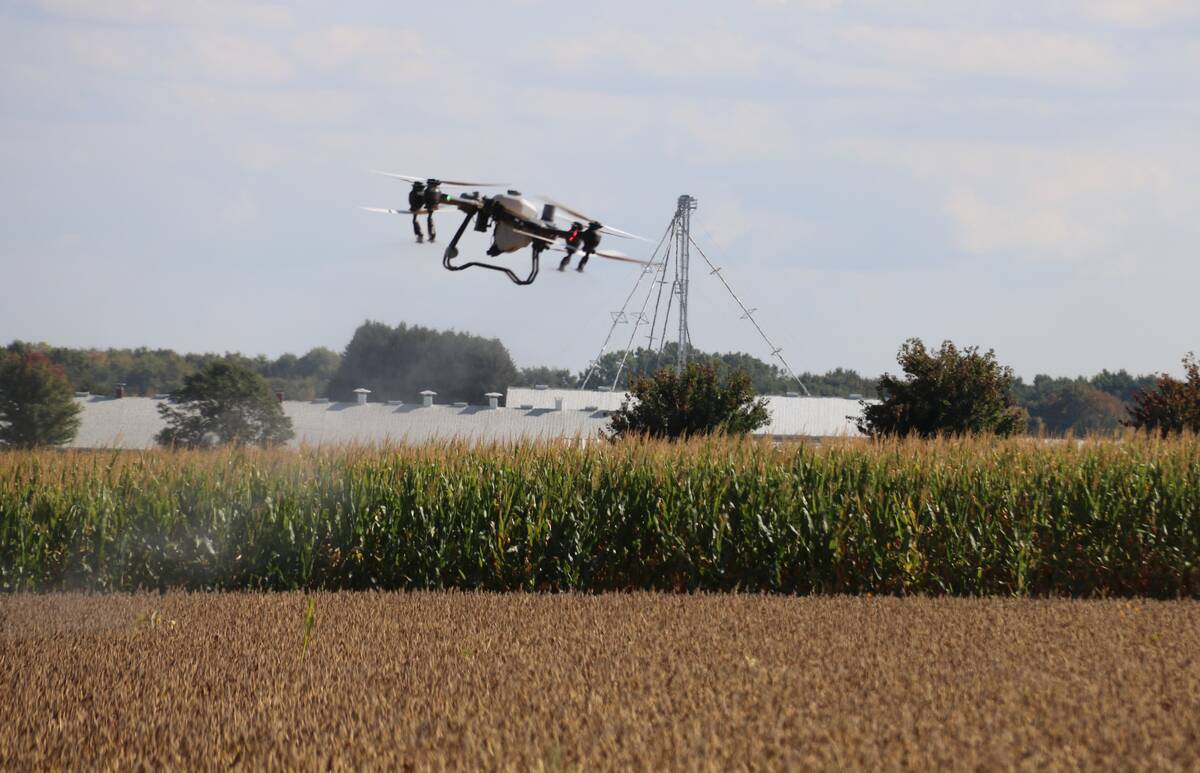
On June 30, a cheer went up from agricultural drone users and dealers across Canada.
Health Canada approved the use of drone technology for pesticide application, so long as the product is already approved for conventional aerial application. This new policy aligns with that of countries such as Australia and Japan.
Drone demos are now a major part of farm shows, like Ag in Motion, where they hold farmers captive during demonstrations. At Ag in Motion, held July 21 to 23 near Langham, Sask., spray drones make up an expanding section of the show as interest in the aerial machines grows.
WHY IT MATTERS: With spray power comes spray responsibility.
Health Canada states that pesticide application via drones doesn’t create any additional health or environmental risks compared to traditional aerial spraying.
This follows the letter of no objection that was issued in early June as a temporary measure authorizing drone pesticide application for the 2026 spraying season due to terribly wet spring conditions.
Read Also

“Being just this incredibly wet spring, when people can’t get into fields, really is bringing home what a great tool a drone will be in certain circumstances,” said Markus Weber, familiar face at Ag in Motion as owner of Landview Drones and president of the recently formed Canadian Agricultural Drones Association.
“It’s not an everyday spray tool, necessarily, but in some instances, it’s the only spray tool that’s going to work.”
Weber suspects that with the federal go-ahead, the user profile of drones will shift. It’s more likely to be of interest to mainstream farmers instead of just those who were pushing the envelope as the “cowboys” of the drone world.
However, as the average farmer dives into the world of drones, some factors need to be considered.
Drone regulation
As with any new technology, there are new rules and regulations that must be understood and heeded.
“I get it from the grower, the farmer side, where, ‘oh, it’s only Roundup,’ ” said Adrian Rivard, president of Drone Spray Canada.
“But again, there’s a lot of consideration that needs to go into this that maybe some of us are a little bit callous to.”
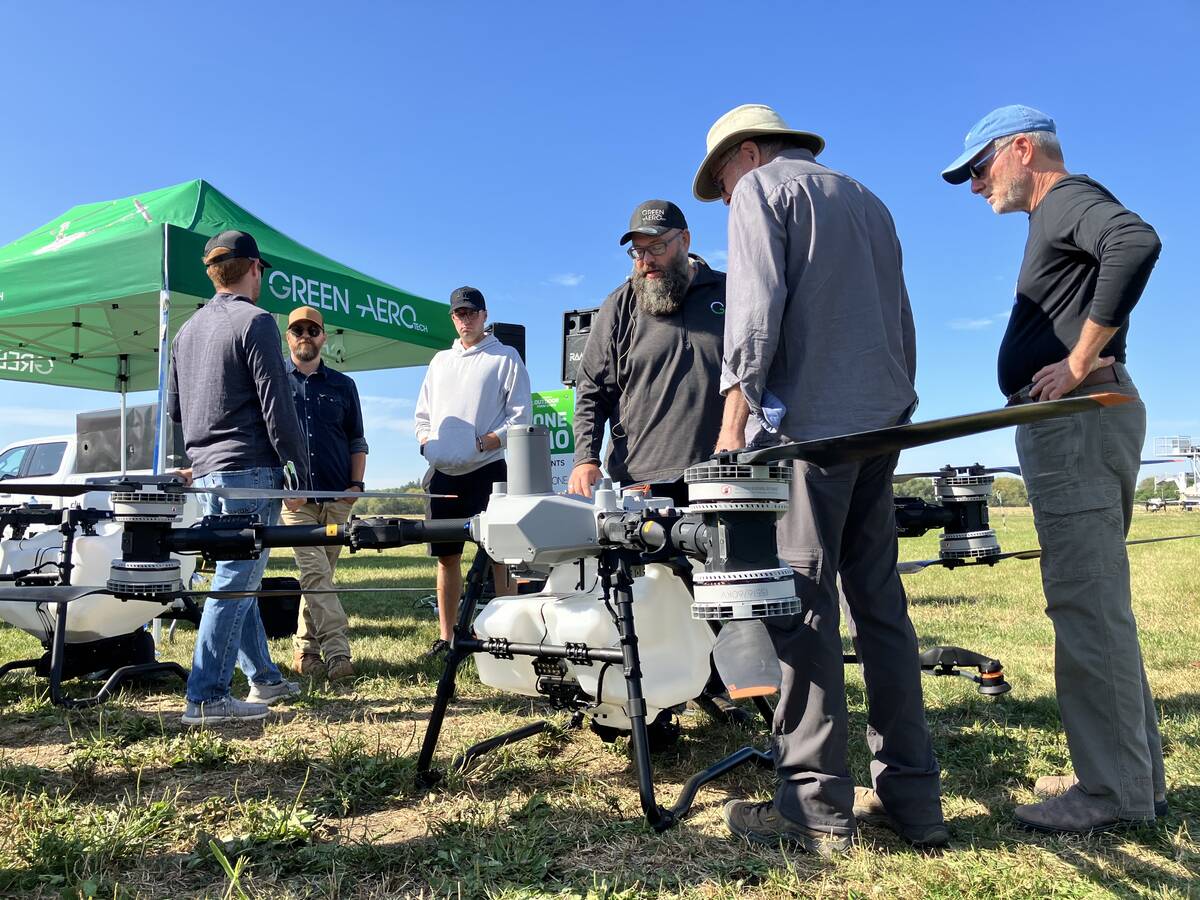
Agricultural drones range from 25 to 150 kilograms, with the T100 weighing 177 kg if full.
Rivard said there are two “pillars” to drone regulations: the aircraft factor, regulated by Transport Canada, and the sprayer and chemical factor, regulated by Health Canada and Environment Canada.
Transport Canada requires pilots to hold a Pilot Certificate – Advanced Operations if operating drones in the weight range of 25 to 150 kilograms. Most agricultural drones fall within this range and can exceed it when fully loaded.
To obtain the licence, there is a written portion, including legality, flight restrictions and carrying rules, and a hands-on portion.
Once the written exam is passed, the student goes out with an advanced flight reviewer and spends an hour to an hour and a half with the drone to understand safety, the steps in flying a drone that weighs 25 to 150 kg, flying in controlled airspace and flying above people.
“It’s not just because you’re out spraying a canola field that that licence lets you fly that drone,” Rivard said.
“It doesn’t matter if you’re in the canola field 16 miles west of Lloydminster or if you’re right next to the Regina Airport — you’re licensed to be in all those places.”
This licence applies to all drones in the weight range, for any purpose — not just spraying — because it’s a matter of safety for the user and those around the drone.
In addition to licences and federal regulations, producers must review their provincial requirements, if established.
“In Alberta, we’ve had study materials for over a year,” said Weber.
“We’ve had an exam available for drone pesticide certification, specifically for applying by drone. Saskatchewan also now has that, but most of the other provinces aren’t in that position yet.”
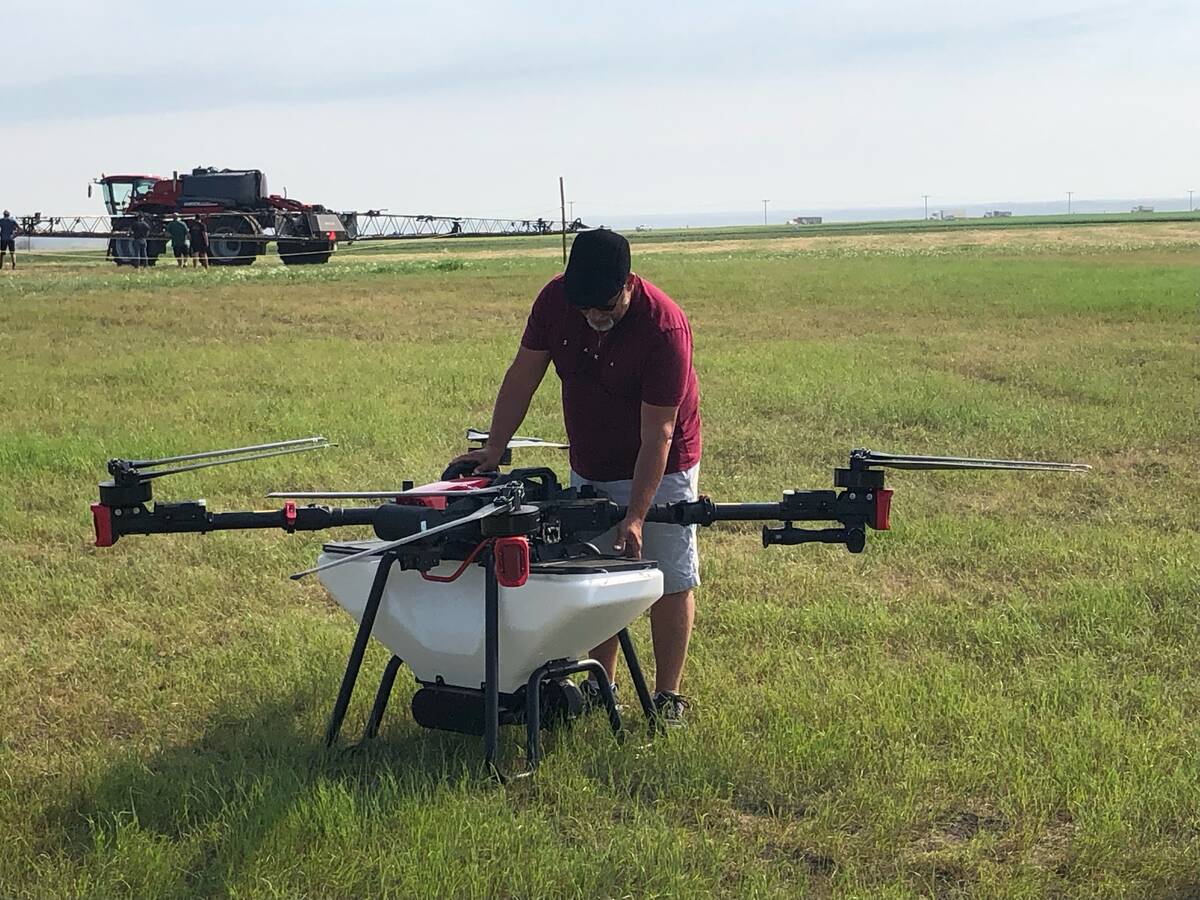
The largest drone, the T100, requires a refill every four to five minutes.
The new Health Canada regulation doesn’t mean everything is “all good,” he added.
Landview and Drone Spray Canada both offer drone licensing classes, as do many other dealers. However, depending on the location of the dealer and their availability, the program of the classes will vary.
Some, such as Drone Spray, offers online courses for producers to get an in-depth handle on the material necessary for the certificate exam, while Landview has a variety of classes and “boot camps” that include exam prep, aviation and pest regulations, and learning the practicalities of drone use.
Weber said Landview’s courses include lessons on safety factors, logistics, mission planning, establishing effective swath width, proper swatch measuring and spray drift considerations. They also spend time on wind conditions, when to stop spraying — 12 km-h wind is the recommended cut-off — inversion risk (where droplets could carry further) and deposition (adjusting for the conditions, such as coarseness of droplet and height of drone).
“A drone is essentially a mini-tornado,” Weber said.
“There’s turbulent air underneath that drone distributing droplets, and you need to figure out exactly how wide that swath is going to be under your circumstances.”
Technology differences
There’s a fit for any operation, with choice of model depending on what is needed in efficacy and efficiency for the farm.
By using a tool such as a return-on-investment calculator, producers can determine what model is optimal for their acres, manpower and budget.
A T100 may be best for cropland and applying pesticide and fungicide, while a T25 would be better for spot spraying and pasture management. However, the better option for a grain producer may be three T70s instead of two T100s.
Drones also boast lower costs than a typical sprayer.
“Now that we’re seeing that the drones can actually cover a lot of acres effectively, your operating costs are under $5 an acre, for sure,” said Rivard.
However, there are a few other aspects that should be kept in mind, such as batteries, generators, docking spots, spray trailers, personal protective equipment (PPE) and additional manpower.
The T100 — the largest spray drone model available in Canada — has a 26 gallon tank, spraying at 10 gallons per minute. That translates to a cycle time of approximately four minutes, and the producer must then refill the tank and likely change the battery.
Because of the short timeline between refills, PPE requirements should be top of mind.
“The frequency of refill is something to be concerned about for any operator,” Weber said.
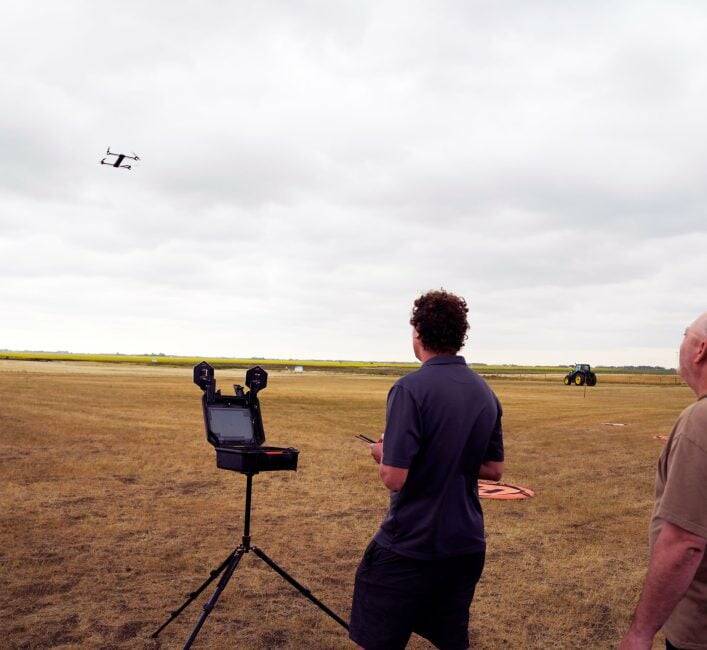
As the average farmer dives into the world of drones, theres a few things to keep in mind.
“If you’re handling chemicals every hour or two, that’s quite different from handling them every five or six minutes. So you need to take the PPE requirements seriously.”
To swap batteries and change them out efficiently, most drone operators will outfit their spray trailers with generators alongside their water tanks and chemical.
“You still need some sort of support rig (for the drone),” Rivard said.
“Not many guys are running the sprayer home from the field to fill the tank back up. Usually there’s a tender crew out there with them, so in our logic, it’s kind of something you would need regardless of how you’re putting out that product.”
Rules to limit exposure
With the new regulations, proper PPE must be followed, and the drone pilot and the chemical loader and mixer have to be two different people to limit operational exposure. This rule is aligned with what’s required for typical aerial application.
Weber believes this rule will be one of the most challenging aspects for farm operations.
“The reality is, much of farm operations in Canada will likely be conducted by one person, if it was legal to do that,” he said.
Other challenges with the new regulations are with label requirements — some require application with a closed cab or closed transfer systems.
“A drone doesn’t have a cab,” Weber said.
“Does that mean the person needs to be indoors, inside the vehicle? Does that mean perhaps the drone is downwind to get the same type of protection?
“It’s challenging to figure some of those aspects out when they were clearly meant for a different type of operation from what a drone operation looks like.”
A closed transfer system is “doable,” Weber said, but there is no drone system with closed transfer yet, which limits some availability of spray products.
When in doubt, the best choice is to talk to a chemical sales rep or an agronomist in terms of label requirements.