
MULTIDISCIPLINARY CANADIAN artist Keerat Kaur is creating a season of gathering with her latest exhibition, If Gardens Could Dream, opening as part of Surrey Art Gallery’s summer programming,
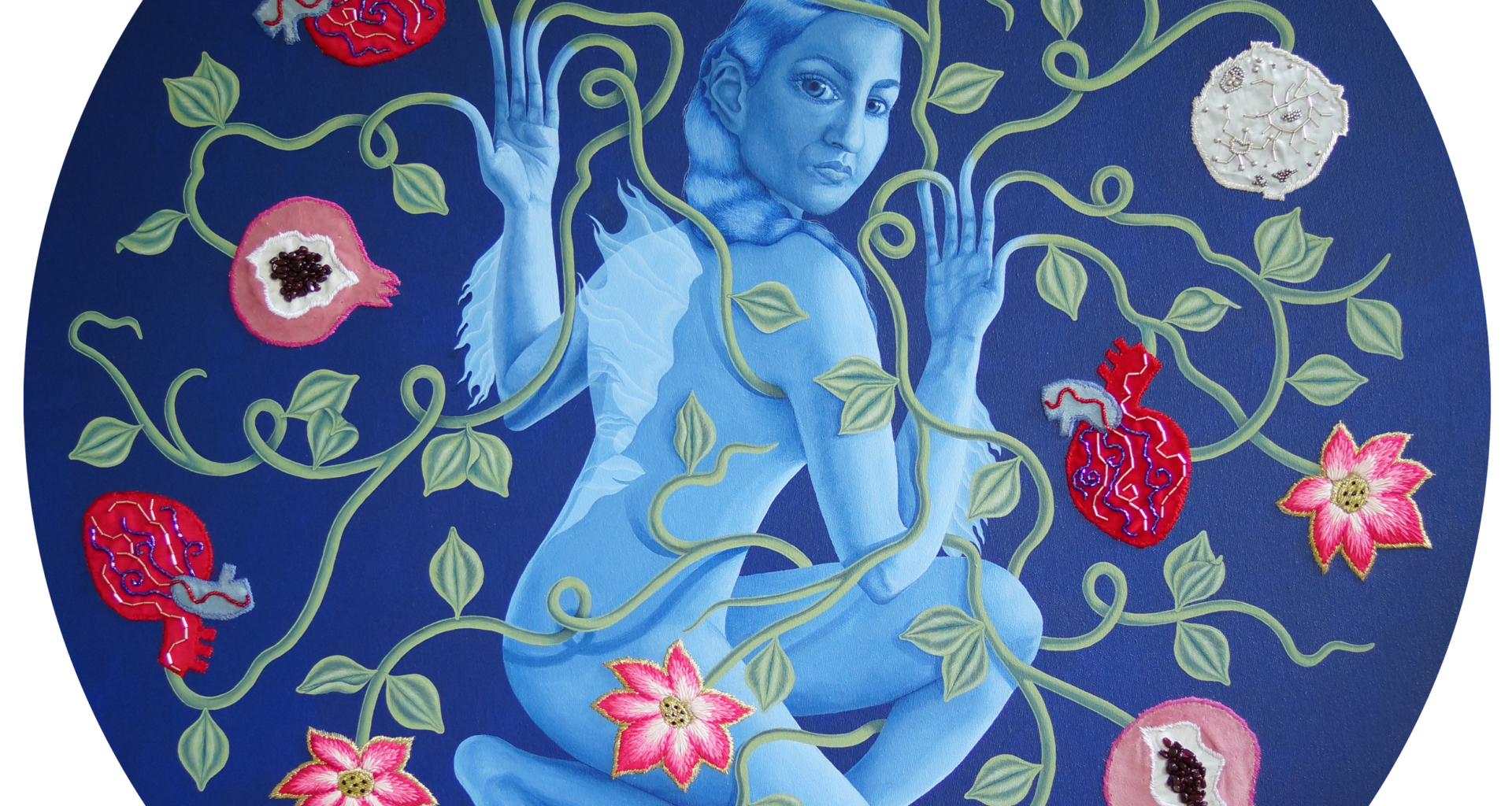
Kaur’s latest offering is a testament to her expansive practice, showcasing painting, sculpture, digital media, embroidery, poetry, and architectural forms to examine generational ties within the South Asian diaspora. Her visual language is keenly felt in paintings such as Cor Granati, which highlights the recurring visual symbols embedded in her work: the pomegranate and the anatomical heart. Much like the transformed gallery space, the human and natural world become synonymous in Kaur’s body of work in ways that are both culturally specific and universal in theme. Co-creating within the gallery space has presented unique opportunities to engage with Surrey’s diverse community.
“One thing the gallery does very well is activating exhibitions in different ways, using artist talks, language tours, vocal performances, and workshops,” says Kaur in conversation with Stir. “We’ve been constantly thinking about community, about ways to make exhibitions non-static and in movement.”
Mounted in collaboration with associate curator Suvi Bains, If Gardens Could Dream reimagines the gallery space, as Bains writes, as “a living archive of memory, language, and belonging”. Their first formal collaboration came when Bains curated Kaur’s 2023 exhibition Panjabi Garden, which was inspired by the artist’s language-learning book of the same name. Bains recalls the artist talk overflowing with visitors, some of whom travelled from as far away as Seattle to see Kaur’s performance. Since then, parts of the exhibition have joined Surrey Art Gallery’s permanent collection. Expanding and following up on Panjabi Garden with If Gardens Could Dream has been a natural reflection of the gallery’s mission to honour its own multicultural community.
“Part of my practice is translation work, and that’s a huge part of our accessibility practice here, is privileging other languages,” Bains explains. “Keerat has such a gorgeous practice around sign-setting, so working with an artist that also can translate their own works is pretty extraordinary.”
Surrey hosts one of the largest and most vibrant Punjabi-speaking communities in the diaspora, and the city’s South Asian population continues to grow every year. For Bains, facilitating a space that can hold the diverse experiences of the diaspora, across multiple languages, offers an alternative to the current climate of division.
“If Gardens Could Dream is talking about how these languages continue to be spoken at home,” says Bains. “I care deeply about my community, and I’m also attached to this feeling of bringing people in. If there’s a space where people feel at home and can see their communities being represented, I think it’s such a huge responsibility to institutions.”
Growing up in London, Ontario, Kaur was introduced to different cultures alongside her Punjabi Sikh identity, and these formative experiences have influenced her approach to artmaking. She holds a master’s degree in architecture from the University of Toronto and is trained in Indian classical vocal traditions, as well as in traditional Pahari painting. She speaks Panjabi, French, and Hindi, and is currently studying the Shahmukhi script and the Braj language. Her writing and her artistic vision for language engagement have been a constant in her work. This has translated into two self-published illustrated storybooks for all ages, Panjabi Garden and The Horse Who Fell From the Sky, with the latter set to be creatively featured in the upcoming exhibition. There is little friction between honouring her background alongside the Punjabi community in Surrey and universal themes that resonate with a diverse audience. This is perhaps best exemplified through the banyan tree installation debuting in If Gardens Could Dream, which will include beaded works by participants in a beading workshop Kaur facilitated as part of the exhibition.