
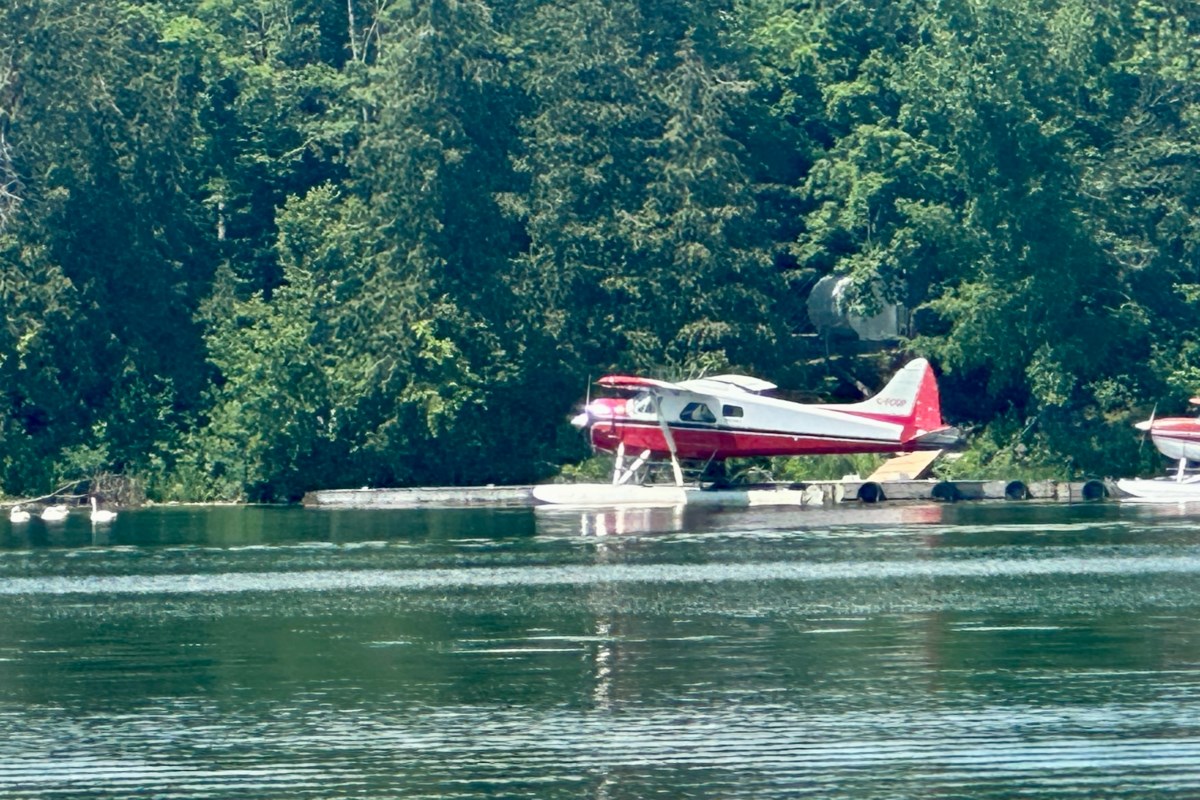
‘It feels like one little accident and the contents would be in the lake,’ worries Camp Couchiching official in wake of fuel tanks being installed at lakeside aerodrome
Life around Lake Couchiching this summer has been disrupted by seaplane activity, revealing numerous gaps in aerodrome regulations, say residents.
Many in the area have voiced safety concerns since Lake Country Airways relocated to Rama Road.
Now, there’s one more drop added to the sea of worries. Jen Dundas, executive director of Camp Couchiching, noticed what appears to be a fuel tank at the property after a neighbour notified her it would be installed.
“It’s another risk factor related to this aerodrome,” said Lisa Sherin, one of the residents who organized a petition Simcoe North MP Adam Chambers brought to the House of Commons last month.
An advocate for improving aviation regulations, she was surprised Lake Country Airways was not required to consult with anyone before setting up an aerodrome at Lake Couchiching.
This is happening in the centre of Ramara, Sherin noted.
“The quality of living and the environment is eroding before our eyes,” she said about the seaplane activities.
Since early spring, Randy Stratton, owner-operator of Lake Country Airways, and his aircraft were banned from the Orillia Rama Regional Airport property. His float planes have fuelled up elsewhere.
There are at least three known float planes associated with the charter flight service and training school located on Lake Couchiching. Residents witness them taking off and landing daily.
“We didn’t think that being so close to the lake would even be possible. I understand why they would want it close to the lake, because it’s near their planes, but it feels like one little accident and the contents would be in the lake,” said Dundas.
The most recent question that surfaced is how the controversial aerodrome acquired the approvals and permits to install a fuel tank.
“Can anyone just fuel their aircraft there?” Dundas asked, wondering how much more activity will be seen on the lake.
Stratton did not respond to a request for comment in time for publication of this article.
Who regulates aerodomes and seaplane fuel stations?
There are numerous authorities, each with specific responsibilities, that regulate this process, explained Hicham Ayoun, senior communications adviser, media services and issues management with Transport Canada.
“Transport Canada Civil Aviation is responsible for aviation safety related to aircraft fuelling under the Canadian Aviation Regulations (SOR/96-433), associated standards, and advisory materials. This oversight includes air operators, aerodromes, and airports,” he said in an email.
“Transport Canada has published Advisory Circular (AC) No. 300-012, which addresses the storage, handling, and dispensing of aviation fuels at aerodromes. This circular recognizes Canadian Standards Association CSA B836, the accepted Canadian standard for these practices.
“Additionally, Transport Canada regulates the transportation of aviation fuel as dangerous goods. This includes aspects such as classification, packaging, documentation, placarding, and transportation by road, rail, marine, and air.
“Additional requirements concerning environmental protection, fire safety, and occupational health and safety may be imposed by federal, provincial, territorial, or municipal legislation, as well as specific regulations established by relevant port or harbour authorities. These measures are designed to reduce the risk of fuel spills and minimize potential environmental impacts during fuelling operations.”
Ayoun did not answer questions specific to Lake Country Airways.
Sherin suggested a local authority is needed to monitor activities.
She also wonders who will ensure the proprietor is following regulations, not just with installation of a fuel tank but how it is used and maintained.
As with the aerodrome itself, any related infrastructure is not municipal jurisdiction.
“Buildings and structures directly related to an aerodrome are not regulated through the township’s zoning bylaw or the Ontario Building Code,” said Melissa Gowanlock, Ramara Township’s manager of communications and community experience.
A municipal building permit is not required to install a fuel tank, she said.
In an email, the Technical Standards and Safety Authority (TSSA) of Ontario said it does not have responsibility for regulating the safety of aerodrome fuel stations.
“TSSA does not regulate aviation fuel. Therefore, we do not have information about this location,” said Alexandra Campbell, vice-president, communications, stakeholding engagement and customer service.
Questions about the size and number of fuel tanks installed and whether a propane risk and safety management plan was developed were not answered by Transport Canada nor the TSSA.
If a fuel tank larger than 230 litres is installed, it requires registration with Environment and Climate Change Canada (ECCC), which then conducts regular inspections.
Pilots are required to follow Transport Canada’s regulations with respect to fuelling their aircraft.
Owners and operators of fuel storage systems are responsible for checking if they meet the following criteria set by the ECCC.
The system meets the technical specifications, like above-ground tanks with vents and piping or a complex underground system with spill containment built in;
It stores petroleum or allied petroleum products that are listed in Schedule 1 of the regulations; and
It belongs to the federal house, which means it is a system owned or operated by the federal government, or any system owned or operated on federal or Indigenous land as defined in the Canadian Environmental Protection Act, 1999.
If any of the above criteria are not met, the ECCC regulations do not apply.
Locals worry about natural environment
The addition of a fuelling station at the aerodrome heightened worries about the natural environment. The area is known for its wildlife habitat and fish-spawning locations.
Sherin said she noticed fewer swans in the area and wondered about the impacts on turtle habitat.
“There are significant birding populations,” Dundas said, pointing to three swans swimming in the bay below where the fuel tank is situated.
Kids who attend Camp Couchiching learn about the native species to the area and the food chains in the environment. Dundas said the camp staff provide a lot of nature-based learning, including the interdependency of certain animal species.
“Little bits of the fuel, if it leaked into the lake, could harm the bugs that then the fish eat, then the fish that the birds eat,” she added.
The Lake Simcoe Region Conservation Authority does not have jurisdiction of the area where the Lake Country Airways aerodrome is located. A permit was not needed.
“While Transport Canada regulates the safety aspects of civil aviation, other federal, provincial, and territorial laws and regulations may also apply concerning environmental protection,” said Ayoun.
He explained what Transport Canada regulates: proper handling and use of designated equipment, accurately identifying the correct fuel grade and type, filtering fuel as needed, storing equipment correctly, and recording the quantity and timing of fuel added, as well as conducting the necessary inspection before and after a flight.
Pilots and operators of aerodromes are aware of these regulations and are required to follow them.
“It seems like there’s a lot of (roadblocks) because everything is a federal operation, and so we have heard that the provincial government can be connected to fuel tanks through the Ministry of the Environment (Conservation and Parks),” said Dundas, noting she is waiting for a reply from Simcoe North MPP Jill Dunlop.
Mainly, Dundas wants to know the property is monitored.
All of the camp staff, she noted, have stories about being on the water when, suddenly, a plane is landing close by. Campers out on the water often encounter other local residents while canoeing or swimming. Dundas said she worries just as much for them.
A fuelling station that may increase the amount of seaplane activity at the commercially operated aerodrome amplifies those concerns, she said.