
This is part seven of a 12-part series that elevates stories of interesting and important people and touchpoints in a nearly century-long relationship between Jacob’s Pillow and the town of Lee.
In the early 1940s, a meeting between exercise master Joseph Pilates and dance pioneer Ted Shawn sparked a surprising and fruitful relationship between the emerging world of modern dance and the evolving field of physical fitness.
Pilates, a German-born gymnast and creator of a method he called “Contrology,” brought a rigorous and deeply physical approach to movement that complemented and sometimes clashed with the artistic goals of Jacob’s Pillow. Though his initial tenure at the Pillow was short-lived due to philosophical differences with Shawn, Pilates maintained ties to the Berkshires and the Pillow. He even purchased property within walking distance of the dancers, helping him stay connected to the community. His methods found eager followers not just on the dance campus, but also in the neighboring towns, especially Lee, where residents embraced his vision of health, strength, and daily discipline.
Joseph Pilates brings Contrology to Jacob’s Pillow
While Ted Shawn and his wife Ruth St. Denis lived apart after the couple separated in the early 1930s, they maintained a close personal and professional relationship. Shawn was in Massachusetts forming what was considered America’s first all-male dance troupe. St. Denis continued the Denishawn House, founded by the couple, in The Bronx.
According to Pilates’ biographer Cathy Strack, it is at this time, in 1933, that Joseph Pilates convinced St. Denis to allow him to present his techniques in film and with a live demonstration to the Denishawn dancers. St. Denis then began training with Pilates to address chronic pain and damage to her body from years of dance. St. Denis credits Pilates with helping her be able to return to the stage.
According to Norton Owen, historian and founding director of preservation at Jacob’s Pillow, Pilates’ technique “was very helpful for her, for her body, and that worked well for her. She’s the one that let Shawn know about Pilates and recommended him.”
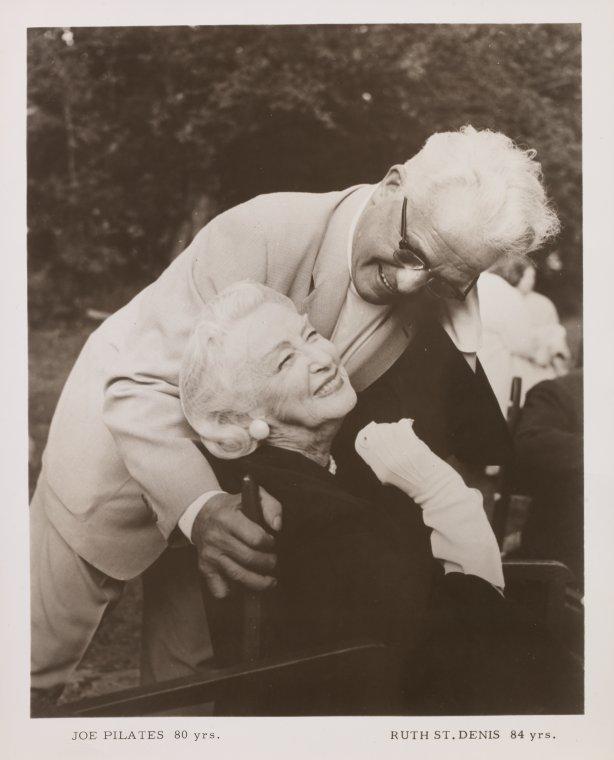 “Photo of Joe Pilates, 80 yrs. and Ruth St. Denis, 84 yrs.” Jerome Robbins Dance Division, The New York Public Library. The New York Public Library Digital Collections. 1954 – 1960.
“Fundamental to all normal and artistic expression of the body are certain basic principles and rules of beautiful human movement, and I am convinced that Joe Pilates, in his long career as the refashioner of men and women, knows more and practices what he knows on a demonstrable basis than anyone else with whom I have come in contact,” wrote St. Denis for a promotional pamphlet Pilates produced. “Under his treatment not only is the body rebuilt and rejuvenated, but the mental and spiritual refreshment is beyond calculation. I think there should be a thousand Joe Pilateses scattered over the United States to work hand-in-hand with the spiritual forces of this country. With them we would indeed create a great nation and the real hope of the world. I close these few inadequate sentences with a sense of deep gratitude to all that Joe Pilates is doing for me today.”
In an unpublished section of an early draft of Shawn’s autobiographical memoir “One Thousand and One Night Stands,” Shawn described how he first met and trained with Pilates:
Facing a winter of physical inactivity in 1940, I decided I would look up and try out a course of exercises at the studio of Joseph Pilates. Ruth St. Denis had discovered this man and raved about him, and I could see with my own eyes how he had helped her. She had suffered for years with bad knees and could not kneel or get up without excruciating pain. The result of this and a general discouragement had kept her from practicing as she should, and she had added weight all over, and her ankles had gotten big.
Then, a year or two later, after working faithfully for many months with Pilates, she was slim as in the years when I first knew her, her ankles like a young girl’s, and she had no more pain or trouble with her knees. She called him a sculptor of the body and said he was no ordinary gymnastics instructor, but an inspired genius.
And so, I found him. I dimly recognized the old Van Dyke Studio building when I first went to him. But only after many days did it dawn on me that it was in this building, I had taught my first lessons in New York, spring of 1914. Joe and his partner Clara, intensely German in manner and dialect, were martinets. But he was truly a genius, and his system of exercises was all that Ruth had described. I went daily all that winter and the following year whenever I was in New York, and lost weight, trimmed down waistline, got suppleness throughout my torso, and was altogether made over.
In further praise of Pilates’ help with his physical transformation, Shawn wrote:
Your set of exercises for chair are so complete that every muscle of the body is toned up equally all over, and the varied exercises are also void of monotony (such as, for instance, the floor exercises sometimes seem just drudgery to me)… This necessity to keep one’s mind alert, and the constantly changing positions hold one’s interest and this, in itself, is a valuable part of daily exercising- to enjoy it.
Shawn invited Pilates to join the faculty of Jacob’s Pillow in 1941. He said it wasn’t until the summer of 1942 that Pilates was able to carve out a substantive role on campus: “I had tried to sell him to [Anton] Dolin who was running the Pillow in 1941 and Joe did conduct a few classes in 1941 but Dolin was not really interested in his work and they did not get along well.”
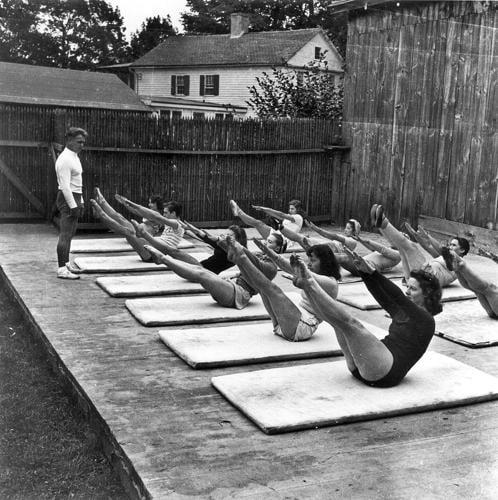 Joseph Pilates instructing a mat class in the Tea Garden at Jacob’s Pillow in 1942. Photo by Eric Sanford, courtesy of Jacob’s Pillow Dance Festival Archives.
“We never got further than the mat,” shared dancer Ann Hutchinson Guest in talking about Pilates’ class at Jacob’s Pillow in 1942.
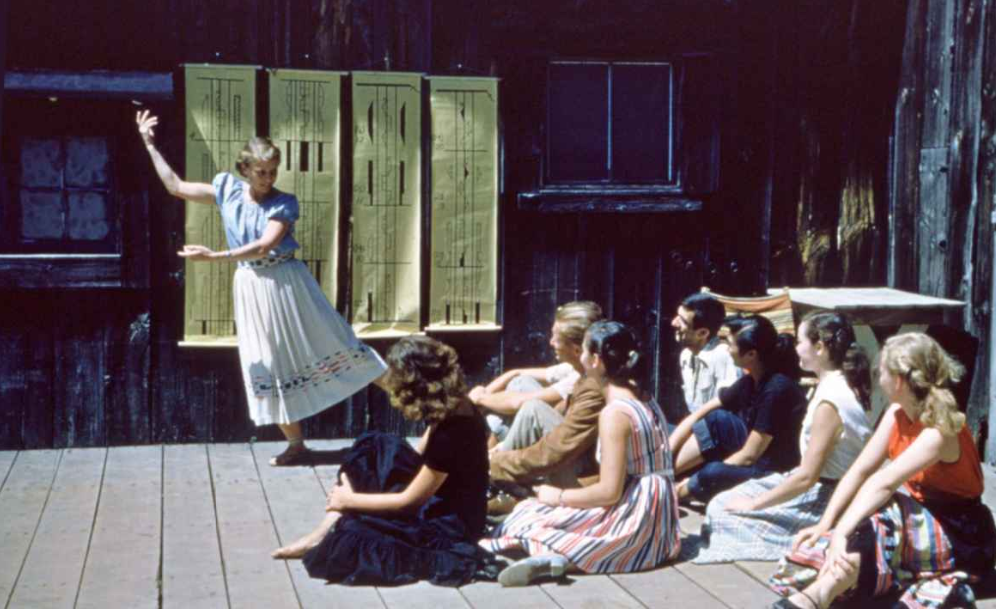 Ann Hutchinson teaching Labanotation at Jacob’s Pillow. Photo by John Lindquist, circa 1953. © Houghton Library, Harvard University.
Dancer Sharry Underwood shared her memories of taking Pilates classes at Jacob’s Pillow:
In 1942, when I was 20, I ran away from home to be a dancer. At Jacob’s Pillow University of the Dance, my first class was called Pilates…. Promptly at 8:00 a.m., clapping his hands together, Pilates directed class with a relentless stream of demands designed for strength and control. There was no music. Each exercise had its own rhythm and breathing—air out! air in! On the bare floor, I envied those on mats as we did the ‘Hun’ert’ (The Hundreds), flung our bodies ‘onza stomick,’ then ‘onza back!’ or to ‘da udder zide an hold it!’
Pilates’ class was compulsory for every student. We came willingly as we better understood how it strengthened us, gave us faith in our bodies. What I had called my ‘dancer’s back’ was a physical defect: lordosis. Under Pilates’ care, I gave birth to three vertebrae I had never felt before, correcting my alignment. Joe was famous for correcting back problems, saying, ‘You are as strong as your weakest vertebra, like a ladder with a broken rung.’
…At first I was not sure Joe liked dance or dancers. He gave no quarter in class. We were still considered flighty dilettantes during the war. But he grew to respect our struggles…. During the three years I studied under Joe, he never used any of his machines or weights with us. The body must supply the energy. He seldom used kinesiology nomenclature, calling out his 33 exercises: Corkscrew, Scissor, Boomerang, etc. Teaser, the body balancing like a jackknife, was a favorite.
…Once you have learned Pilates, it becomes a conscience for your body the rest of your life. For me [at 88], pure Pilates is still the best.
In 1943 Pilates initiated a “War Fitness Program” hosted at Jacob’s Pillow “for laymen, industrial workers etc.” and Pilates invited Berkshire residents to attend.
At the end of the 1943 Festival season, Shawn wrote that Pilates’ attitude and behavior had crossed red lines with him:
He wanted to run everything. He maintained that all this dance business was nonsense and the whole of Jacob’s Pillow should be turned over to him to run his health farm—health was really important, art was only trivial and unessential. He drank a lot, he philandered with the girl students, and he took no orders and abided by no rules or schedules of the place. He did what he wanted to do when and how he wanted to do it. His work was so excellent that I put up with this for two summers but at the end of the 1943 summer he got so ugly in manner and so peremptory in his advice as to how I should run all of my business that when he left the place hardly speaking to me… I continued to recommend people to go to him.
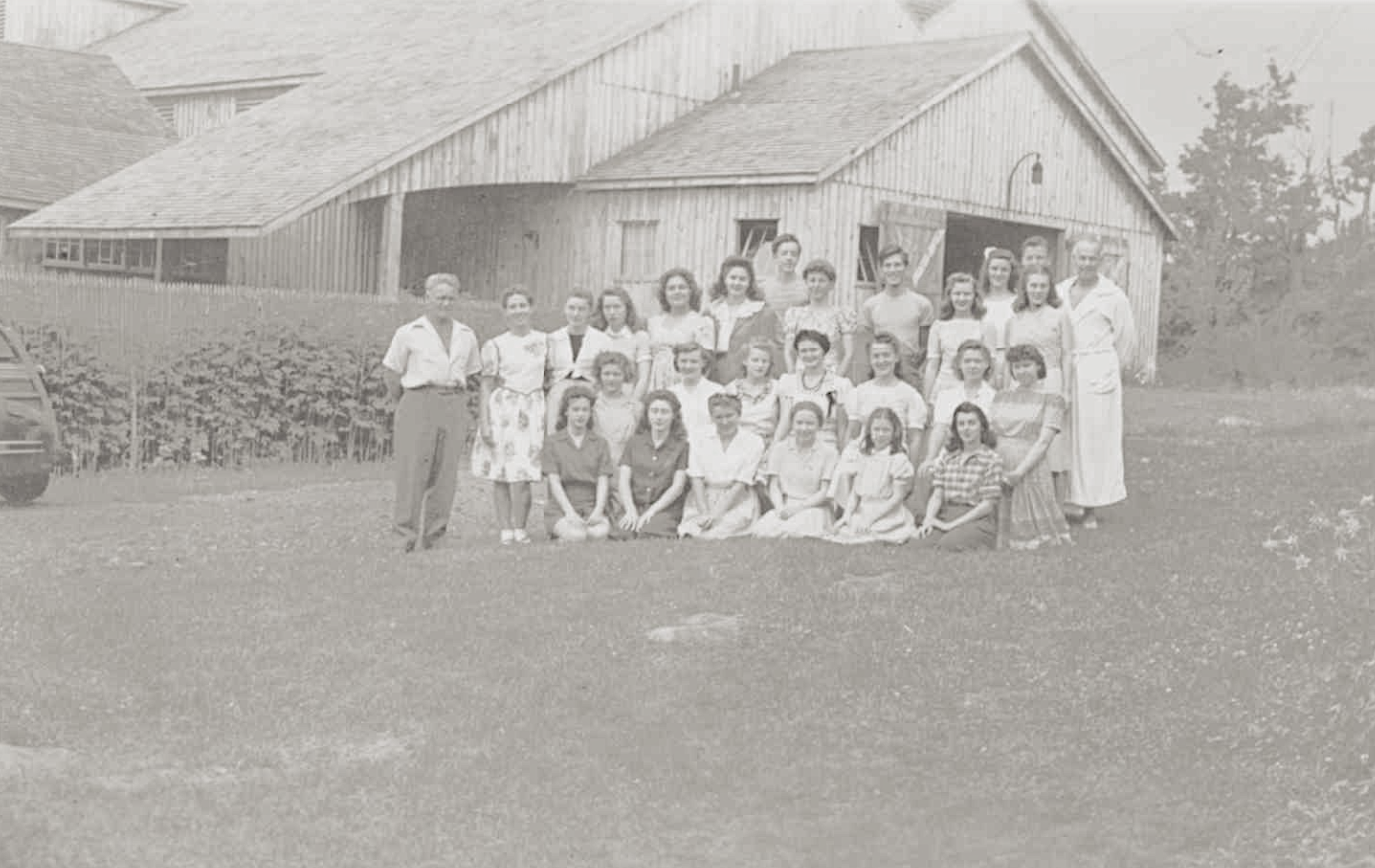 “1943 Unidentified Students with Joseph Pilates and Ted Shawn.” Identified individuals are: Joseph H. Pilates (far left), Ted Shawn (far right), Betty Jones, Ruth Alexander.Photo courtesy of Jacob’s Pillow Dance Festival Archives.
Sharry Underwood provided firsthand accounts of how Pilates’ behavior with her crossed a line. “Once when he was massaging my strained ankle, I caught him massaging all the way up my thigh. I clasped my hands at my knee, giving him a look. He just chuckled,” wrote Underwood in Dance Magazine in 2010. She described another inappropriate interaction from the summer of 1942: “Pilates strode over to me. Throwing a heavy hand over my left breast and jiggling it up and down, he roared, ‘You vant schloppy pectorals? You sqveeze!’ Mortified, I sqveezed.”
Pilates’ quarrel with Shawn at the end of the 1943 season minimized his presence at Jacob’s Pillow for several years, but he returned in limited official capacities beginning again in 1947. That summer he was also working as a physical conditioning specialist at the Berkshire Playhouse Drama School.
In 1948 Pilates bought and began using a nearby cottage and studio in Becket. He later commented, “I couldn’t stay alive if every weekend I didn’t go to the country.” He would train dancers both at Jacob’s Pillow and work with them on his apparatuses at his personal studio.
Ann Hutchinson Guest said: “When he had his own house…[and] barn, he put the various apparatuses that he was using.”
Gordon Hyatt, who lived in Lee and Stockbridge for most of his life, helped Pilates maintain his newly acquired property. During one of those weekly visits, Pilates pulled Hyatt into a workout. “You have no stomach muscles,” Hyatt recalled Pilates telling him while being instructed to engage his core on a piece of equipment called a Bednasium.
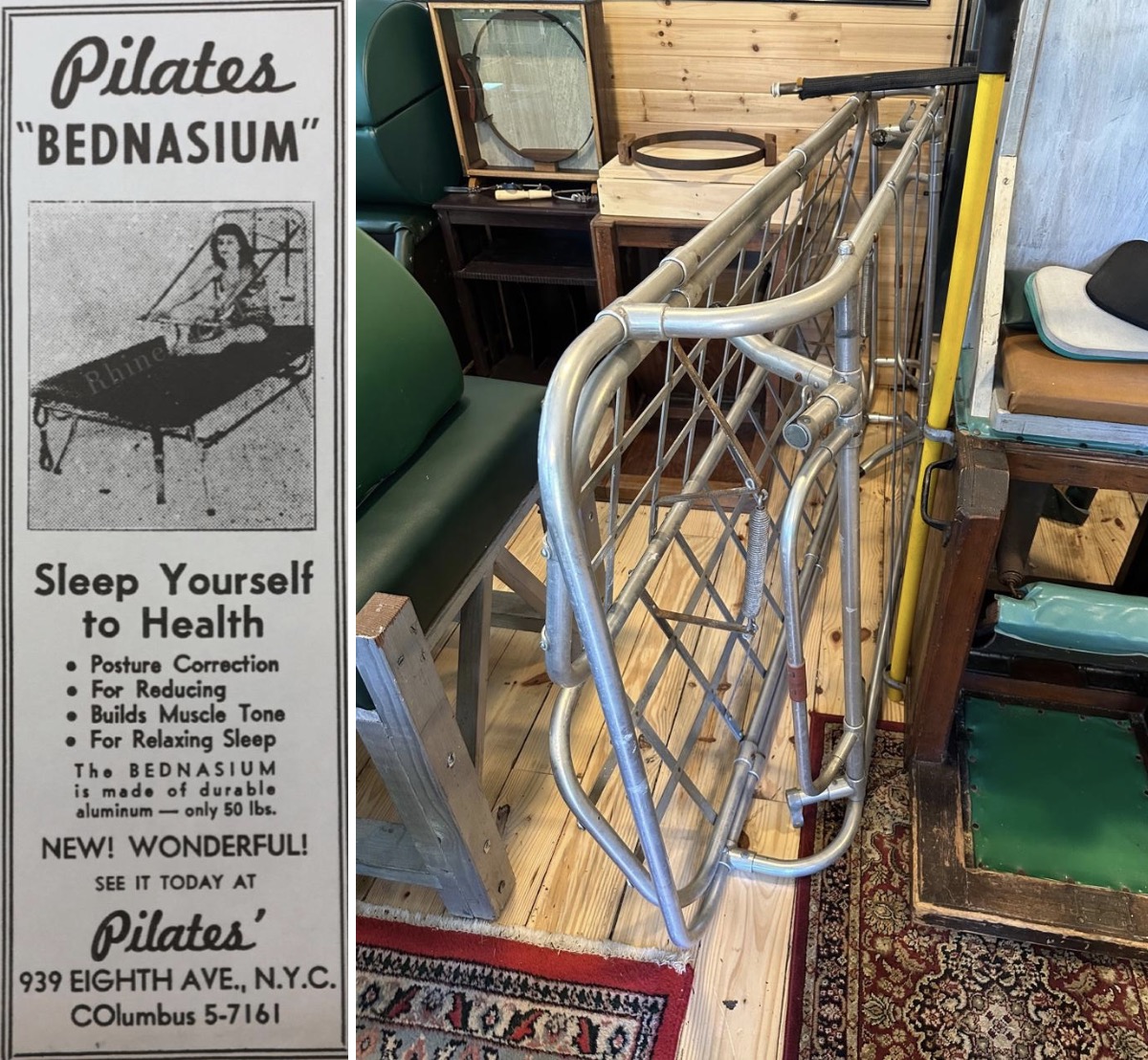 Left: Bednasium ad. Provided by The Pilates History Research Archive™. Right: Joe Pilates’ original Bednasium from his Becket studio. Photo by Joshua D. Bloom.
“Mr. Pilates, he was wonderful,” said Madeline Cantarella Culpo, a Pittsfield native who was a student at Jacob’s Pillow in 1950 and is now in her 90s. “We would have his class at Jacob’s Pillow. Whatever he tells you to do, you did. The exercises were not very hard; I was a kid and flexible, so the movements were easy. Now if you were to ask me to do those exercises, I can’t sit on the floor without slipping off a couch because that’s the only way I can get to the floor.”
In “See All the People,” Lee historian Florence Consolati shared an anecdote about taking a Pilates fitness class at Jacob’s Pillow with her cousin Rena Kamena:
In the early 1950s Cousin Rena came up from New Jersey with her son to visit. She would regularly nurse the two-month-old infant, then rush over to the Pillow to exercise with a body trainer named Joseph Pilates and to listen to Shawn’s wife, Ruth St. Denis, discourse on religious dance. Rena persuaded me to join the sessions. I unearthed a red Sears and Roebuck undershirt that looked like a leotard. With the other sketchily dressed neophytes we raised broomsticks in salute to dawn, at our ageless teacher’s bidding.
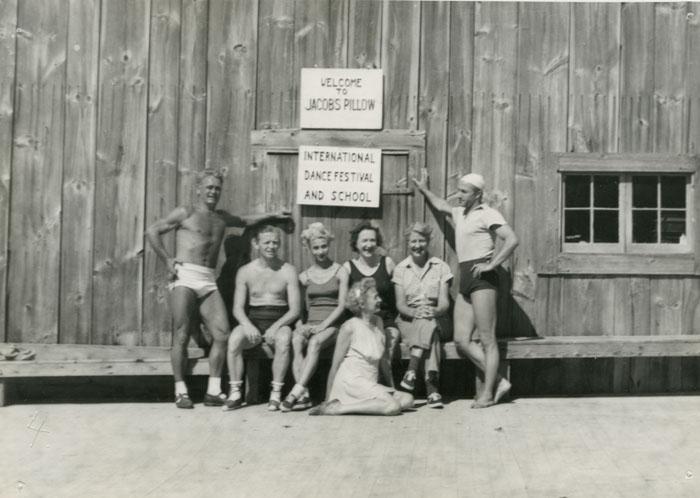 From left: Joseph Pilates, unknown subject, unknown subject, Carol Lynn, Mary Campbell, unknown subject, and Jeanette Schlottman on the ground in the Tea Garden at Jacob’s Pillow. Sign reads, “Welcome to Jacob’s Pillow, International Dance Festival and School.” Photo from the Mary Campbell Collection, Texas Woman’s University.
East Lee Package Store
German-born Richard “Dick” Keinath immigrated to New York, where he first met fellow German American Joseph Pilates. Serendipitously, both men ended up reestablishing themselves in the same rural corner of western Massachusetts.
A friend first introduced Keinath to the Berkshires in the mid-1940s, and he and his family continued to return each summer. In 1954, the Keinaths left Islip, Long Island, where they were the proprietors of Islip Terrace and East Islip Bakeries for 30 years; they moved to East Lee and bought the East Lee Package Store and gas station on Water Street. As one of the few area liquor stores at the time, their business was popular.
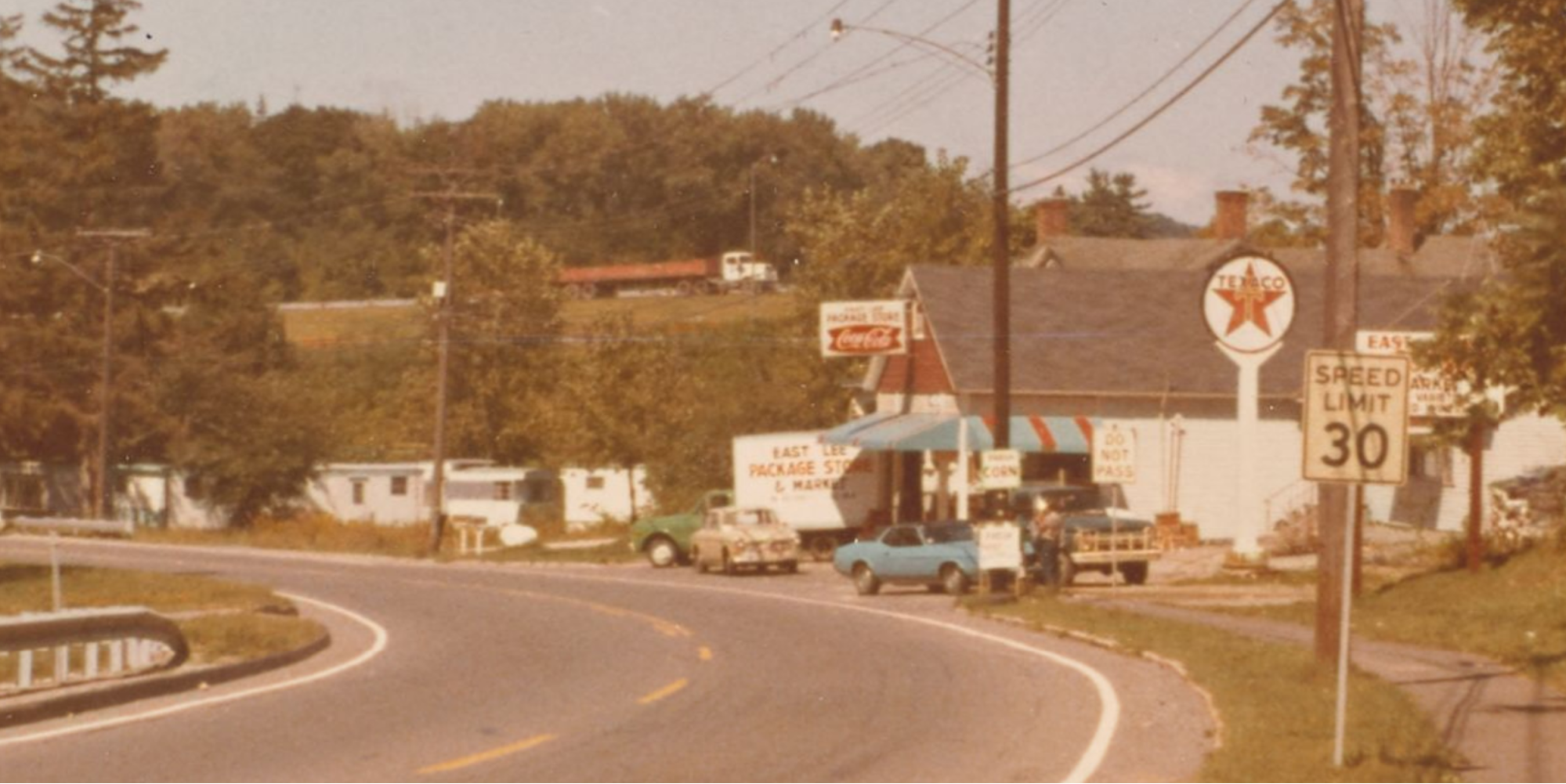 East Lee Package Store and old Amoco station, East Lee. 1970. Name on Item: Peter Scolforo. Photo courtesy of the Lee Library Historical Collection.
Keinath recommended Pilates’ exercises to his friend and East Lee neighbor, George Allen, to help him recuperate from an injured back. Keinath told Allen: “I want you to talk to Joe Pilates. I know he can fix you.” Pilates did, beginning a training regimen with Allen.
While Allen worked at the P.J. Schweitzer Division paper mill and eventually would go on to own Allen’s Trailer Park in East Lee, he was also a carpenter. Allen built his own Reformer and used a Bench Mat provided by Pilates. Allen practiced daily for two years and saw significant physical improvements.
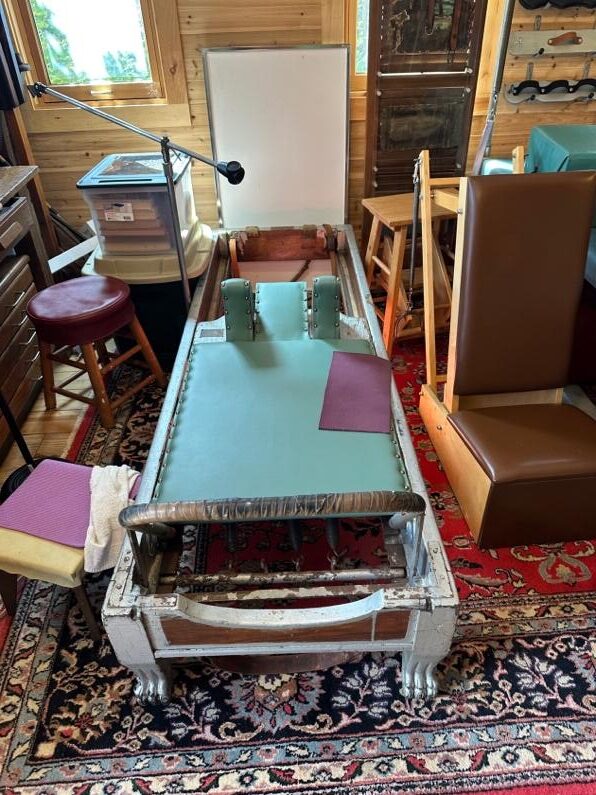 An original Joe Pilates Reformer from his Becket studio. Photo by Joshua D. Bloom.
Jonathan Grubb interviewed Allen’s daughter Beverly. She reported that both of her parents visited Pilates in New York. Back in the Berkshires, Allen and his sons, George Jr. and Paul, helped maintain Pilates’ property in Becket. Together they served as the caretakers, groundskeepers, handymen, and jacks-of-all-trades.
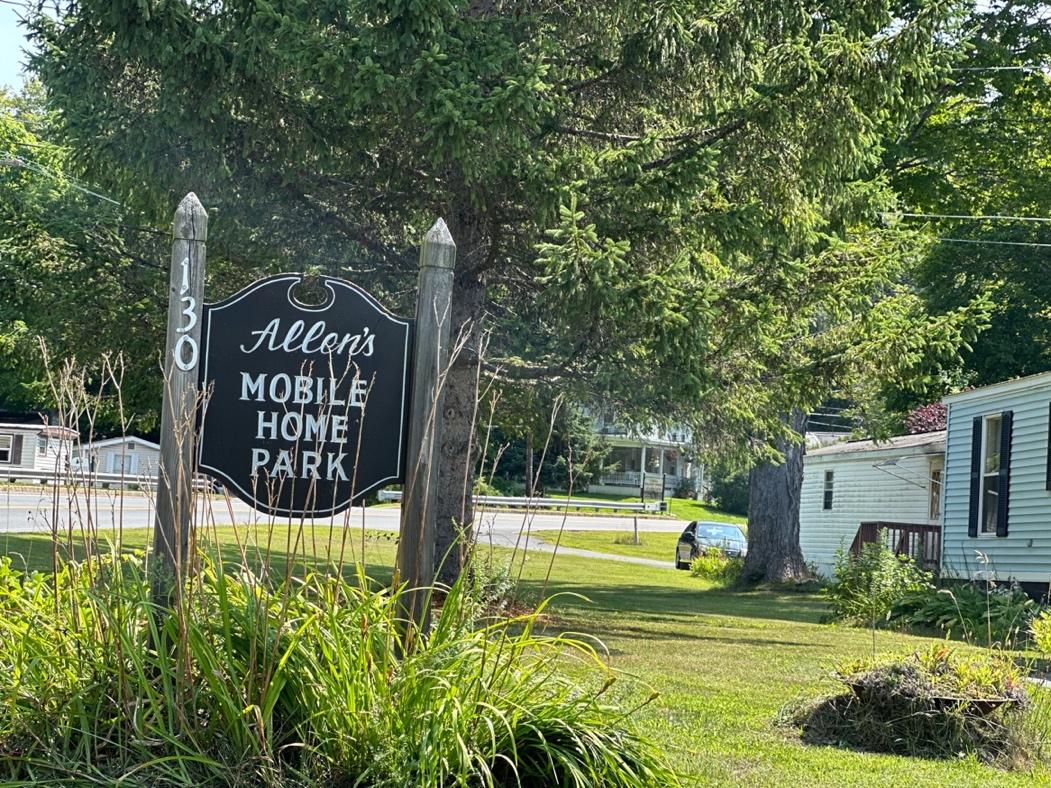 Allen’s Mobile Home Park, owned by the late George Allen, located across the street from the East Lee Package Store. Photo by Joshua D. Bloom, Aug. 8, 2025.
“My history with Joe Pilates and company dates back to when I was a small child,” said Paul Allen in a 2022 interview with Pilates’ historians, Sean Gallagher and Elaine Ewing. “My dad had a back problem, and he was introduced to Joe to help repair that back problem and he did. Joe helped my father out an awful lot. My father had a severe disc injury. The disc injury was kind of pushed back in place through exercises. And my father was so grateful to Joe for helping him out without any surgery that he offered his service to come up and help Joe at this campus when I was, oh, probably 12 or 13 years old and I worked with my dad at this campus: Mowing the lawn, doing small jobs, painting, and whatever Joe wanted done as a handy group, my father and I, until I was I think about 16 or maybe 17.”
George Allen continued training with Pilates on his apparatuses when he and his sons came over to tend to the property. “We, as kids, would play on them,” said Paul Allen. “I mean he chose what the exercises were. And, of course, when you’re 12, they were easy because we were very flexible.”
Paul Allen also fondly reminisced about how Pilates passed down his old photo processing equipment to him. “I remember this one plastic cylinder and you’d unwind the film in it and put it into the liquid, and you know play with it. And, he gave me all the chemicals and everything. I would play with it, and it was a really funky homemade enlarger.”
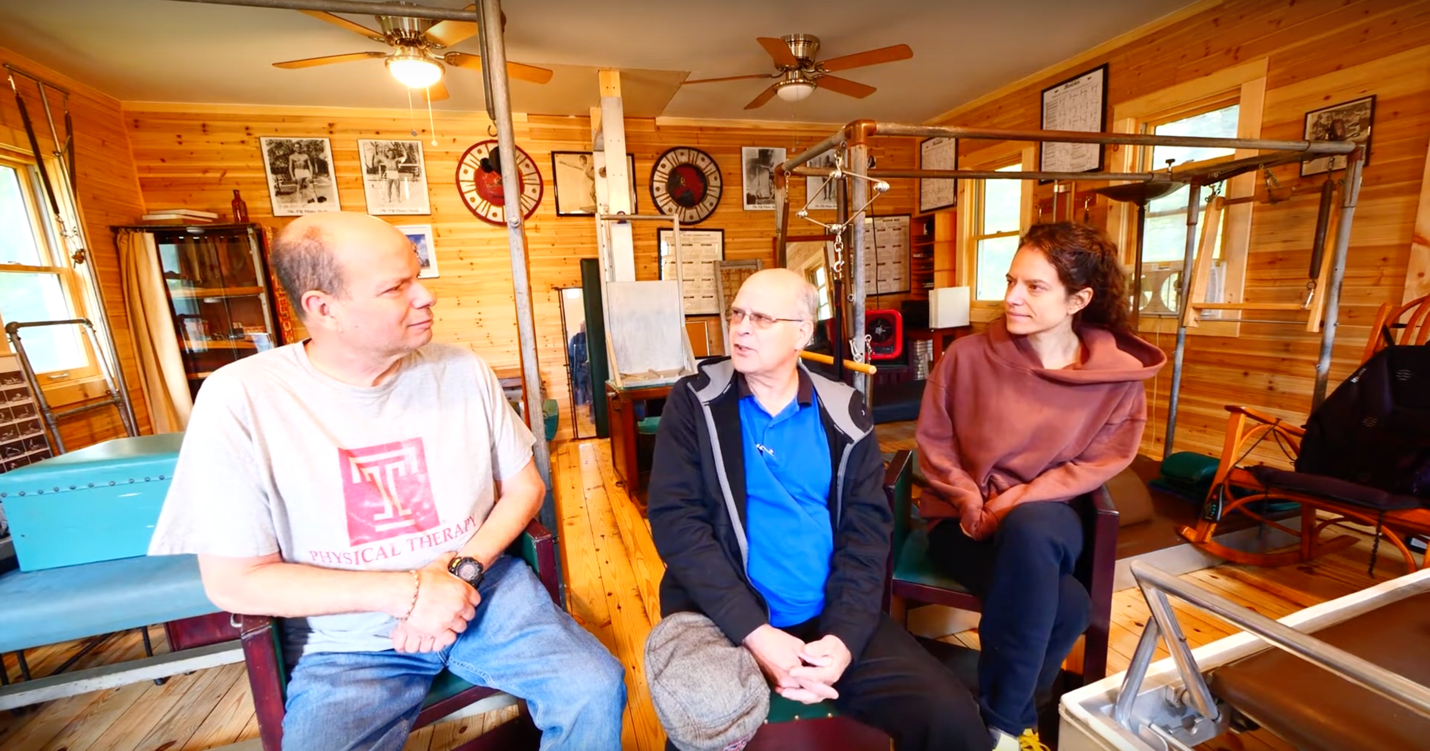 Screenshot from a 2022 interview of Paul Allen with Sean Gallagher and Elaine Ewing at the former Becket studio of Joseph Pilates on Pilates Source® YouTube channel © 2022 Richtone Design Group LLC.
Paul Allen said what he believed made Pilates a genius was “making not just one muscle group develop but the entire body and the mind… That’s what geniuses do; they put stuff together that has never been put together before.”
Tony’s Barber Shop
As Joseph Pilates deepened his roots in Lee, his influence extended across unexpected corners of town life. His reputation spread through word of mouth, physical transformations, and personal encounters. One of the most memorable of those encounters began in a barbershop on Main Street, where a returning Navy veteran named Anthony “Tony” Carlino met Pilates and became one of his most devoted local followers.
Carlino had recently returned to Lee after serving in the U.S. Navy from 1943 to 1946; upon his return stateside, Carlino completed barber school and then resettled in Lee.
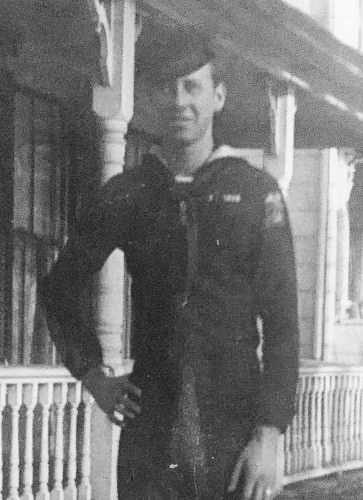 Anthony “Tony” Carlino. Photo via Legacy.com, published with permission of the Carlino family.
When Pilates walked into the barber shop at 74 Main Street, he and Carlino hit it off immediately. Carlino said, “I was just so amazed at this man [Pilates]. He was so straight, chiseled, and beautiful straight white hair. He loved the sun on him all of the time. He was as tan as tan could be. And we talked about exercise because that was his life, you know.”
At this first encounter, Pilates had Carlino try a position that is now known as the “Teaser.” “And he says, let me see you…touch your toes… so I put my hands up to the toes and held it there, held it there. He didn’t say stop. And he thought that was pretty good, you know,” said Carlino. “I was so impressed with him. We became friends right away.”
The relationship continued when Carlino opened his own barber shop, Tony’s Barber Shop, just across the street. “I’d give a haircut—a shave—you know. I wouldn’t charge him. I loved him so much—you know. I admired him so much.”
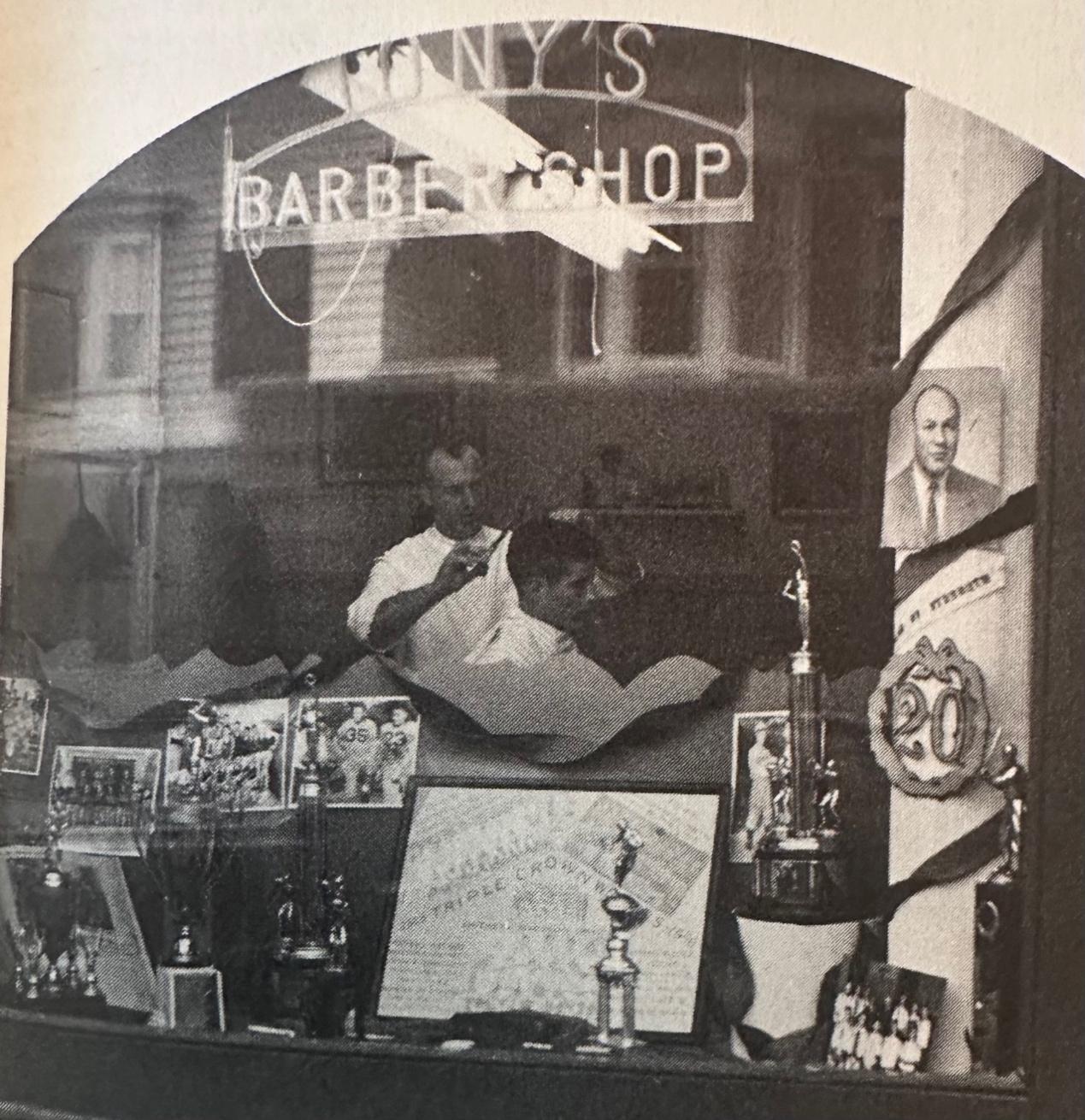 “Main Street barber Tony Carlino displayed a picture of Lee High’s triple crown winners of 1949-50 and several trophies the team collected in that era. The window of his shop mirrors the old block across the way.” In Florence Consolati’s book “See All the People.” Published with permission of Deidre Consolati.
Carlino trained with Pilates both at his Pillow studio and later at the Becket property. The exercises became part of Carlino’s daily routine. In a 2015 interview with Pilates’ biographer, Cathy Strack, Carlino said:
He was so strong and without fear. He would invent things. This strap you would put on your head and hook it up to a wall or a post and you pull it, and it would strengthen your neck. … He would fix little rings to his fingers, and he would stretch them. And his fingers would be strong. … He would have an idea and he would make it. The machinery or a gadget. For the fingers or the neck or legs or whatever.
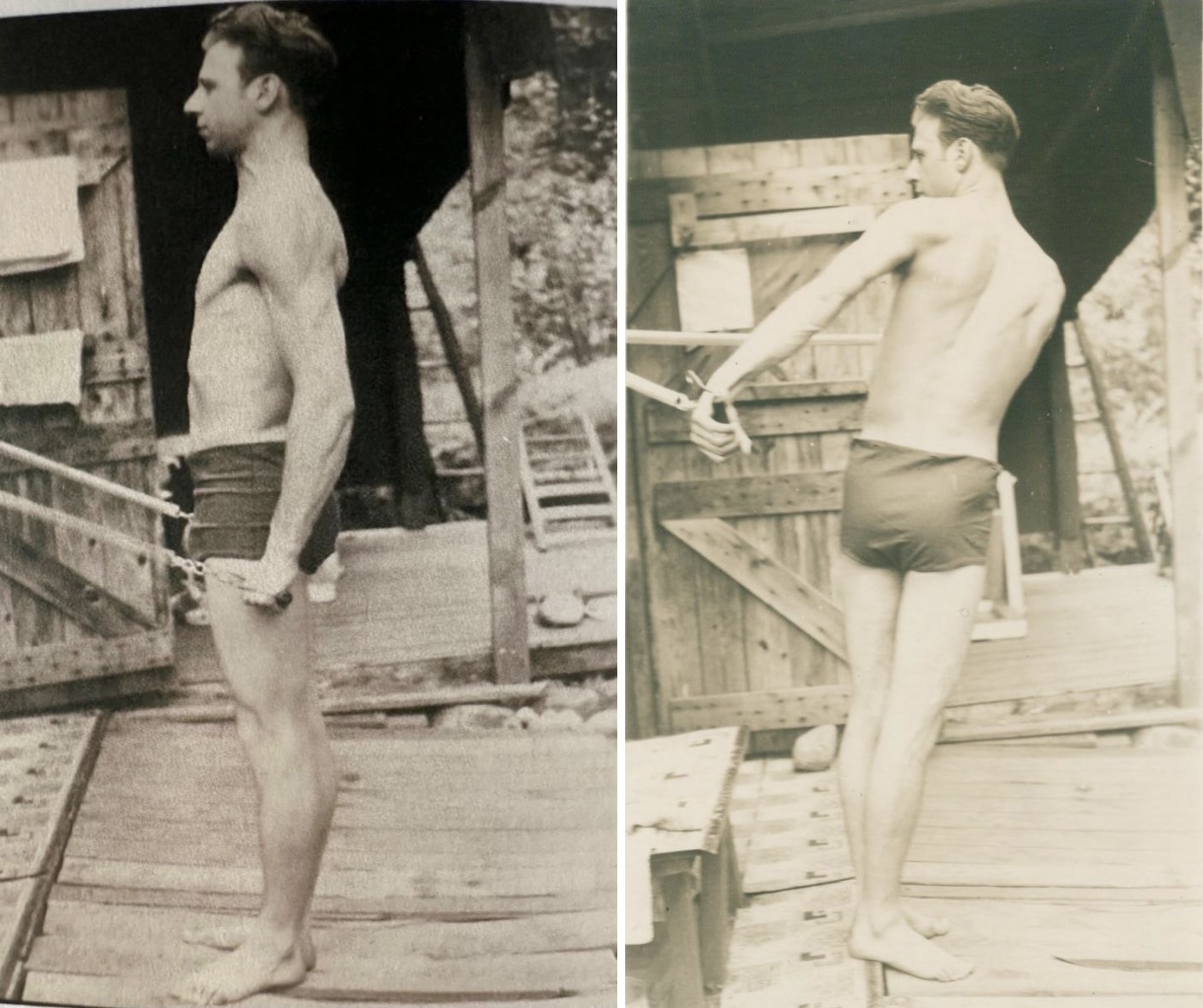 Tony Carlino working on Pilates’ equipment. Photo courtesy of Cathy Strack. Picture on the left can be can found in her book “Get to Know Joe Pilates.”
Carlino said that, one time in November, Pilates instructed him to: “Go outside and take a [cold] shower.”
Carlino’s reaction was: “You kidding me?! Take a shower now?! I’m freezing.” Carlino confirmed that was what Pilates wanted him to do: “He built the confidence in me to do that…. Wow! I didn’t think I could do that. But I did and it felt good…. That’s the kind of man you want. He gives a command and when you do it, it’s done, and you have that kind of confidence that he has that gives him fuel.”
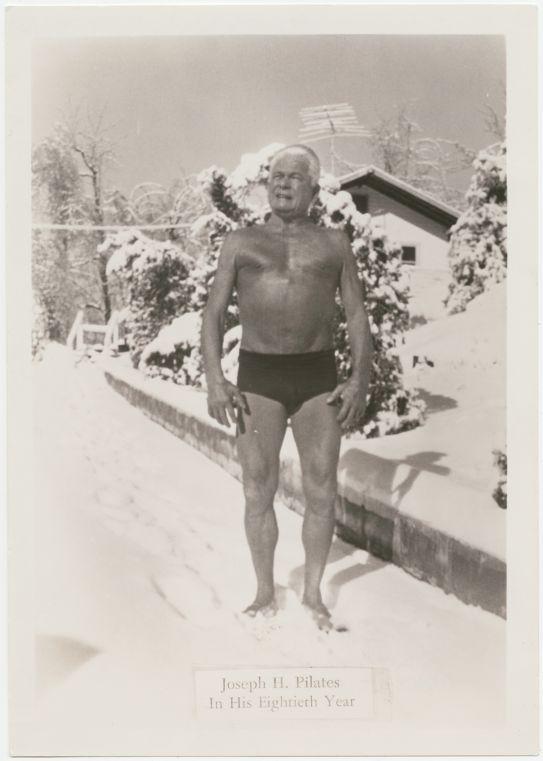 “Joseph H. Pilates in his eightieth year,” photographed at his Becket studio. Jerome Robbins Dance Division, The New York Public Library Digital Collections, 1961.
Sean Gallagher, owner and founder of The New York Pilates Studio®, shared: “When you talk about body, mind, and spirit, Tony got that. He had [PTSD]. Coming back from the war, he was a young guy, and he really had troubles.”
Carlino confirmed: “The reason why I started exercise [is] I was in World War II, and my ship got hit by a kamikaze plane and bombed.” A fellow sailor rescued Carlino that day. Forty-nine shipmates did not survive.
“I was really a wreck when I got home,” explained Carlino. “I was OK over there because I was with everybody on the ship, but as soon as I got home, it was not the same. I was shaky. I was just not in great shape. They wanted to send me to a VA hospital.”
Carlino decided on a different route: “I decided, I think I’ll try exercise. So I started doing the exercises, and also meeting Joe helped me learn more about myself—how to exercise and how to have my body more in tune. That’s what made us more friendly, and it just started me on a new path of life at the time.”
“And Joe took him under his wing, and trained him, and taught him, and became his friend, and helped him come back from that,” said Gallagher. “Joe really helped him psychologically, not just physically.”
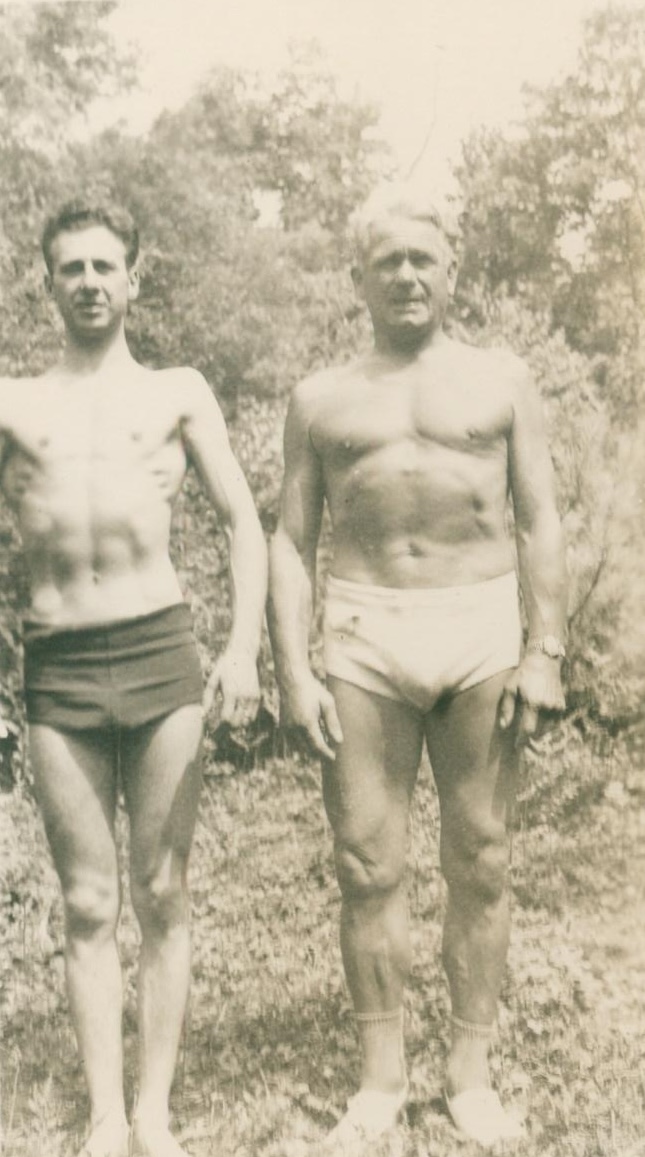 Tony Carlino with Joseph Pilates. Photo courtesy of Cathy Strack and found in her book “Get to Know Joe Pilates.”
Return to Life Club opens on Main Street
In 1954, Tony Carlino, Joseph Pilates, and shopkeeper Ben Slaminsky (of Ben’s in the Baird Block of Main Street) opened an exercise studio above Slaminsky’s shop. They named their club The Return to Life Club after Pilates’ exercise book of the same name.
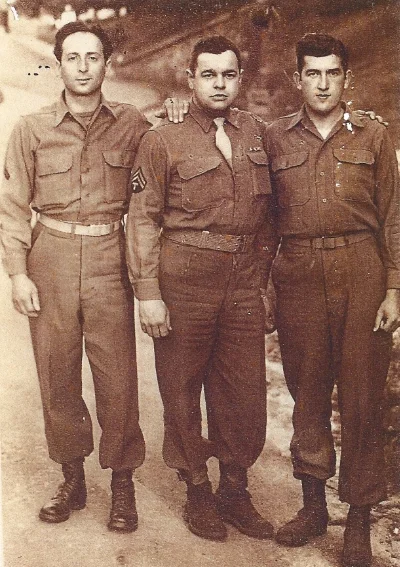 Ben Slaminsky during World War II, on the left with two other members of the Army’s 106th Division: Joe Gaherty from Lee on the right and an unidentified man from Connecticut in the middle. Photo courtesy of Marcia Slaminsky and published with her permission.
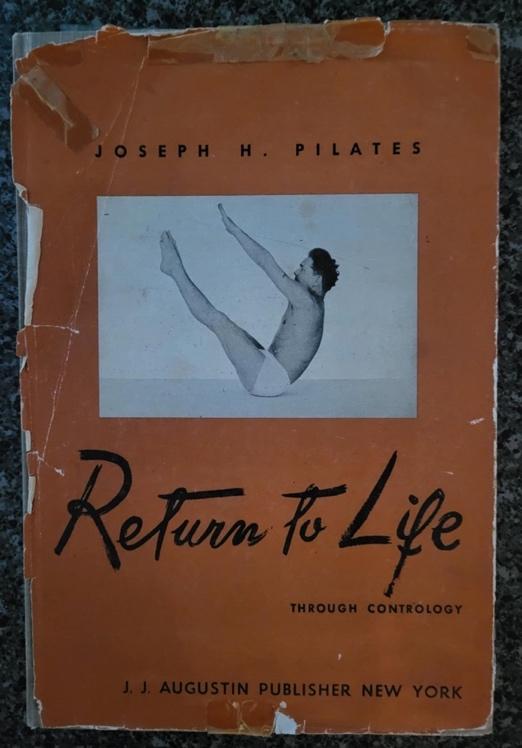 Ben Slaminsky’s signed copy of “Return to Life” by Joseph Pilates. The Return to Life Club in Lee was named after this book. Photo courtesy of Marcia Slaminsky and published with her permission.
Jonathan Grubb spoke with Slaminsky’s daughter Marcia in 2021 and reported:
Slaminsky (1911 to 1985), a clothes store owner in Lee, Massachusetts was suffering from severe back problems and was reluctant to undergo surgery. Ben’s wife, Ruth, sought out Joseph Pilates and Marcia remembers her father ‘doing his exercises every morning’, which she also joined in with. Ben also had a friend who was a carpenter who made a reformer for Ben probably for the club.
Marcia’s sister still has that Reformer.
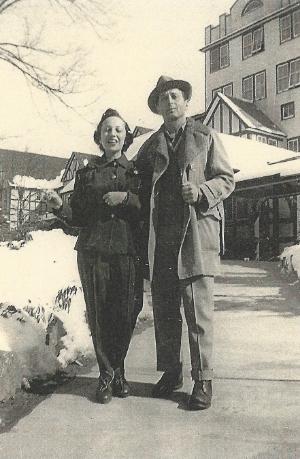 Ben and Ruth Slaminsky, 1952. Photo courtesy of Marcia Slaminsky and published with her permission.
The club’s first meeting was on April 10, 1954. Pilates donated equipment and served as an instructor. Carlino was named president, and Slaminsky became the secretary-treasurer. The other board members were Joseph Pilates, Thomas Connelly, and Peter Shaker.
Pilates’ biographer, Cathy Strack, reported that Connelly was nursing a leg injury from his time in the military. He worked for the gas company upon his return to Lee and became an active sports and recreation community volunteer.
Shaker lived in New York City in the 1930s, where he boxed in his youth. Strack said that he had a reputation for being “a great storyteller.” After his wife Anna died in 1947, he moved to Lee and opened Peter Shaker’s Food Store on Center Street and co-owned the Lenox Hotel. He sold the store to Frank Ustoitis in the early 1970s, and in 1985 the building was demolished to make way for a bridge across the Housatonic River.
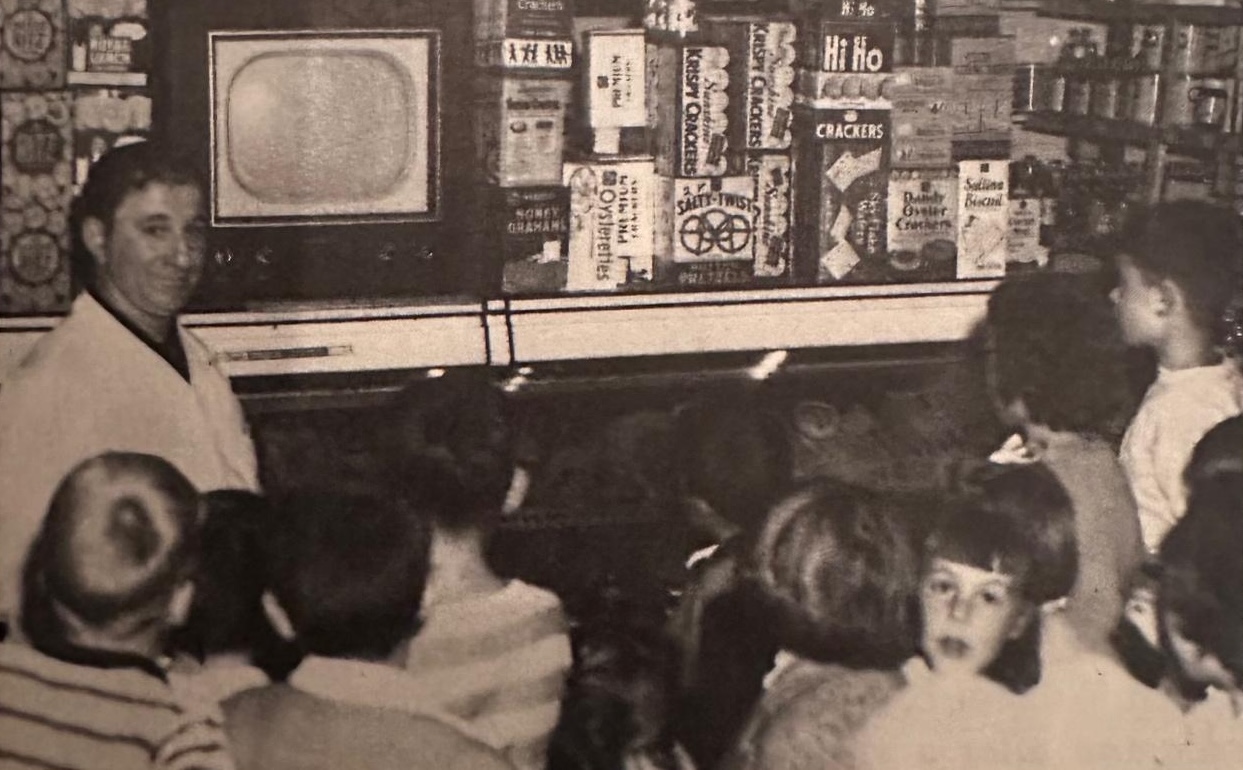 Peter Shaker with an early television in his shop garnering the interest of the town’s children. Photo from of “See All the People” by Florence Consolati.
Three more men were involved in drafting the club bylaws. Theodore Hitchcock served in the Army Air Corps during World War II. He was a truck driver who worked for the Department of Public Works and served as a police officer and volunteer fireman in Lee. Hubert Orienti was the Lee Fire Chief. And William Salinetti was an insurance agent with John Hancock Insurance Co. in Lee.
George Allen functioned as an additional instructor based on his personal experience training with Pilates and his understanding of Pilates’ methodologies.
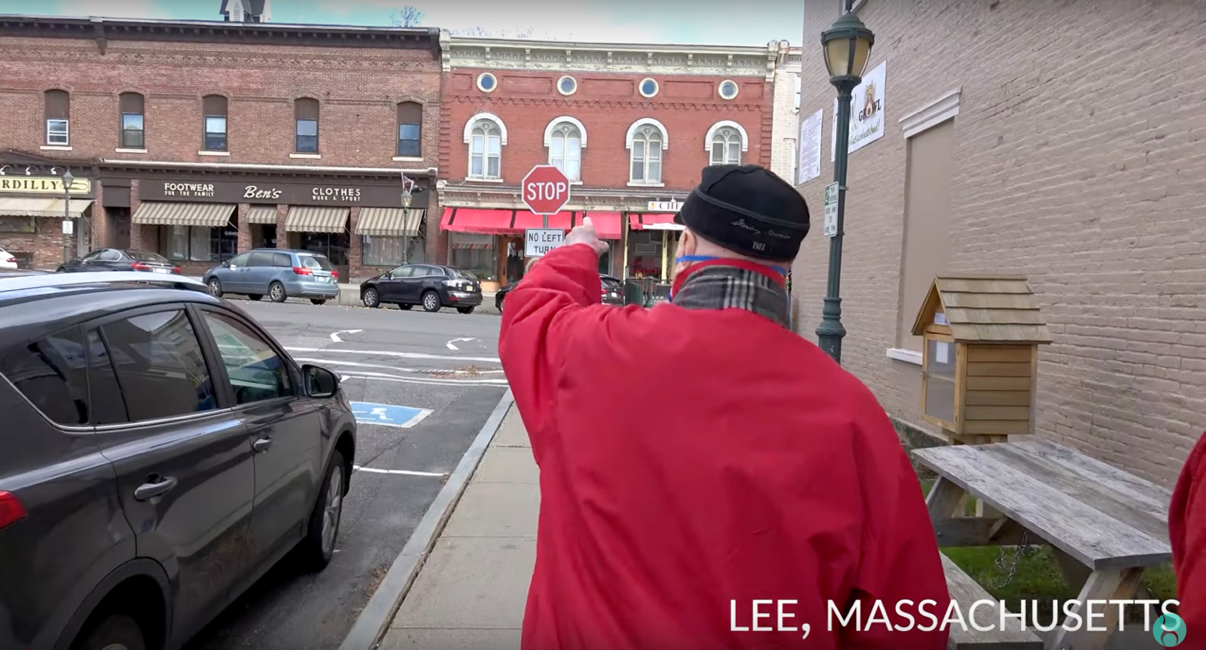 Screenshot of 92-year-old Tony Carlino pointing to the second-floor location of Pilates’ Return to Life Club above Ben’s, May 8, 2019. Published with permission of Pilatesology. The full video interview with Tony Carlino is available at Pilatesology.com.
Carlino told Strack that the formality of having officers and bylaws was Pilates’ doing and mostly meaningless, but good for PR. “They ended up doing these mat classes [above] Ben’s…. Above the store were these empty rooms and they would go up there and they would do their mat classes. And Joe started them. He taught them the exercises. He taught the classes there for a while. And then you know, he obviously couldn’t be there all the time, so the men started just doing it on their own.”
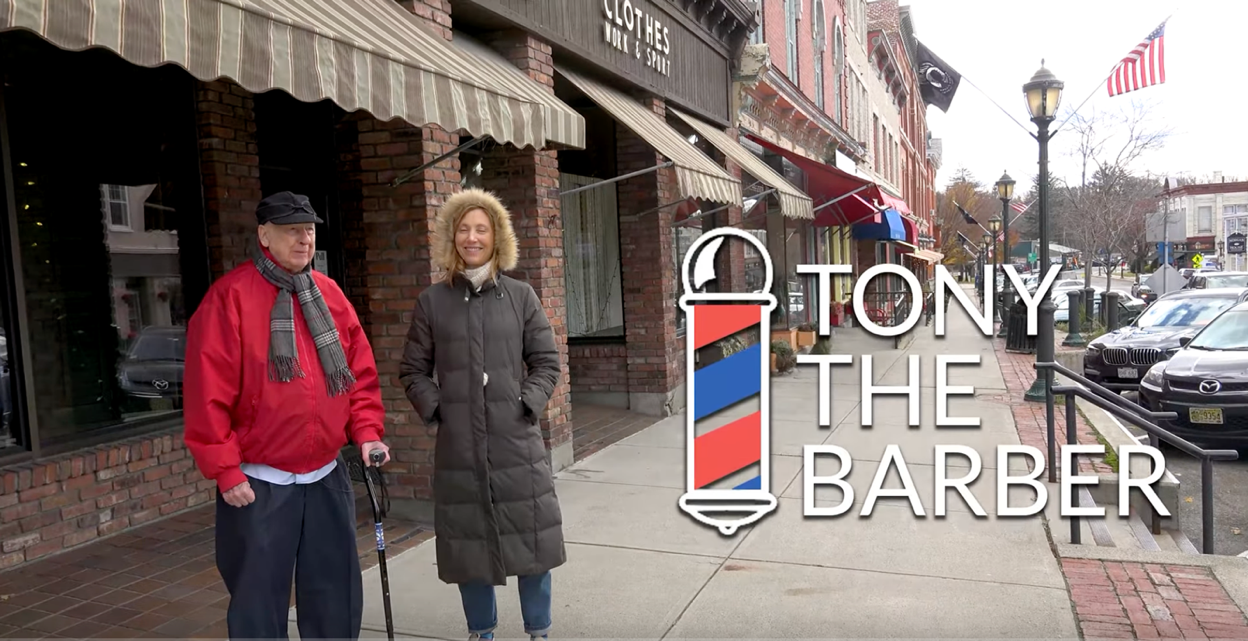 Screenshot of 92-year-old Tony Carlino on May 8, 2019, with Alisa Wyatt, founder of Pilatesology, in front of the building that housed the Return to Life Club. Published with permission of Pilatesology. The full video interview with Tony Carlino is available at Pilatesology.com.
Carlino said that Pilates was happy to have a way to give back to Lee. “He was charitable. He gave his all,” said Carlino. “One thing about him was, there was no money involved. He just wanted to do something good for the town and for the people in it.”
Classes were held every Saturday morning. Slaminsky and Carlino told The Berkshire Eagle that they planned to “promote among its members the body-building techniques developed by Joseph H. Pilates, New York City physical culturist, who spends his weekends in the Berkshires…. Membership in the club will be limited to about 20. Regular meetings will probably be held weekends, but the club rooms will be open to members all week.”
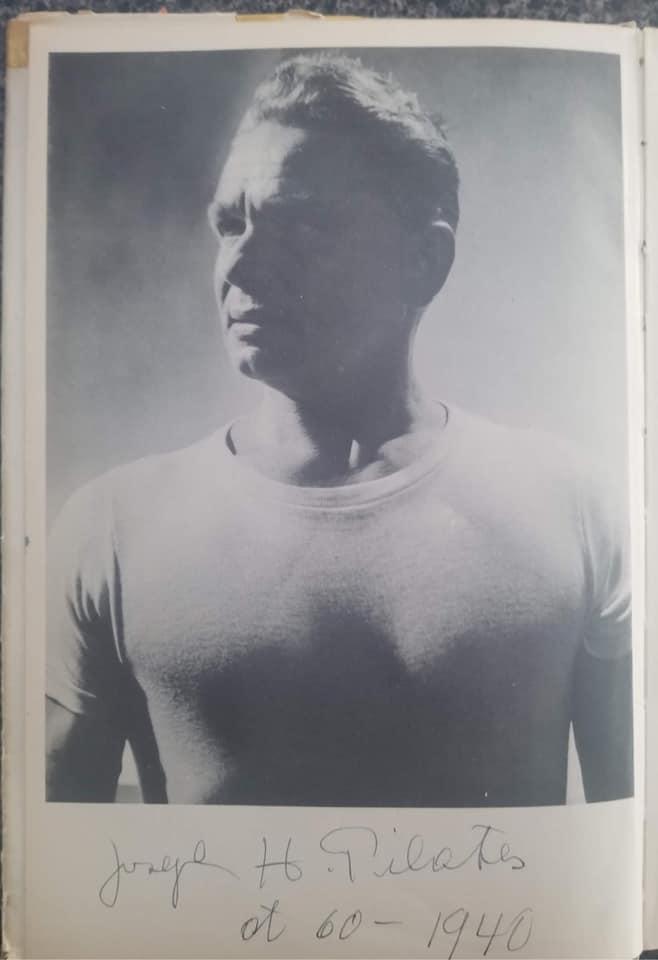 Slaminsky’s signed copy of “Return to Life.” Photo via Facebook. Published with the permission of Marcia Slaminsky.
By May 4, 1954, the club had 28 members. “We had businessmen, the fire chief, there was a policeman there, there was a Shaker who owned a store, a banker,” said Carlino.
Peter Shaker’s grandson, Eugene Klos, said his family was unaware of Shaker’s connection to Pilates.
William Salinetti’s son Peter said, “The funny thing is that I never heard my father ever mention Pilates. I know that in his younger years he was a pretty good athlete.”
Marcia Slaminsky said something similar, “My father rarely talked about 1) WWII 2) his history with Joe Pilates 3) his childhood. He did his ‘exercises’ EVERY morning for the rest of his life. And I did them with him when I was little. I still do a similar routine every day.”
Allen’s family reported that his family commitments meant that he was only able to remain an instructor for a year or two before the club closed.
Carlino told Strack that the Return to Life Club “eventually broke up because you had all of these really strong personalities…. They just all had different ideas about what to do. But they all appreciated the exercises and in their own way, a lot of them kept doing them.”
Even after the club disbanded, the exercises, and the sense of shared purpose, continued in individual routines throughout Lee.
Pilates’s Becket home studio is preserved
In 1997, Sean Gallagher, owner and founder of The New York Pilates Studio®, first visited the archives at Jacob’s Pillow to share research on Joseph Pilates after he came into possession of more than 1,000 photographs that once belonged to Joe and Clara Pilates. Gallagher was embroiled in a copyright dispute over branding the name Pilates in the late 1990s. He eventually lost in court and the case established Pilates as a generic exercise term that was not copyrightable.
At Gallagher’s first visit to the Jacob’s Pillow Archives, he met Director of Preservation Norton Owen. Gallagher reported that Owen told him about Pilates’ former Becket property, saying, “This property is for sale, and I think it has the equipment in it.”
Gallagher visited the property and studio with the realtor. Gallagher conveyed his conversation with the real estate agent: “I told the realtor, ‘I don’t want the property, but I’ll buy the equipment.’ And then the owner said, ‘if you want the equipment, you have to buy the property.’ So, here we are, almost 20 years later with the property.” Gallagher is pleased to have saved and revived the original studio.
With the initial restoration of the Becket studio now complete, Gallagher hopes to build bungalows on site. Gallagher is on a mission to keep Pilates’ fitness legacy alive both at Jacob’s Pillow and on Pilates’ former Becket property. In addition to the bungalows, Gallagher wants to open his Pilates Museum to the public, and he has begun offering on-site classes inspired by Pilates and his original equipment.
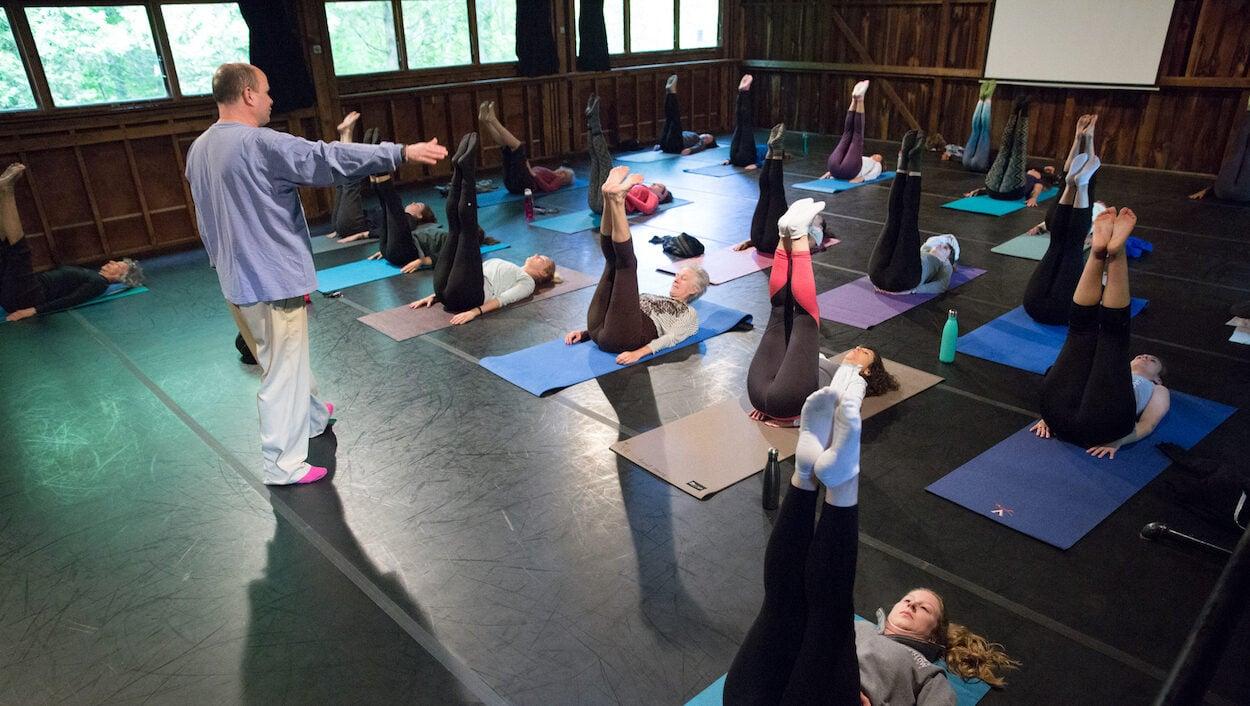 Sean Gallagher teaching a Pilates class at Jacob’s Pillow. From an article, “Pilates at the Pillow: Keeping the Tradition Alive,” by Emma Garber, published by Jacob’s Pillow in July 2022. Published with the permission of Jacob’s Pillow Dance Festival Archives.
Jacob’s Pillow invited Gallagher to teach a weekly Pilates Morning Class, beginning in 1998. The Pillow kept inviting him to return until the COVID pandemic shuttered the campus. Gallagher was invited back for the 2023 season, but he did not teach at the Pillow during more recent summers.
Once the Pillow built new housing that could accommodate guests in the off season, Gallagher teamed up with the Pillow to host a semi-annual Pilates at the Pillow® conference in the off season beginning in 2018.
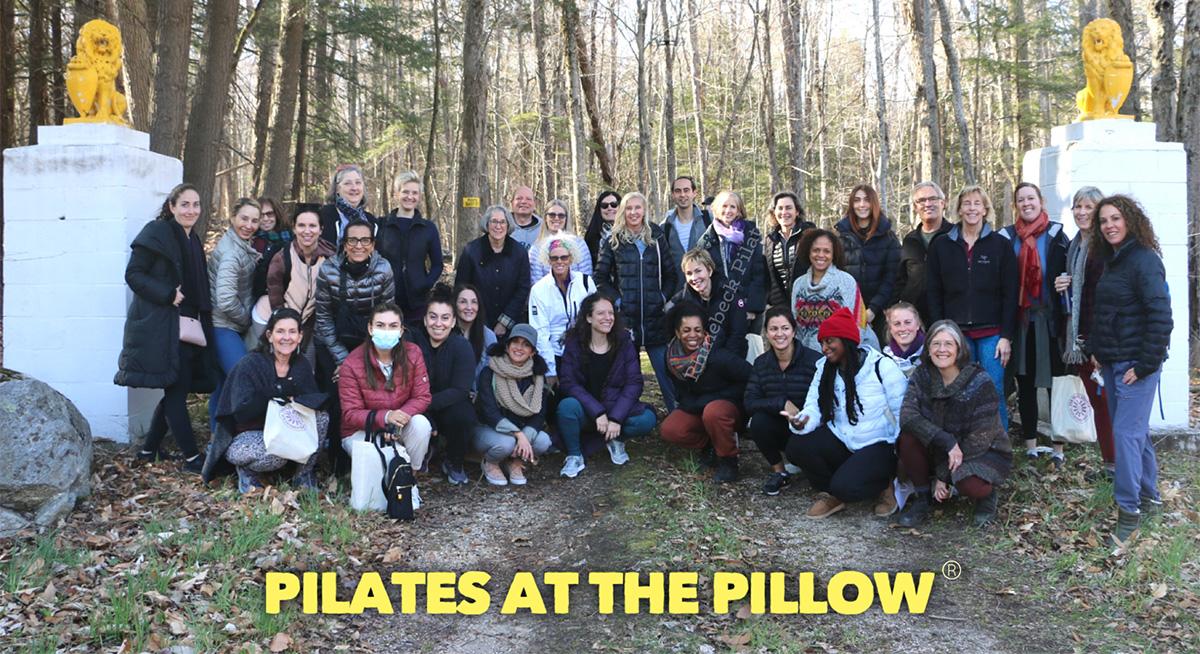 Pilates at The Pillow® attendees from around the world gather between the original pillars that Joseph Pilates placed at the entrance of his driveway, currently preserved and maintained as part of Sean Gallagher’s Pilates Museum. ©Richtone Design Group LLC.
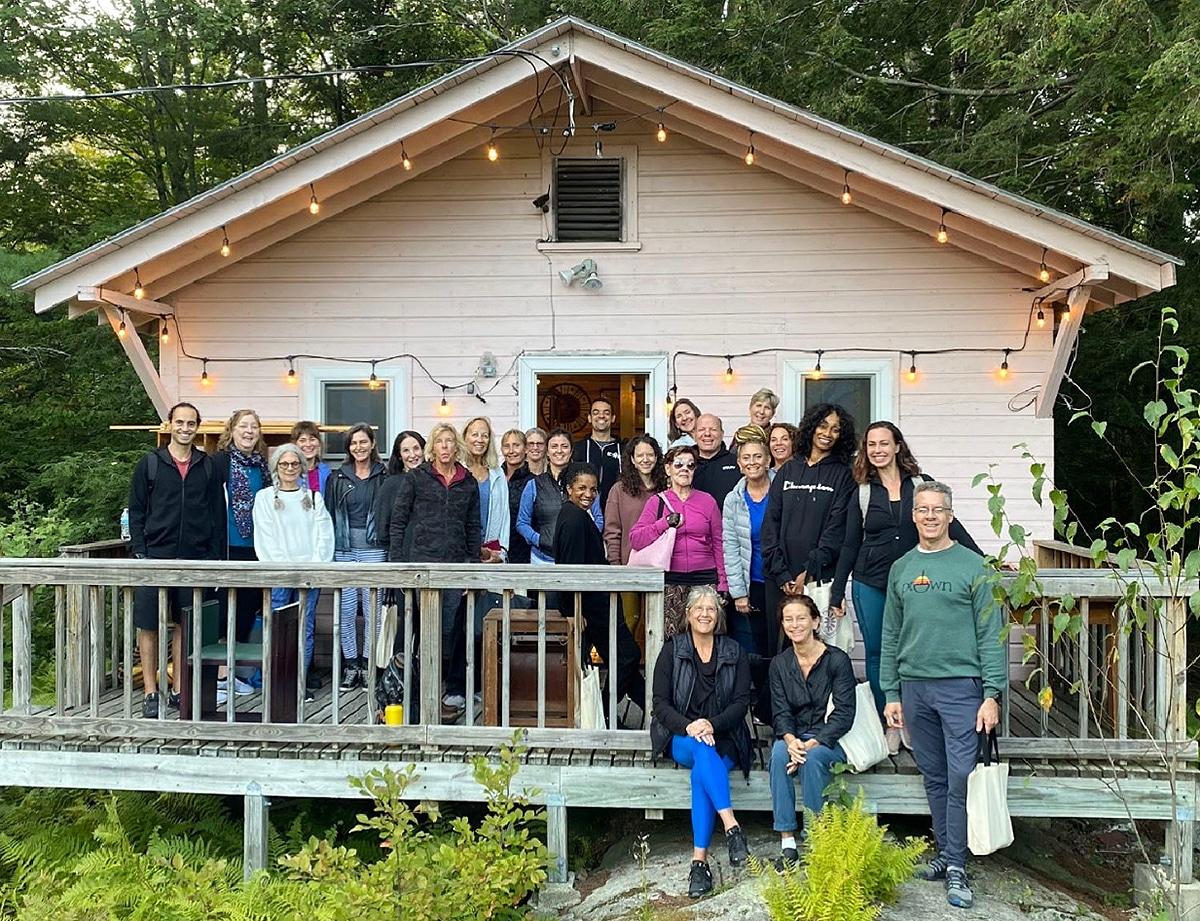 Pilates at The Pillow® attendees from around the world gather in front of Joe Pilates’ original Berkshires studio, now fully restored as Sean Gallagher’s Pilates Museum/Studio. ©Richtone Design Group LLC. Photo courtesy of Elaine Ewing from Rhinebeck Pilates.
Pilates at The Pillow® invited Carlino to speak at their September 2021 conference. Attendees were in tears from Carlino’s stories about coming home from the war and meeting Pilates. Eilaine Ewing, owner of Rhinebeck Pilates, said, “When he stood up out of his wheelchair and said that he could do that because of Joe Pilates, and his story about coming back from the war, people were really touched by that.”
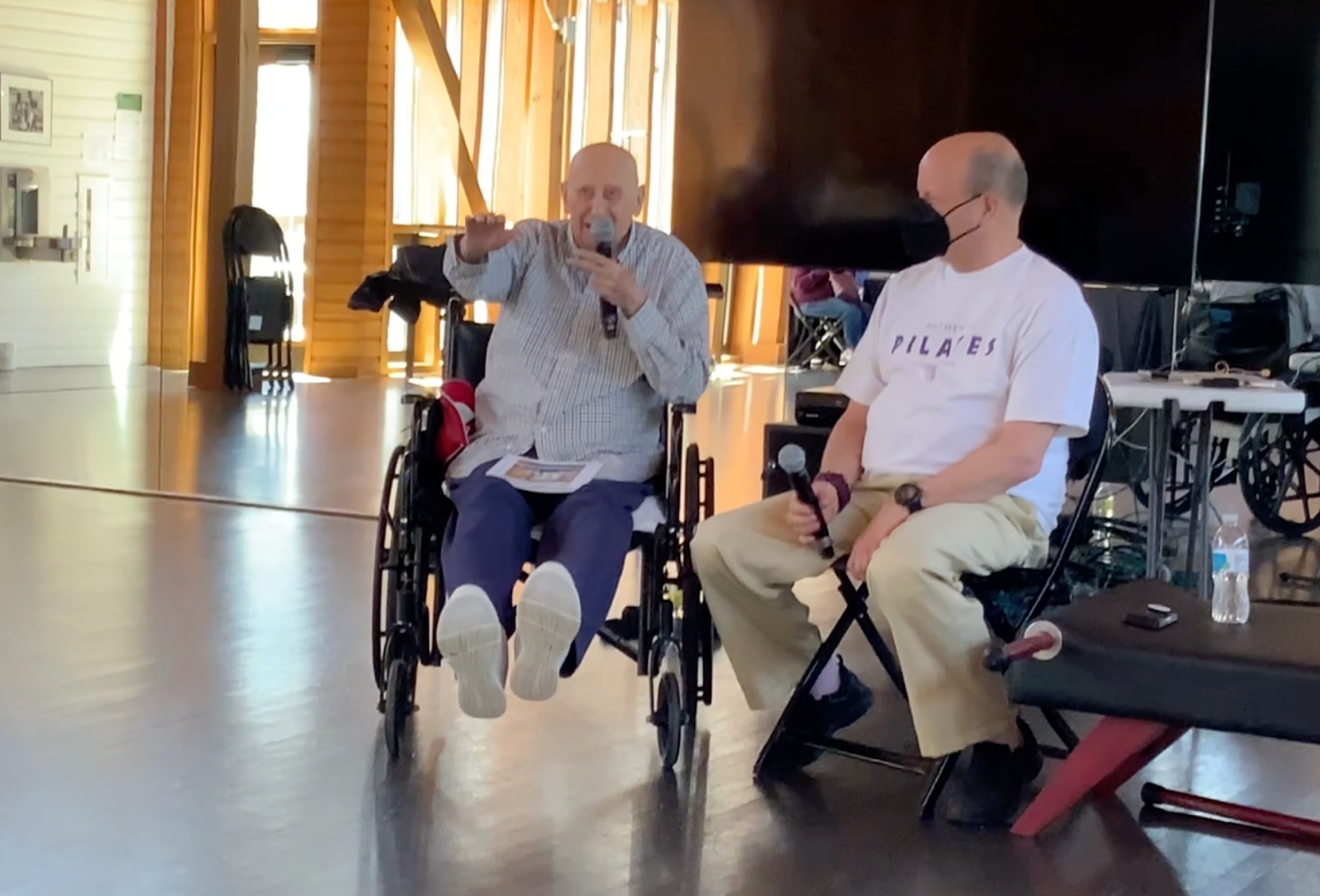 Tony Carlino being interviewed by Sean Gallagher at the 2021 Pilates at The Pillow® conference demonstrating how Joe Pilates instructed him to attempt the Teaser position upon their initial meeting. Screenshot of a video by Elaine Ewing and published with her permission.
Carlino returned to Pilates at The Pillow® in April 2022 to again tell a new generation of Pilates devotees what Joe Pilates was like as a person and as a trainer. Carlino died four months later on September 15, 2022, at the age of 96.
Pilates returns to Lee
Dr. Kerry McGinn, a doctor of physical therapy, opened Yoga Lee on January 20, 2024, at 62 Main Street, one building over from where the Return to Life Club met 70 years earlier. McGinn said, “We take a modern science-backed approach to movement and yoga. This means our flows are steeped in tradition and science—weaving together mind, body, and soul.”
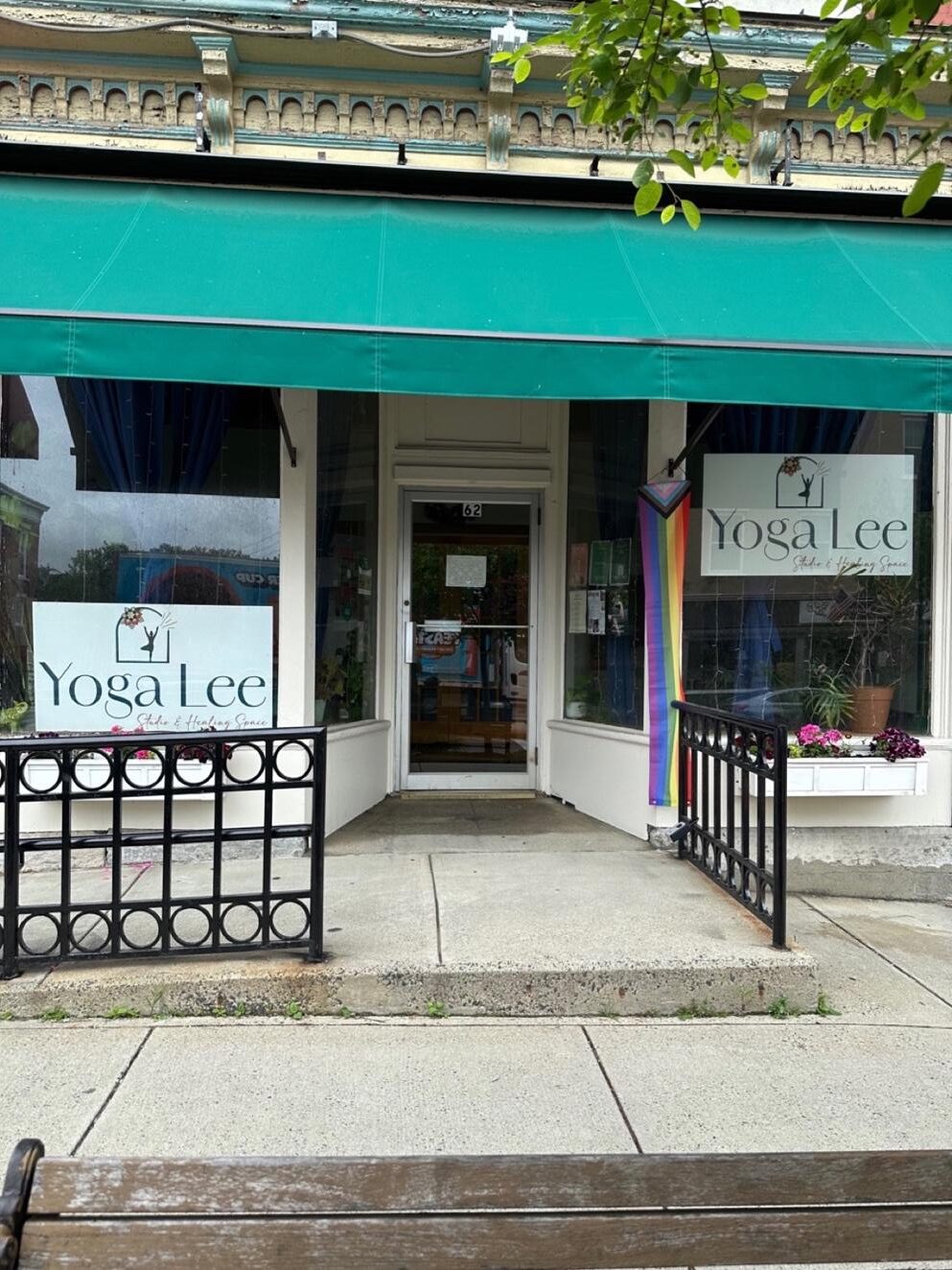 Yoga Lee storefront. Photo by Joshua D. Bloom, 2025.
Yoga Lee offers Pilates classes taught by Candace O’Neil Cihocki. “I came to Pilates as an actor/dancer in New York City as a way to recover from injury and maintain physical strength,” explained Cihocki. “My desire to teach Pilates came from an interest, as a director and choreographer, for a way to teach non-dancers (mostly actors but physically performers) how to use their core to help prevent injury, and to learn to listen to the subtle movements of their body to gain more physical awareness as they moved on stage.”
Cihocki shared how meaningful it is was to her to learn about the history of Joseph Pilates in Lee:
Today, I have found myself in Lee teaching mat Pilates just a few storefronts down from the former location of the Joseph Pilates’s ‘Return to Life’ Studio. …Knowing that I am down the street teaching Pilates in a community that has a history of Pilates feels full circle for me. As we, at Yoga Lee, are building a new community of Yoga, Pilates and movement lovers, I feel Joseph Pilates himself would be happy to know his legacy continues in a town he cared for. It also reminds me that no matter our backgrounds, we can all agree that Joseph Pilates’ methodology was something quite magical. It brought people together, and it continued even when their differences separated them.
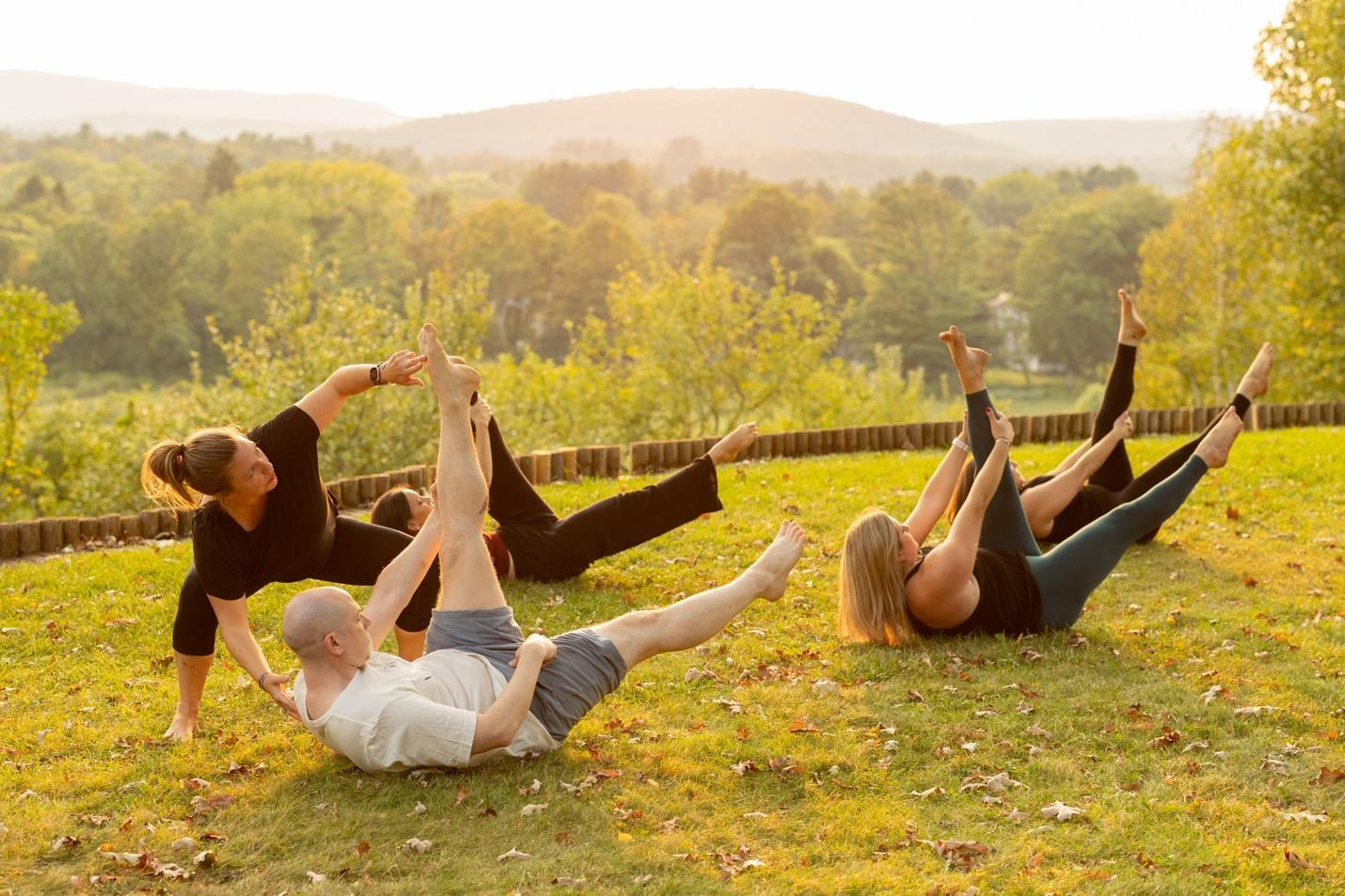 Candace O’Neil Cihocki teaching a Yoga Lee Pilates class at Naumkeag. Photo by Chelsea Proulx Photography, 2025.
Pilates’ legacy in Lee
Joseph Pilates’ time in the Berkshires revealed how physical culture could transcend the boundaries of stage performance and reshape everyday life. What began as a faculty position at Jacob’s Pillow evolved into a series of connections that brought Pilates into barbershops, clothing stores, and living rooms along Main Street. Through friendships with locals like George Allen, Tony Carlino, and Ben Slaminsky, Pilates’ exercises took root in the town of Lee, culminating in the creation of the Return to Life Club. Long before his method became an international fitness phenomenon, Pilates found a loyal following in this small corner of western Massachusetts, where discipline, camaraderie, and personal transformation came together. Seventy years later, that historical legacy carries on through a new generation of Pilates classes on Main Street.