
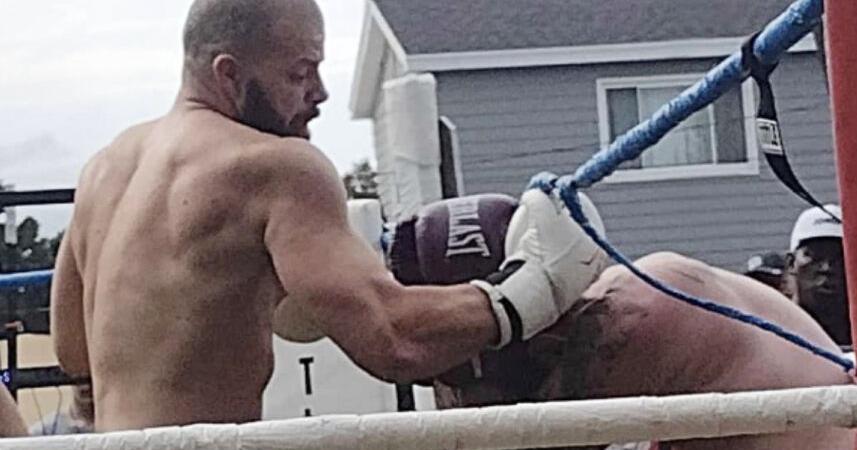
MENOMINEE — On paper, it sounds like trouble: hundreds of people crowded into a backyard, a homemade boxing ring and fighters from across the region trading punches for three brisk rounds.
In practice, Menominee’s informal “fight club” has quietly evolved into a six-year tradition of charity, community and personal redemption.
What began as a way to give friends “something to do” has grown into a grassroots event drawing 200 to 300 spectators and hundreds of volunteer fighters — all without an admission fee.
“This is our sixth year of doing it,” Organizer Tyler Mays said. “The crowd has gone up, it has gone from like 100 to … we get past 300 people in the backyard.”
The rules are simple but strict. It is boxing only — no mixed martial arts, no street-fight chaos.
“Just boxing … only a minute-and-a-half rounds, three rounds,” Mays said. “People can wear headgear if they like to and 12-16 ounce gloves.
Fights take place in a ring the group built themselves, backed by a large speaker system and a crew of volunteers.
Over six years, Mays estimates that around 500 fighters have climbed through the ropes, some traveling four hours or more to participate.
The location is no accident. The club operates on the Menominee side of the river, at 1721 13th Ave., because neighboring Marinette’s local codes are tighter.
“Marinette is a pretty strict town, they have their own ordinances so it only works in Menominee,” Mays said.
Despite the crowds and the work involved, there are no ticket sales. Instead, the event runs entirely on goodwill.
“We charge no admission, nothing and we actually cook food for everybody. We give free water out the whole event,” Mays said.
A single donation box sits out for those who want to help. Each fight night is dedicated to a local family or individual in crisis and every dollar in the box goes directly to them.
“We pick a family out and all the money that gets in that box goes right to the family.
The most recent fight, held June 27, raised $526 for a local two-year-old boy who is in the hospital with serious medical issues. Past events have brought in as much as $1,271 in one night, boosted by a $500 check from Waupaca Foundry, which has sponsored the club before.
Local businesses routinely donate supplies — cases of water, boxes of hot dogs and other basics to feed the crowd.
“People bring bottles of water for us every time people have donated boxes of hot dogs … random businesses around here ask how they can help out and donate to the fight club,” Mays said.
In a small town, a backyard full of fighters and spectators was bound to draw official attention. Early on, city leaders sent the issue to the State of Michigan for review.
“When there are 100 people in a backyard fighting each other, they were a little concerned and probably uncomfortable with it,” Mays recalled.
He said state officials warned they would investigate and charge him if anything was illegal, but after he responded in writing, the matter went quiet.
Mays bristles at the idea that the club is just about violence. He describes the ring as a place where people work through addiction, grief and personal challenges in a structured way.
“It is way deeper than what you might think on the surface,” Mays said. “It is helping people with their addictions, it is helping people that have lost family members come in and let some emotions out.”
He points to one older woman who initially refused to attend because she “just can’t do it” when it comes to watching people get punched.
“She came and watched one, and she was standing on top of her chair, screaming, ‘Go, go, go,’ and she now comes to every one now,” Mays said. “It is not just black eyes and bloody noses, it is disciplined and it is chess with your mind.”
Some fighters step into the ring to mark sobriety, others to process loss and still others to test skills honed over years of practice.
“If you have gotten sober, you can go and show it in the ring … people have had family members pass away and got in to let aggression out,” Mays said.
To minimize risk, organizers invite paramedics and first responders, require mouth guards and hand wraps and rely on a referee with Golden Gloves experience to stop bouts early if needed.
Between fundraising goals, safety concerns and logistics — from building the ring to lining up fighters — the event has essentially become a second job. Still Mays calls it “pretty much a hobby” built around boxing and community.
The club planned to march in the Marinette Logging & Heritage Festival parade Sunday, with volunteers walking together under its banner.
The next fight is tentatively set for Aug. 15, continuing a backyard tradition that has become one of Menominee’s unlikeliest engines of charity.
Get any of our free email newsletters — news headlines, obituaries, sports, and more.