
Breadcrumb Trail Links
Published Jul 19, 2025 • Last updated 6 minutes ago • 5 minute read
You can save this article by registering for free here. Or sign-in if you have an account.
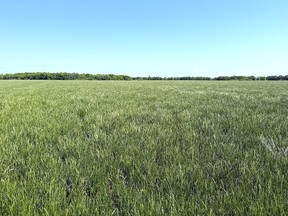 “We also contract some soybean seed and grow perennial ryegrass with Imperial Seed.” Photo by Harry Siemens /Winnipeg SunArticle content
Markets and crops go hand in hand, and yet the farmer depends on the crops and the markets. In today’s column, Walter Smith of Pilot Mound, MB, a seed grower and farmer, talks about this year’s crop and farming.
Advertisement 2
This advertisement has not loaded yet, but your article continues below.

THIS CONTENT IS RESERVED FOR SUBSCRIBERS ONLY
Subscribe now to read the latest news in your city and across Canada.
Exclusive columns by Ryan Stelter, Paul Friesen, Ted Wyman, Scott Billeck, Lorrie Goldstein, Warren Kinsella and others. Plus newsletters: Gimme Stelter for your beat on the city, The Exit Row for all your Jets news and On the Rocks for curling.Unlimited online access to Winnipeg Sun and 15 news sites with one account.Winnipeg Sun ePaper, an electronic replica of the print edition to view on any device, share and comment on.Daily puzzles, including the New York Times Crossword.Support local journalism.
SUBSCRIBE TO UNLOCK MORE ARTICLES
Subscribe now to read the latest news in your city and across Canada.
Exclusive columns by Ryan Stelter, Paul Friesen, Ted Wyman, Scott Billeck, Lorrie Goldstein, Warren Kinsella and others. Plus newsletters: Gimme Stelter for your beat on the city, The Exit Row for all your Jets news and On the Rocks for curling.Unlimited online access to Winnipeg Sun and 15 news sites with one account.Winnipeg Sun ePaper, an electronic replica of the print edition to view on any device, share and comment on.Daily puzzles, including the New York Times Crossword.Support local journalism.
REGISTER / SIGN IN TO UNLOCK MORE ARTICLES
Create an account or sign in to continue with your reading experience.
Access articles from across Canada with one account.Share your thoughts and join the conversation in the comments.Enjoy additional articles per month.Get email updates from your favourite authors.
THIS ARTICLE IS FREE TO READ REGISTER TO UNLOCK.
Create an account or sign in to continue with your reading experience.
Access articles from across Canada with one accountShare your thoughts and join the conversation in the commentsEnjoy additional articles per monthGet email updates from your favourite authorsSign In or Create an Account
or
Article content
Jonathon Driedger of LeftField Commodity Research in Winnipeg but lives with his family near Grunthal, MB, discusses the markets and the crops. As I said, they go hand in hand. I’ve watched crops for probably 75 years and the markets for more like 55 years, and it’s always interesting how one depends on the other. If we don’t have any crops, we don’t have any markets, and if we don’t have markets, we can’t establish the correct price.
Article content
Recommended Videos
Article content
 Jonathan Driedger: “In general, crops have improved compared to where we were in mid-June,” Driedger says. “There are still areas that are struggling, but overall, conditions have improved. If you’d looked at things a few weeks ago, they could have been much worse.” Photo by Harry Siemens /Winnipeg Sun
Smith knows that farming is as much about observation and patience as it is about hard work. This year’s growing season has had its ups and downs, but like any seasoned farmer, Smith takes it all in stride.
“The crops are generally looking good out here,” Smith says, although he adds that some areas are experiencing dryness, while others are slightly too wet. “We’ve got pockets of dryness and wetness, but overall, it’s not as bad as we feared,” he adds. Smith’s farm, which spans 12 miles east to west and approximately 8 miles north to south, experiences varying rainfall amounts, with sometimes a 4-inch difference between the wettest and driest parts of his land.
Advertisement 3
This advertisement has not loaded yet, but your article continues below.
Article content
“I’d say we’ve had around 6.5 inches of rain so far this year,” Smith says, noting that although it’s not a lot compared to some other areas, it’s certainly better than the dry spells that hit earlier in the season. Despite the challenges, Smith’s crops are growing well, especially his corn. “I was looking at the corn with my 10-year-old son last week, and in just under a week, it had grown about eight inches. That’s more growth than my son has had!” Smith laughs.
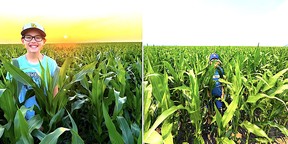 “We took a picture, and then a few days later, I took another one. The corn had grown about eight inches in just under a week — faster than my son was growing!” Photo by Harry Siemens /Winnipeg Sun
Smith grows Pioneer 72068 corn, a variety chosen for its ability to handle the region’s limited heat units. While many farmers in Manitoba are dealing with varying weather conditions, Smith is hopeful that his corn will continue to thrive. “We’re in fringe corn country here, but this variety does well with our cooler temperatures,” he explains.

The Winnipeg Sun’s Daily Headline News
Thanks for signing up!
Article content
Advertisement 4
This advertisement has not loaded yet, but your article continues below.
Article content
Smith’s farm also grows a variety of seed crops, including wheat, oats, barley, peas, and some soybean seed. He works with Imperial Seed on perennial ryegrass.
However, despite his optimism, Smith is aware that farming is a game of balance. “In this business, if you don’t get a strong yield, you won’t make any money,” Smith shares. “You need at least 75 to 80 bushels of wheat per acre to turn a profit. If we get 55 or 60 bushels, it’s going to be tough.”
The costs of farming are another major concern. “With high costs for fertilizer, fuel, machinery, and land, it’s more important than ever to manage your expenses,” Smith says. “Even if prices are good, if yields are low, the margins are tight.”
As the growing season progresses, market analyst Jonathon Driedger brings a broader perspective on the grain market. Driedger discusses how various factors, such as weather conditions, global trends, and crop yields, impact the prices farmers like Smith rely on to make their business decisions.
Advertisement 5
This advertisement has not loaded yet, but your article continues below.
Article content
Driedger acknowledges that this year’s crop conditions are varied, with some areas struggling with dryness, while others are seeing better results. “In general, crops have improved compared to where we were in mid-June,” Driedger says. “There are still areas that are struggling, but overall, conditions have improved. If you’d looked at things a few weeks ago, they could have been much worse.”
However, the weather remains unpredictable. One Manitoba farmer in the Langruth area, who experienced two inches of rain one evening, yet only a few neighbours received that same amount. “That’s just how thunderstorms work. Some areas receive the rain, while others don’t. It’s tough to get a clear picture of the situation when conditions vary so much in small areas,” Driedger explains.
Advertisement 6
This advertisement has not loaded yet, but your article continues below.
Article content
This unpredictability is something farmers like Smith deal with every year. The inconsistency in rainfall can make or break a crop, making it challenging to plan for. Driedger agrees, noting that the weather has always been a wild card in agriculture. “Sometimes, even just a few miles away, the conditions can be drastically different,” he says. “It’s all about navigating those variables.”
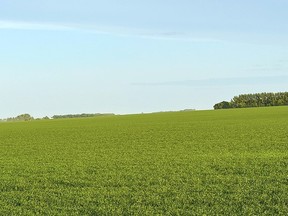 While market conditions for the fall are uncertain, it’s important to stay sharp. “We may not make much, but with careful planning, we can avoid losing money. If we were getting 50 or 60 bushels of wheat, we’d probably be losing money. But if we get 75 bushels, we should be okay.” Photo by Harry Siemens /Winnipeg Sun
Examining the markets, Driedger emphasizes that pricing remains volatile, and farmers need strong yields to maintain their profitability. If a farmer gets 55 or 60 bushels per acre of wheat, they probably are not going to make money. The farmer needs 75 to 80 bushels per acre to cover costs and make a profit. Even with wheat prices hovering around $7 to $8 per bushel, the rising costs of farming have made it harder to turn a substantial profit. “Costs have gone up across the board — fertilizer, machinery, land, interest rates. It’s not just about the price you get for the crop; it’s about the margin,” Driedger adds.
Advertisement 7
This advertisement has not loaded yet, but your article continues below.
Article content
He also highlights that farmers who can store their grain and wait for prices to improve post-harvest will likely fare better. “If you can wait and avoid selling during the harvest rush, you might see prices improve later on,” he says. “But it’s not always possible for every farm to store their grain.”
Forward selling is another tool that can help farmers manage risks, though Driedger notes that it’s not for everyone. “Forward pricing can help manage risk, but it’s not without challenges,” he says. “Some farmers are more comfortable using hedging tools like futures and options to lock in prices, while others prefer to wait and see how the market develops.”
Both Smith and Driedger emphasize the interconnectedness of crops and markets. “At the end of the day, it’s all about margins,” Smith says. “You can’t just look at crop prices without considering how much it costs to grow that crop. If we don’t get good yields, even high prices might not be enough to cover costs.”
Advertisement 8
This advertisement has not loaded yet, but your article continues below.
Article content
Driedger agrees, stressing that prices and crop conditions are linked. “Markets are influenced by what’s happening in the field,” he says. “Good crops can lead to better prices, and bad crops can put downward pressure on prices.”
For Smith, navigating this delicate balance is a part of everyday life on the farm. “If we can get good yields and manage our costs, we can make a living. If not, we have to adjust.”
 Walter Smith: Quality Seed is my passion. Your success starts with your seed. Let’s talk about that. Farming in South Central Manitoba. Photo by Harry Siemens /Winnipeg Sun
As the growing season continues and harvest approaches, the relationship between crops and markets remains a crucial factor for farmers like Smith and analysts like Driedger. Both agree that staying informed, managing risks, and adapting to changing conditions are key to success in this ever-evolving industry.
— Harry Siemens is a farm journalist, podcaster, speaker, writer and communicator, and a guest writer for the Winnipeg Sun.
Have thoughts on what’s going on in Winnipeg, Manitoba, Canada, or across the world? Send us a letter to the editor at wpgsun.letters@kleinmedia.ca
Article content
Share this article in your social network