
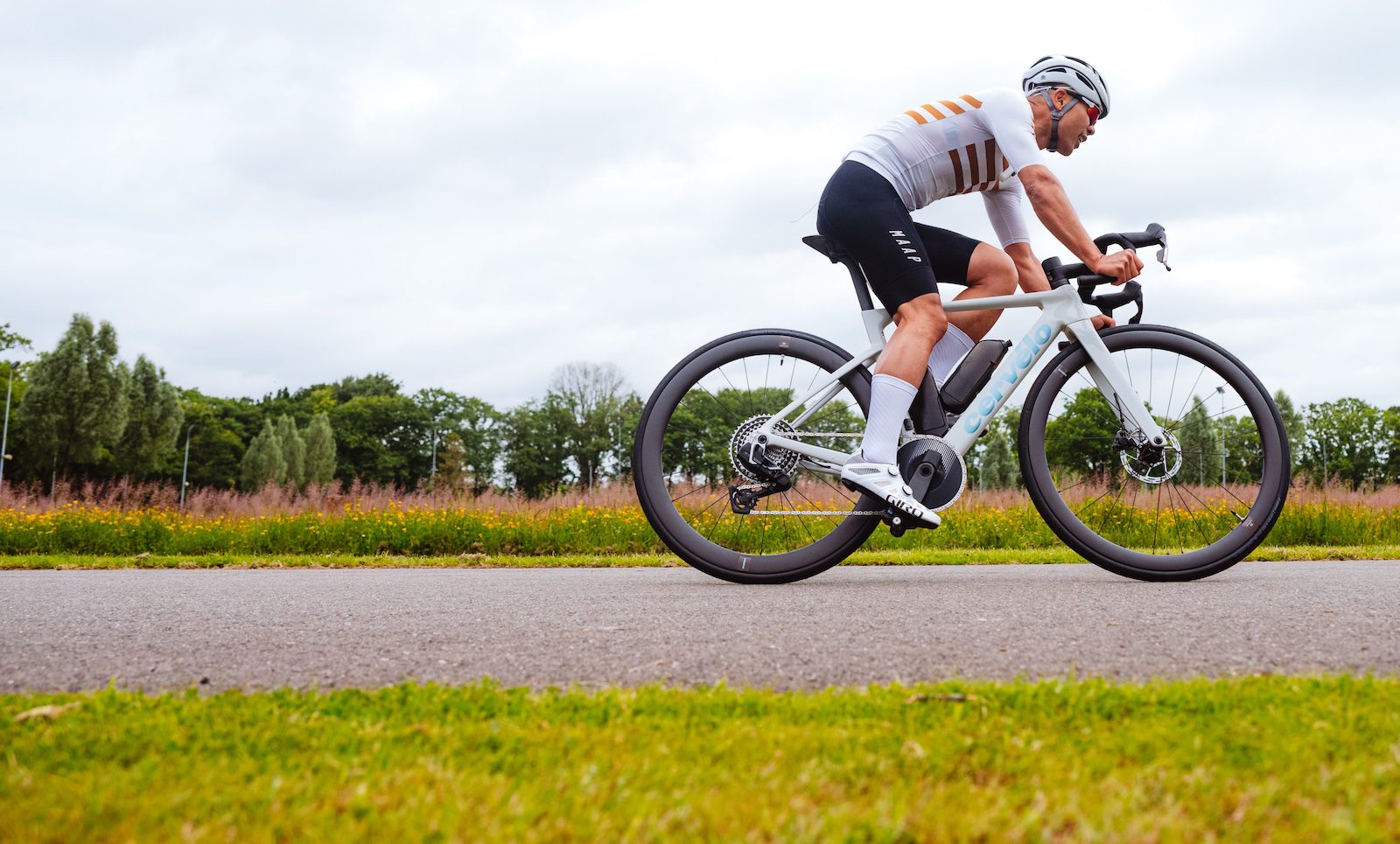
When Cervélo revived the Soloist four years ago, their partnership with Visma Lease A Bike (then Jumbo Visma) had just started, too late to have much influence on the development of that Soloist, which was very much positioned as a race bike for amateur racers rather than for the Pros. Four years later, Cervélo’s partnership with Visma LAB has matured and deepened, and the Soloist has been revamped accordingly. While it remains positioned between the aero S5 and lightweight R5, the latest Soloist is much more attuned to the needs and wants of the Pros of Visma LAB. But the target rider of the new Soloist is still not Jonas Vingegaard or Pauline Ferrand-Prévot of the elite teams, but the riders on the development squad, riders like recently crowned U.S. U23 National Road champion Ashlin Barry.
 At a quick glance, it would be easy to miss this is the new Cervelo Soloist, but almost every tube has been subltly reshaped. Except for the seatpost shape, it’s a clean sheet redesign. Image: Courtesy Cervélo
According to Jenco Drost, Visma LAB’s head of Performance Equipment, the reasons to give the development squad the Soloist, rather than the S-series are both practical and philosophical. “We have the development team currently running the bike, and there we make really a specific choice. We want them on a bike which they ride every year to be an all rounder. For the world tour team, we have an S5 and R5 to choose from, we have quite a range of wheel sets, and we try to pick the right setup for every stage. For the development team, we also try to pick a little bit, but we just do not have the time or let’s say the manpower to do the same. And further, we also do not want them to ride the best set up in every case because they also still need to develop. If you give them an S5 with the ultimate fastest setup when he’s 15, then when he’s 20, you cannot give them anymore. So it’s also a philosophy of the team to get them a really good setup but not change them every day, and I think with the Soloist we give them an all-round bike which is super fast in the sprint, but also good on the climb.”
“Faster and lighter, but faster is more important.”
At a glance, the new Soloist looks very similar to the outgoing model. So much so that the development squad raced it successfully at the Giro Next Gen ahead of the official launch without anyone noticing. Despite appearances, just about every tube has been scrutinized and reshaped.
“When the project first started for the Soloist, I asked Jenco what the bike needed to be like?” recalled Terry Best, Cervélo’s Road Product manager, his answer was “faster and lighter, but faster is more important.” Translation, the bike needed to improve aerodynamically.
 Different options were ran through CFD simulations, with the most promising few tested at the wind tunnel to find the optimal solution. Image: Courtesy Cervélo
“They needed more speed out of the bike, that was part of the reason why we invested heavily a good number of wind tunnel sessions for this bike, a lot of CFD work. The ride dynamics of the current Soloist were good, they just wanted more speed out of the bike.”
Towards that end, the Soloist received new head tube and fork crown shaping, bigger bottom bracket junction, sculpted and lowered seat stay and seat tube junction. The front end in particular has been extensively reworked, with a deeper and narrower head tube and fork blades, made possible with an “hourglass” steerer that kept as narrow a profile as possible while still allowing routing of brake hoses. “Leading edge of the bike is very important aerodynamically, so we tried to skinny it up as much as possible” lead engineer Anton Petrov explained, “Aerodynamic is pretty simple sometimes, you just want to minimize frontal area”
 In pursuit of the narrowest frontal area possible, the fork steerer pinches in the middle into an “houglass” shape to provide space for brake hose routing. Image: Courtesy Cervélo
As a result of all that careful CFD work and tunnel testing, Cervélo claims their wind tunnel test shows the new Soloist saves 8.6w over the previous model, at a tested speed of 48km/h.
To ensure the hard won drag improvement is not lost once water bottles are in place, Cervélo have designed aero water bottles made to work in concert with the Soloist frame. Unlike other brands which claim improved aero performance with aero bottles, Cervélo maintains a bare frame is still the fastest configuration for the Soloist, but the aero bottles only cost two watts, while round bottles will add 6.3w of drag to the bike. The cages are compatible with standard round bottles, and will also work on other models of Cervélo, including ones with down tube storage like the Aspero-5.
Shaving weight from the aero gains
While aero improvement was the primary goal, Drost and Visma LAB also wanted less weight for when the road tilts up. “The one downside of improving aero is that typically means increasing surface area, increasing chord length, which means increased weight,” explained Petrov, “however we were able to save weight by improving lay up and using more expensive carbon.” Essentially, Best elaborated “we said let’s spend a bit more on how we put the frame together.” The improved layup and construction means the new frame and fork saves approximately 133g over the outgoing model.
 The one piece cockpit saves weight and drag over the previous separate bar and stem set up. It looks slick but come at the expense of easy adjustment. Image: Courtesy Cervélo
Best and Petrov found further savings by borrowing the one piece carbon HB18 handlebar and stem from the R5, specing it throughout the new Soloist line up, all the way down to the Rival build. The one piece HB18 saves another 134g compared to the separate aluminum bar and stem on the previous Soloist, and shaves a further 5.8w of aero drag. Unfortunately the move to one piece bars will limit adjustability, a strong suit of the previous Soloist. The decision to spec this bar also means the new Soloist is electronic drivetrains only, which is not unusual for the high end road market, but it is a design decision that signals the new Soloist has move further away from the privateer racer towards pro team needs. Whether this matters to you will be highly individual.
Geometry is another feature shared with the R5, small tweaks to the Soloist’s geometry brings it inline with the R5. This was a request from Visma LAB, to facilitate easy swaps for their riders between bikes, should they want to ride the new Soloist, for a wet Roubaix for example.
Attention to details FTW
For all the talk of aero and weight savings, the handful of watts saved at 48 Km/h or the couple hundred grams of weight reduction won’t matter in any meaningful way to most of us. Where the new Soloist distinguishes itself from its predecessor and competitors, is by getting all the small things right. Forget aero and weight savings, it’s clear Cervelo sweated the details when specing the new Soloist.
 My test bike showcases a SRAM XPLR 1x set up, made possible by the UDH dropout. There is clearance for 36mm tires front and rear. Image: Courtesy Cervélo
For instance, my size 51cm tester came equipped with 165mm cranks, 38cm bars, and 0 offset seat post, right on trend with the latest thinking in bike fit. If the stock one-piece bar doesn’t work for your fit, Cervelo is offering swaps of the HB18 bar/stem to owners of Soloist free of charge. You will be able to request new bars in a different size through your dealer. It’s still not as easy as a swap as the 2-piece bar and stem set up of the previous Soloist, but at least Cervélo is taking the rider’s fit into consideration, and offering fit customization, a welcome development in my book. For bikes from most brands, the bars that are spec are the ones you are stuck with, if you need a different size, it will come out of your pocket. The one piece bar stem does look undeniably clean, and offers decent weight savings.
Wheels is another area that highlights Best and Cervelo’s thoughtfulness when it comes to speccing out the Soloist. The Reserve 42/49 wheels feature wide 25mm internal, that pairs perfectly with the 29mm wide rim variant Vittoria Corsa N.ext tires, forming a smooth transition from tire to rim, without any airflow disrupting light bulb shape. Should you want to go bigger, the new Soloist is officially rated to accept up to 36mm, which means Soloist owners will be able to take advantage of the new larger sizes of popular race tires like Continental’s GP5000 and Pirelli’s P Zero Race TLR RS, both of which were recently released in 35mm sizes. A progressive and possibly future-proofing move at a time when many newly released race bikes are still limited to 32mm clearance.
Another forward looking move is the switch to UDH, combined with a removable front derailleur hanger means the new Soloist is ready for 1x set ups, as my test bike was set up with. Even the seat post clamp cover is one of the best executions I’ve come across. Most rubber covers in this area are an afterthought with a loose sloppy fit, not so the Soloist. It sits tightly in its recess, and fit flush with the frame. It’s a little thing, but is a good example of the fit and finish of the new Soloist and the care that went into the design.
 The flush seatpost clamp cover is a minor detail, but it shows Cervelo sweated the small stuff. Image: Courtesy Cervélo
All models of the new Soloist will also be equipped with power meters as stock, a clear nod to performance minded riders that’s always been the target audience of the Soloist. Making it one of the best specced and feature rich line up of race bikes that I’ve come across recently. Unfortunately, all of the added features and performance upgrade means notable price increase over the previous generation’s equivalent counterparts.
First ride impression of the Soloist
The previous Cervélo Soloist was a bike that I quite liked, I found its handling to be direct and offer a level of versatility and livability that was ahead of its time. With only two short rides at the launch event and one slightly longer ride at home on the new Soloist, just over a handful of hours on the bike, it is too soon for me to render a verdict on this new iteration. But so far, I’ve found the latest version to offer that familiar handling, the directness that translates my intention clearly into where the bike goes. The Reserve wheels and Vittoria tires are well matched to the Soloist, a highlight just like in the previous version.
 Image: Courtesy Cervélo
The progressive touch points of narrow bars and short cranks is a big plus for me, and goes a long way toward ensuring I feel at home aboard this new Soloist.
I reserve judgement on the aero bottles. I hated them on the first rides at the launch event, I wanted to “launch” them into the road side. But I got more used to them on subsequent rides, still not as second nature as regular round bottles, but I suppose it takes more than a few rides to overcome years of muscle memory and habits. The same can’t be said for for the stock Fizik Arione saddle, which I didn’t jive with on the rides at the launch event and replaced with one of my go to as soon as the test bike arrived.
The previous Cervélo Soloist was a worthy heir to the lineage, I am looking forward to taking this latest version of the storied bike in Cervélo’s line up to see how it measures up. With the changes to suit the requests of the riders of Visma Lease A Bike, is the Soloist still a good bike for us amateur riders? Watch this space to find out.
Prices for 2026 Cervélo Soloist Models
Model
Canadian Price
Soloist RED AXS
$15,500
Soloist Force XPLR AXS
$11,000
Soloist Force AXS
$11,000
Soloist Ultegra Di2
$10,750
Soloist Rival AXS
$8,500
Soloist Frameset
$5,000
The Cervélo Soloist is available now at Cervélo dealers. More at cervelo.com