
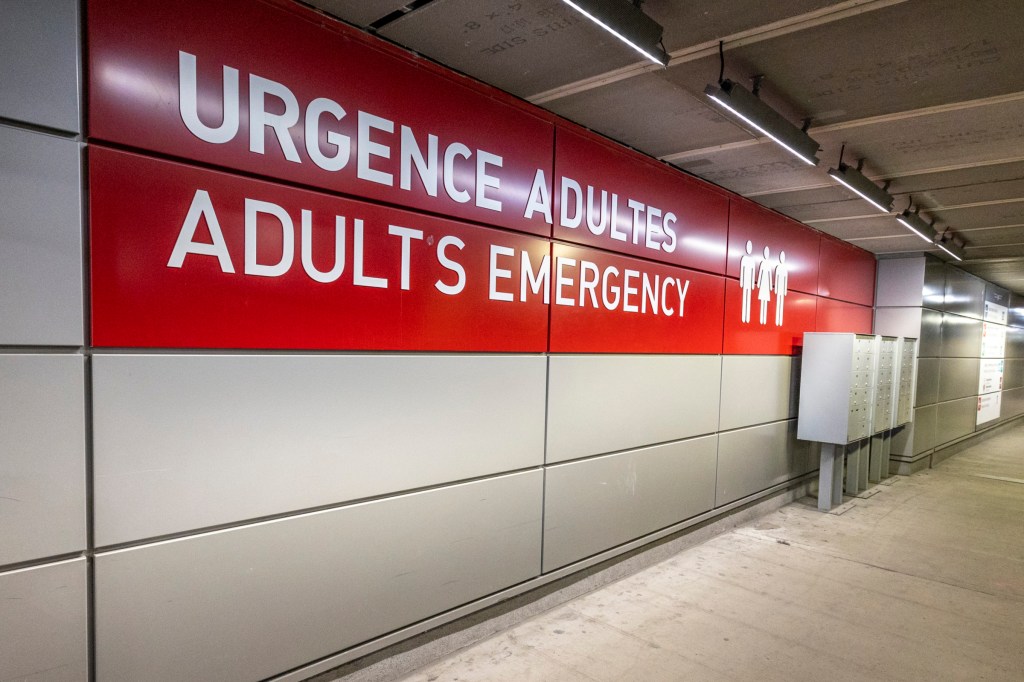
Montreal ERs continue to grow increasingly crowded, with the average stretcher occupancy rate reaching 141 per cent, and ER wait times averaging at five hours as of Monday.
Three of the city’s English-language hospitals are the hardest hit, with the Jewish General Hospital at 211 per cent, Royal Victoria Hospital at 218 per cent, and Lakeshore General Hospital at 219 per cent. The Montreal General Hospital was at 168 per cent on Monday.
While Quebec’s ERs have suffered overcrowding and long wait times for several years, occupancy rates reaching even 140 or 150 per cent is “unusual” for this time of the season, according to Dr. Guillaume Lacombe, a physician working in the ER at the Centre hospitalier régional de Lanaudière.
“It’s summer, so a lot of the clinics have reduced hours, or there’s holidays. It’s not only the doctors, but you know the nurses and all the physical therapists and all the clinics. So it might be a bit harder for a lot of patients to access primary care. That’s why they resort to emergency,” Lacombe said in an interview.
“We’re already in a situation where we have barely enough staff to take care of everyone,” he added, which can add pressure during the summer holiday season. On top of that, several hospital ERs in Montreal have seen patients suffering from heat-related illnesses, Lacombe said.
According to MUHC emergency doctor Greg Clark, over the last two to three years at the Royal Victoria Hospital, the occupancy rate has been “consistently above 200 most days of the year.”
“We’re frustrated. Emergency doctors are frustrated; they can’t help as many people because of system problems. The nurses and support workers, patient attendants and coordinators are all still frustrated because we want to help,” he said in an interview. “We’re handcuffed with our current system.”
He noted the ER congestion makes it harder for doctors to see new patients, since admitted patients are not being moved quickly enough to the correct ward or department, putting extra pressure on the front-line doctors and healthcare workers.
“We have what we call boarding, which means admitted patients have prolonged stays in the emergency department. Why that affects us is that means that not only are we taking on the new patients that are arriving, we’re also dealing with patients that should be in another part of the hospital.”
MUHC spokesperson Evelyne Dufresne said the sustained pressure in its emergency departments are due to a combination of factors, “including seasonal viruses, an increase in trauma-related cases during the summer months, heat-related illnesses and the summer vacation period,” she wrote in an email statement. She noted many hospitals across the province suffer from similar issues.
Santé Québec Ouest-de-l’Île-de-Montréal, the network that includes Lakeshore General Hospital, echoed the MUHC. “Although extreme heat waves may lead to an increase in visits related to dehydration or heat-related illnesses, wait times are influenced by several factors, including patient volume, case complexity, the availability of hospital beds, and the diagnostic tests required,” a spokesperson wrote in a statement.
The Royal Victoria’s 218 per cent occupancy rate is “not normal for the summer,” said president of the MUHC’s users’ committee Pierre Hurteau.
“(People) are always saying, ‘Ah, the problem is that there’s so many people there in the ER that should not be there. That’s why there’s a problem.’” But he said that hasn’t been true in recent weeks at the MUHC, noting he’s seen many seniors in the emergency department who appeared seriously ill and require emergency care, and belong at the hospital rather than a clinic.
“I don’t see what a family doctor can do in that case.”
Compared to this time last year, the average wait in the ER before being assigned a bed in a hospital ward has also climbed. In late June 2025, the average wait was 22 hours. As of late June 2026, the average wait is 23.5 hours. In that same time period, the wait time to see a doctor for priority-level patients has jumped from two hours and 21 minutes to two hours and 35 minutes.
For non-urgent health issues, the MUHC and the Santé Québec West-Central Montreal Health and Social Services University Network representing the Jewish General Hospital encourage patients to call Info-Santé 811 for advice on the most appropriate resource, which could be a family physician, a pharmacist, a walk-in clinic, or the GAP (Guichet d’accès à la première ligne).

Leora Schertzer is a reporter at the Montreal Gazette who thrives on the chase. Whether it’s producing a documentary about sewage or investigating a Nazi gold scandal, it’s the novelty and adrenaline that keep her in this challenging industry. Send her tips at lschertzer@postmedia.com.
lschertzer@postmedia.com
Editor’s Picks