

Listen to this article
Estimated 4 minutes
The audio version of this article is generated by AI-based technology. Mispronunciations can occur. We are working with our partners to continually review and improve the results.
What started with a call about an injured adult swan a couple of weeks prior spiralled into a series of calls to the Thunderbird Raptor Rescue in Thunder Bay, Ont., to care for eight orphan baby swans, or cygnets, found across northwestern Ontario.
“Having a swan is new for me because, as most people know, I do raptors and I do try to help out with other situations as I can, but I do not have my federal permit as of yet,” said Jenn Salo, the city’s authorized wildlife custodian, who noted that she was working on getting the permit.
With the aid of North Star Air and Canadian Wings of Rescue, an affiliated organization, the adult swan and, later, most of the cygnets were flown into the city from Sioux Lookout, Dryden and Fort Frances.
“It was super stressful for me to try to keep these things alive and I was pretty much on swan babysitting duty 24/7 to make sure that they were okay, that they stayed out of danger, that they didn’t get hurt (and) that they were eating enough,” Salo said.
Unlike raptors, which she says are pretty straightforward to feed, Salo explained that the swans needed pond vegetation, proper vitamins and not too much protein.
However, with the loss of the adult swan and three of the cygnets to an unidentified illness, the rescue decided to transport the remaining five cygnets south, directly to Trumpeter Swan Conservation Ontario for specialized care, rather than Shades of Hope Wildlife Refuge, as originally planned.
Salo said she felt confident they would get the “best care possible” at a place experienced specifically in swans.
“There’s obviously something going on with the swans if there’s orphaned babies everywhere,” Salo said.
It may be normal to find one or two swans here and there over the years, Salo said, but having a group of cygnets and an adult swan succumb to illness was “very strange.”
While she suspected West Nile Virus was the cause of the illness, since one cygnet from Dryden developed neurological issues and had to be euthanized, Salo could not confirm it because she was not familiar with how it presents in waterfowl, as opposed to raptors.
Until the rescue can test some of the dead swans, she said, they will not know the cause.
A “big brood of cygnets over the summer”
“A lot of times with neurological issues, as she described to me, unfortunately, a necropsy, there isn’t really a specific cause found,” said Kyna Intini, who volunteers as a licensed wildlife rehabilitator for Trumpeter Swan Conservation Ontario.
Nonetheless, Intini — also the charity’s master bander for its banding and tagging program — said the cygnets that made it down to the charity seemed to be currently doing “pretty good.”
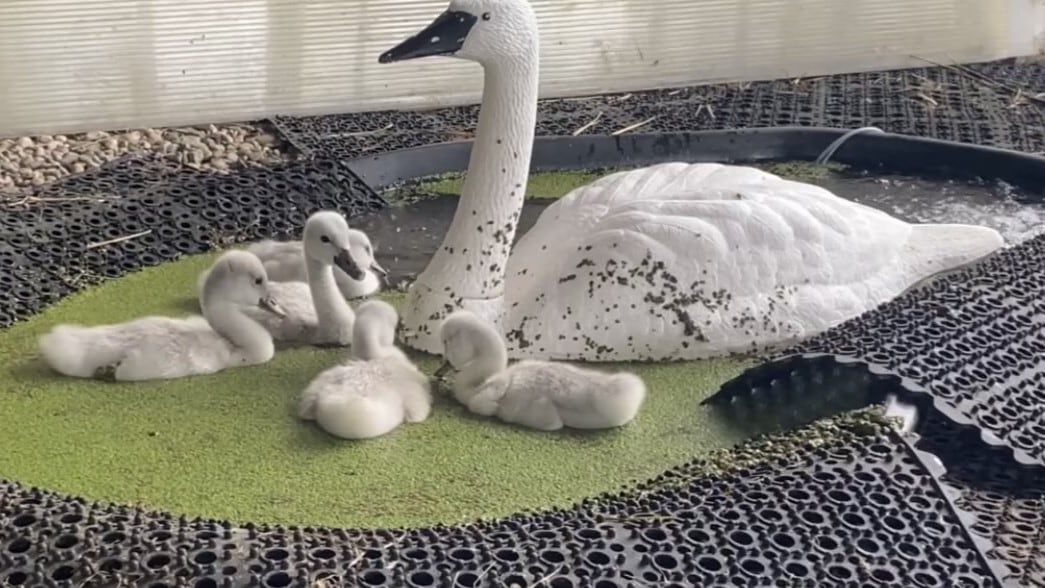 The remaining five cygnets swim with an artificial adult swan at the Trumpeter Swan Conservation Ontario. (Courtesy of Kyna Intini, who volunteers as a licensed wildlife rehabilitator for Trumpeter Swan Conservation Ontario.)
“They are a little bit behind a lot of our broods down here around (the) Lake Ontario area,” Intini said.
Eventually, she said they will be released back into the wild once they’re ready to fly, usually in the fall, around the end of September and into October.
“It’s a common summer occurrence for me that I have cygnets, that I raise them and then I release them. So that’s not too much different, but it is pretty cool that they were flown down from so far north,” Intini said, noting her slight excitement about their release.
Injured swans in the wild
For people who may find an injured swan, Salo encourages them to reach out to her rescue first before they start feeding it food that may not be species-appropriate and also not to put the swan with domestic animals, as they don’t know what is currently killing all the swans.
“If it is something like bird flu, then it is something that can pass on to a domestic fox. So we want to be very careful and conscientious when we find injured or orphaned wildlife because you don’t know what kind of viruses they could be carrying,” Salo said.
Contact the wildlife rehabilitator at the nearest location, Salo said, so they can try to get the animal to the proper centre it needs to go.