
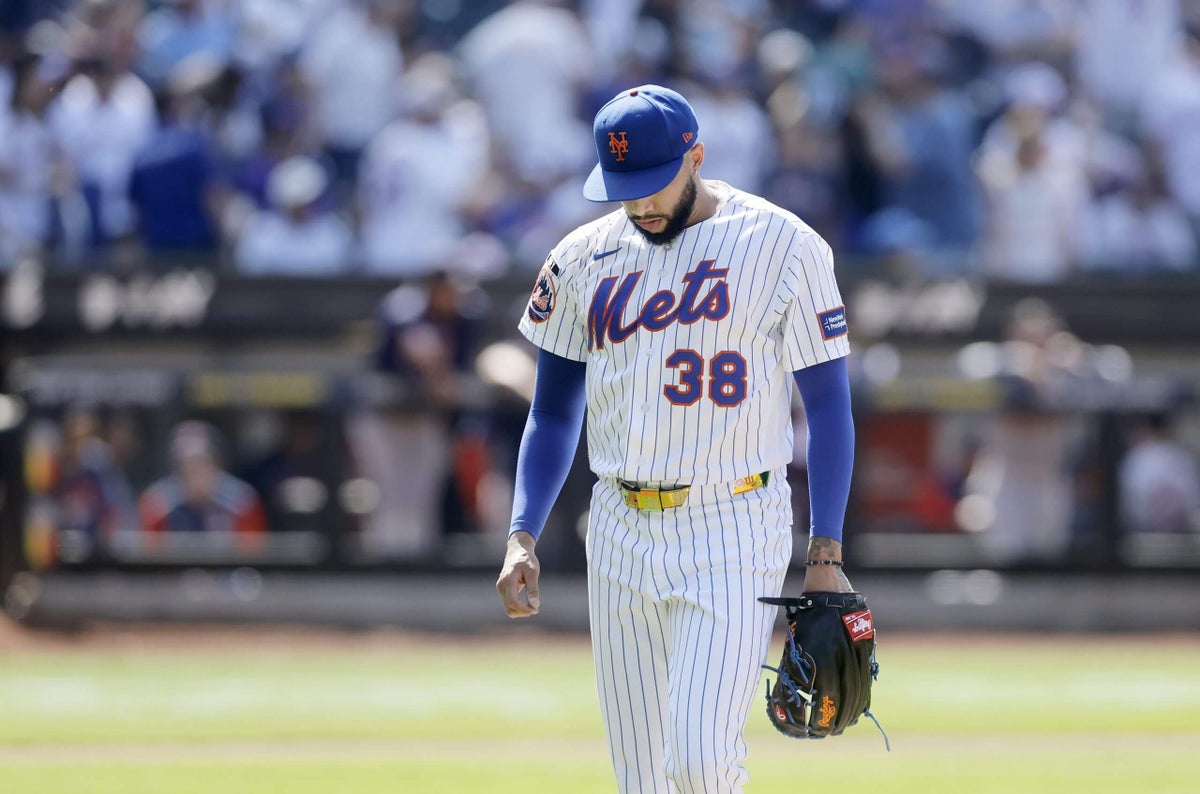
NEW YORK — On Sunday, after a blown save, thanks to a bad error, closed out the New York Mets’ nightmarish first half, closer Devin Williams was asked what he’d do over the All-Star break to get a mental reset.
“Anything but this,” he said without hesitation.
“Anything but this” might as well be the motto for the Mets’ second half — anything but what befell them through a first half in which nothing went according to plan.
A team expected to contend not just for the National League East but for the National League pennant instead finds itself deep in last place, an obvious seller ahead of the Aug. 3 trade deadline. President of baseball operations David Stearns’ transformative offseason has been nearly an oh-fer, with almost every one of his new acquisitions underperforming and/or missing significant time with an injury.
Strangely, a disappointment of this magnitude only amplifies the importance of this second half for the Mets. Owner Steve Cohen has said he’s “extremely worried” about 2027, and the path back toward contention starts with what Stearns can acquire at the trade deadline and what New York shows over its final 65 games.
Here are the other key storylines facing the Mets after the All-Star break:
Who gets traded, and what comes back?
It isn’t just that the Mets will be sellers at this trade deadline. It’s that their status as sellers is explicitly clear this far ahead of the deadline. Even the extremely disappointing 2023 team entered the final week before the deadline with a prayer of contending.
That clarity can be beneficial. Preparing to sell at the deadline is more complex than preparing to buy, because it’s harder to know the ins and outs of other farm systems than your own. And the parity in the American League has limited the number of sellers for the moment, making this a better market for the Mets to peddle their wares.
The Mets have some chips to move. Freddy Peralta, A.J. Minter, Brooks Raley and Tyrone Taylor will be free agents at the end of the season. Clay Holmes has a player option he’ll almost certainly decline.
And then there are the guys under team control beyond 2026 who could move. Luke Weaver has been one of the sport’s best relievers this season, and Huascar Brazobán has been a valuable utility knife. The Mets could deal from their relative strength at catcher.
We’ve reported that the Mets are not thinking about need-for-need trades to acquire major-league talent at the deadline, and they aren’t worried about how any incoming prospects would fit their system’s needs or timeline. They just want the best prospects they can get.
MLB All-Star Futures Game recap
Keith Law
Who steps up on the pitching staff?
Since things went south for the Mets in the middle of the 2025 season, there has been one constant: The pitching staff has not been good enough. Stearns’ main job this winter will be dramatically improving the staff.
The possible trades mentioned above should start that process by opening legitimate opportunities for up-and-comers. Zach Thornton has pitched well in his three big-league appearances, and he should get enough chances in the second half to stake a claim to an Opening Day spot next season. Jonah Tong should get a more sustained look as well once the Mets trade a starter.
If the Mets move some combination of Minter, Raley, Weaver and Brazobán, they’ll create plenty of room for others in the pen. Joey Gerber, Jonathan Pintaro, Dylan Ross and perhaps a returning Dedniel Núñez could all get a head start on the competition for 2027.
Stearns will still need to add significantly to the staff this winter, though the quality and quantity of those additions will be determined by what happens over the next few months.
Do the veterans rebound in the lineup?
The dynamic surrounding the pitching staff is typical for a seller: You trade an established big leaguer and create an opportunity for someone who is not.
That’s not the case in New York’s lineup.
First off, the Mets probably don’t move any of their current starting nine; none are impending free agents. Second, it’s not like the Mets have open questions about A.J. Ewing and Carson Benge. The two rookies have been among their best players since the start of May.
The real questions surround New York’s veterans. Francisco Lindor’s first half went about as badly as it could. He didn’t hit when he played, and he spent two months on the injured list with a calf strain. Ditto Jorge Polanco, who missed even more time with heel soreness that he must manage the rest of the way. Marcus Semien’s first half didn’t go according to plan, and he’s on the IL now with a hip strain he hopes is to blame for those early struggles.
If the Mets’ veteran bats perform in the second half, it becomes easier to lean on them again for 2027 — while ensuring more robust backup plans given their injury histories. If they continue to struggle, however, Stearns and co. may need to make more serious changes to the position-player group.