
The provincial government in Alberta has launched an online reporting portal that critics are already calling a “bike lane snitch line,” inviting Albertans to anecdotally complain about cycling infrastructure they believe is causing all the problems in their communities.
The new website, which went live on July 15, asks users to identify bike lanes they think should be reviewed. People filing a report can choose from a list of concerns including reduced parking, increased traffic congestion, taxpayer costs, reduced access for businesses or homes, and bike lanes they believe are underused.
Of course, offering support for bike lanes is not quite as easy as a drop-down menu of complaints, says Bike Edmonton President Keith Heslinga.
“One of the things they do is launch this snitch line where your only options are all the reasons you don’t like bike lanes. There’s no way for people who support bike lanes to have their opinions reflected in the form,” Heslinga says. “There’s only a pick list of things like, ‘There was no one in the bike lane,’ or, ‘It’s taken away my parking.’ If you want to talk about how good bike lanes are, or even ways to make them better, you have to fill out the long-form section.”
While the form does include an open-ended text box where users can write additional comments—including positive feedback—the structured questions focus exclusively on complaints. The province has also created a dedicated email address where Albertans can report bike lane concerns directly.
“There’s really low barriers to complaining, and high barriers for praising, and that’s intentional,” Heslinga adds.
To that end, Bike Edmonton and other advocacy groups are not only encouraging supporters of smart living by bicycle to use the long form, but are going a step beyond providing templates and guidance to make it easier.
What is frustrating to Heslinga and others is that those at the city level have elected pro-bike city councillors by a large margin. The provincial government surely knows that the decisions over streets and other municipal matters be made at the grassroots level where the outcomes are felt on the daily, not by, as Heslinga explains, a government made up primarily of rural politicians.
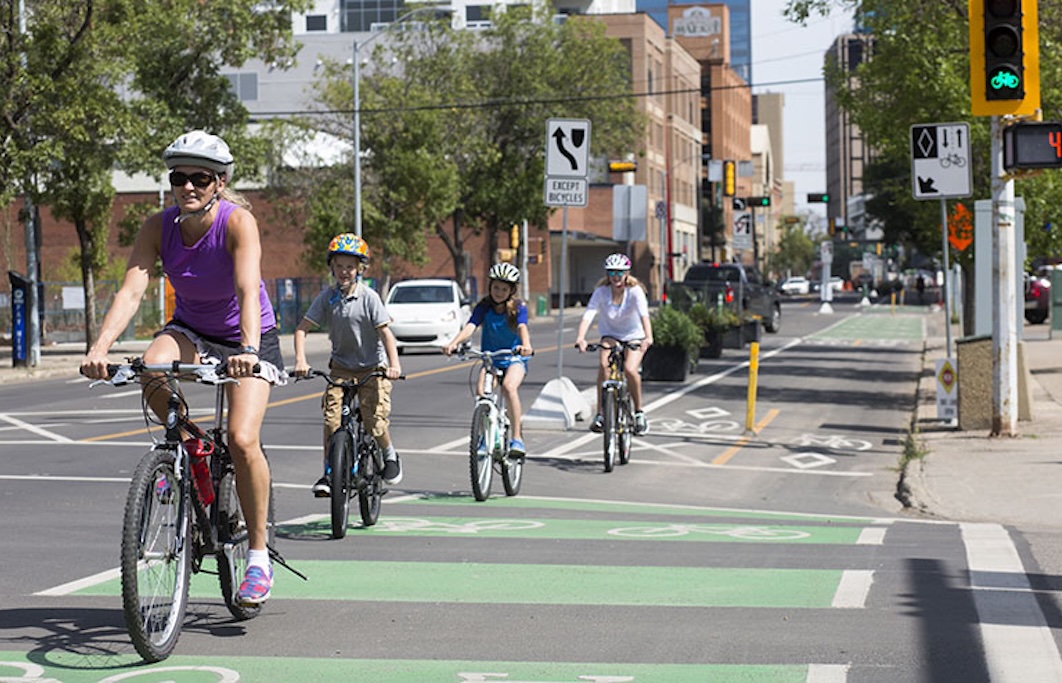
Triple A bike infrastructure design in Edmonton
“By and large, Edmontonians support where their council is going, and the province is just looking over here and saying, ‘I’m still going to step in,’” Heslinga says. “It’s incredibly frustrating. The province says, ‘Go elect your own people and decide how to design your streets,’ and then suddenly someone says, ‘Oh, I need to step in here.’”
According to Alberta Transportation Minister Devin Dreeshen, the submissions will help the province identify what he described as the province’s “most problematic” bike lanes and could influence legislation expected this fall that would give Alberta greater authority to review or remove cycling infrastructure.
The reporting portal is the latest move in Alberta’s increasingly public debate over cycling infrastructure.
Earlier this year, the provincial government announced plans to introduce legislation that would expand its oversight of municipal bike lane projects. The province has also asked Calgary and Edmonton to provide detailed information about how individual bike lanes affect traffic, businesses, emergency response times and surrounding neighbourhoods.
It’s a pattern that is repeating across the country with the pollutor commuter Ontario government led by Premier Doug Ford similarly attacking bike lanes with anecdotes instead of facts. And, in Montreal, where newly elected mayor Soraya Martinez Ferrada is slowly picking away at one of North America’s most bicycle friendly cities.
For Heslinga, it’s all about distracting from other issues.
“Bike lanes come up, and it’s a really easy way to make everyone start talking about something else,” Heslinga explains. “It’s the equivalent of throwing a dead cat on the table and saying, ‘Now we have to talk about the dead cat.’”
Several municipal leaders have argued that decisions about bike lanes should remain with cities rather than the provincial government.
In a CBC article, Calgary Ward 7 Councillor Myke Atkinson said local governments are best positioned to decide how residents travel safely, whether by bicycle, on foot, by transit or by car.
“No offence to someone who lives in rural Alberta or northern Alberta or Edmonton or Red Deer, but they don’t have anything to do with how people get around in the city of Calgary,” said Atkinson.
The new reporting portal is expected to remain open as Alberta prepares legislation this fall that could significantly reshape how bike lanes are approved—and potentially removed—across the province.
Visit Bike Edmonton’s reporting form here: