
Look up (and that’s not a movie reference).
A total solar eclipse will cloak the sky before sunset with perfect darkness across a mighty swath of Spain next month (whew, that sounds poetic). But while Spain gets the ultimate daytime blackout, Metro Vancouverites will unfortunately miss out.
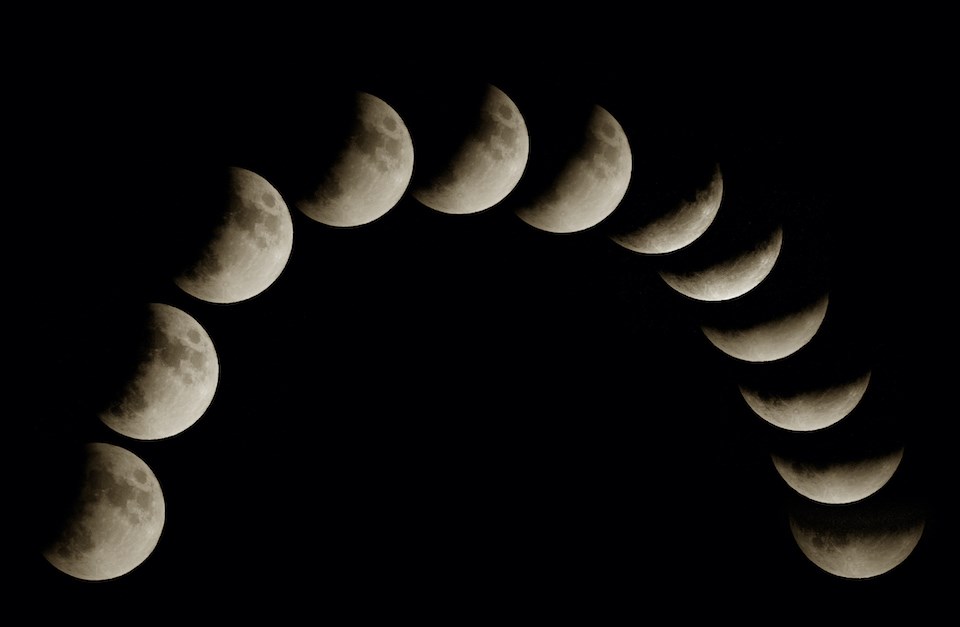
Instead, we will have to feel content with a lunar treat later on in August. While it won’t be a total lunar eclipse (of the heart), the Earth’s shadow will cover a whopping 93% of the moon, making it look almost completely blanketed.
And I know what you’re thinking: close only counts in horseshoes and hand grenades. But in this case, a nearly complete lunar eclipse looks pretty darn sweet. At its peak, the moon will take on a deep, reddish hue—which is pretty nifty if you are a lunar lover.
This is much ado about space, without context. So let’s break down all the celestial treats in store next month for Metro Vancouverites.
Total solar eclipse, partial lunar eclipse in August 2026
Rosanna Tilbrook, an astronomer at the H.R. MacMillan Space Centre, has previously told Vancouver Is Awesome that eclipses occur in interesting “pairs” with the Earth-moon-sun system.
“[They’re] separated by about two weeks (half a lunar cycle),” she said. “During a solar eclipse, the moon appears to block out the sun when viewed from certain places on Earth.”
Next month’s solar eclipse takes place on Aug. 12, but the timing will depend on where you are.
A partial lunar eclipse, meanwhile, is expected on Aug. 27. It will begin at 7:56 p.m. and then reach its maximum fullness at 9:12 p.m. before ending just after midnight, according to dateandtime.com. The event will last a total of four hours and five minutes.
“Nowhere in Canada will see the total [solar] eclipse, though, where the moon completely obscures the sun. Instead, viewers will observe a partial eclipse, where the sun will appear to have a bite taken out of it,” says Tilbrook.
“The ‘path of totality‘ will cover parts of the Arctic, Greenland, Iceland, Spain and Portugal,” she adds.
For anyone checking out the partial lunar eclipse, there is an explanation for that reddish hue.
“As the Earth moves in between the sun and moon, the scattering of sunlight through Earth’s atmosphere will cause the moon to glow an eerie red, which is the origin of the nickname ‘blood moon,'” notes Tilbrook.
Lunar eclipses can be viewed with the naked eye and do not require special equipment. Unlike solar eclipses, they aren’t harmful to the eye.
Of course, the Metro Vancouver weather forecast needs to cooperate. Thankfully, August nights typically feature ideal skywatching conditions.