
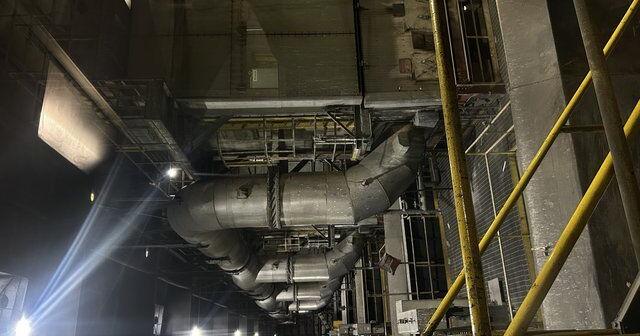
While provincial government approval may have settled the question of expanding operations at a Brampton garbage incineration plant, it has also opened debate about the role this type of waste management plays in an evolving economy and the need for greater public oversight.
For critics, the expansion at the Emerald Energy from Waste (EFW) facility on Bramalea Road signals a future in which waste remains prevalent, placing the incinerator squarely in the ideological crosshairs of environmental activists who argue Ontario should be taking steps to move away from disposal-based solutions and enhancing pollution oversight.
“The idea of moving to a circular economy, that is the answer. To find ways to do better waste diversion, whether it’s through recycling or better material choices … Even if you look at the incinerator right now, after they finish burning, about 40 per cent of the waste still goes to landfill,” said Steve Papagiannis, a board member of the Brampton Environmental Alliance and Scientific Liaison Coordinator.
“If this (plant) is going to operate, I’m going to direct my energy to how do we starve this thing so it doesn’t get as much waste to burn?”, Papagiannis added.
However, Emerald officials do not see incineration as being in opposition to a circular economy but a part of it.
The facility burns nonrecyclable waste to generate heat. The steam from that incineration process powers a turbine connected to a generator which in turn produces electricity that is supplied to the power grid.
“I can see there being a world where there is increased diversion … We want the material you can’t divert. And then what you can’t reasonably divert, you can send to EFW to recover energy, and then that energy goes back into the economy … so EFW does play a role in the circular economy,” said Joseph Lyng, vice-president of Emerald Energy from Waste.
The expansion will increase the incinerator’s annual waste-burning capacity from 182,000 tonnes to 900,000 tonnes, making it one of the largest incinerators in North America.
Environmental groups and Peel Public Health have raised concerns that the expansion could have adverse health impacts on the local community and that there is insufficient public oversight.
EFW commissioned consulting firms to conduct studies on the expansion’s health and environmental effects, which were reviewed by the Ontario Ministry of Environment, Conservation and Parks (MECP). The studies concluded there would be no negative impacts on the local community and that emissions would remain within provincial guidelines.
Critics argue the cumulative effects of pollution from multiple sources are not fully understood and could pose long-term risks. In 2025, Peel Public Health echoed those concerns, warning of potential impacts on heart and lung health in the surrounding community.
The Region of Peel has identified air quality as a significant issue, noting in a 2022 report that pollution comes from multiple sources in the area, including industry and traffic.
Peel Public Health said additional information is needed before it can make a more fulsome determination on the expansion’s potential health impacts.
“In order to fully understand the emissions and their impact on air quality in the surrounding community, we require specific details on the incineration and pollution control technology that will be used at the expanded facility,” the agency told the Brampton Guardian.
Emerald is expected to submit those details to the province within the next year, after which Peel Public Health will provide its assessment through a public consultation process.
With the project approved and now under provincial jurisdiction, activists and local officials have limited options to address concerns about the plant’s expansion. They are largely left to monitoring its development and operations to ensure compliance with environmental regulations and the protection of community members.
“Now that it’s underway, all we can do is hold them accountable for staying within standards and, hopefully, make those standards stricter over time,” said Papagiannis.
One of the main avenues for public oversight of the incinerator and its expansion project is the Public Liaison Committee (PLC), established by Emerald Energy from Waste in 1992. The committee was created to respond to community concerns, provide a forum for public input and address incidents at the facility with local residents.
However, meetings are often sparsely attended, with some residents arguing they are inaccessible and inadequately promoted.
“Most of us around here have a job, so the Public Liaison Committee is not accessible,” said Stacey Wilson, a Brampton resident and former member of the Brampton Environmental Alliance.
“The meetings aren’t widely advertised. I think they put an ad in the Guardian in a small corner saying the event is coming up,” said Papagiannis.
“Part of it is that we lost local newspaper delivery, so their way of getting that information to everyone was not accessible,” Wilson added.
Lyng acknowledged that Emerald has struggled to attract greater public participation in those meetings. “Getting the public engaged is very, very difficult. I wish there was some way to do it more effectively, and there’s just not. We’re open to suggestions that will help get more people involved in the (committee),” he said.
In addition to the Public Liaison Committee, EFW has held four open houses to discuss the expansion project.
Residents can also report concerns to provincial officers responsible for enforcing environmental laws and investigating potential harms to the community.
However, Wilson said that, in her experience, reporting issues such as unpleasant odours from nearby facilities can be an onerous process. She described challenges ranging from uncertainty about whom to contact to limited followup on complaints.
The project’s approval was contingent on compliance with conditions set by the Ontario environment ministry, including the installation of best-available pollution-control technology, the removal of unacceptable incoming waste and the public reporting of real-time emissions data.
Activists and residents, however, said those measures should go further. They are calling for real-time air-quality monitoring and independent third-party inspections.
“It should not be a make-work project for residents to find information that could affect their quality of life,” said Wilson.
Emerald has said it is “working to provide real-time emissions reporting for the public,” but has not provided a timeline for when the system will be in place.
“We’re not trying to do anything nefarious,” said Lyng. “A lot of the people who work for Emerald Energy from Waste live in this community, so why would we do something that would pollute the community they live in?”