
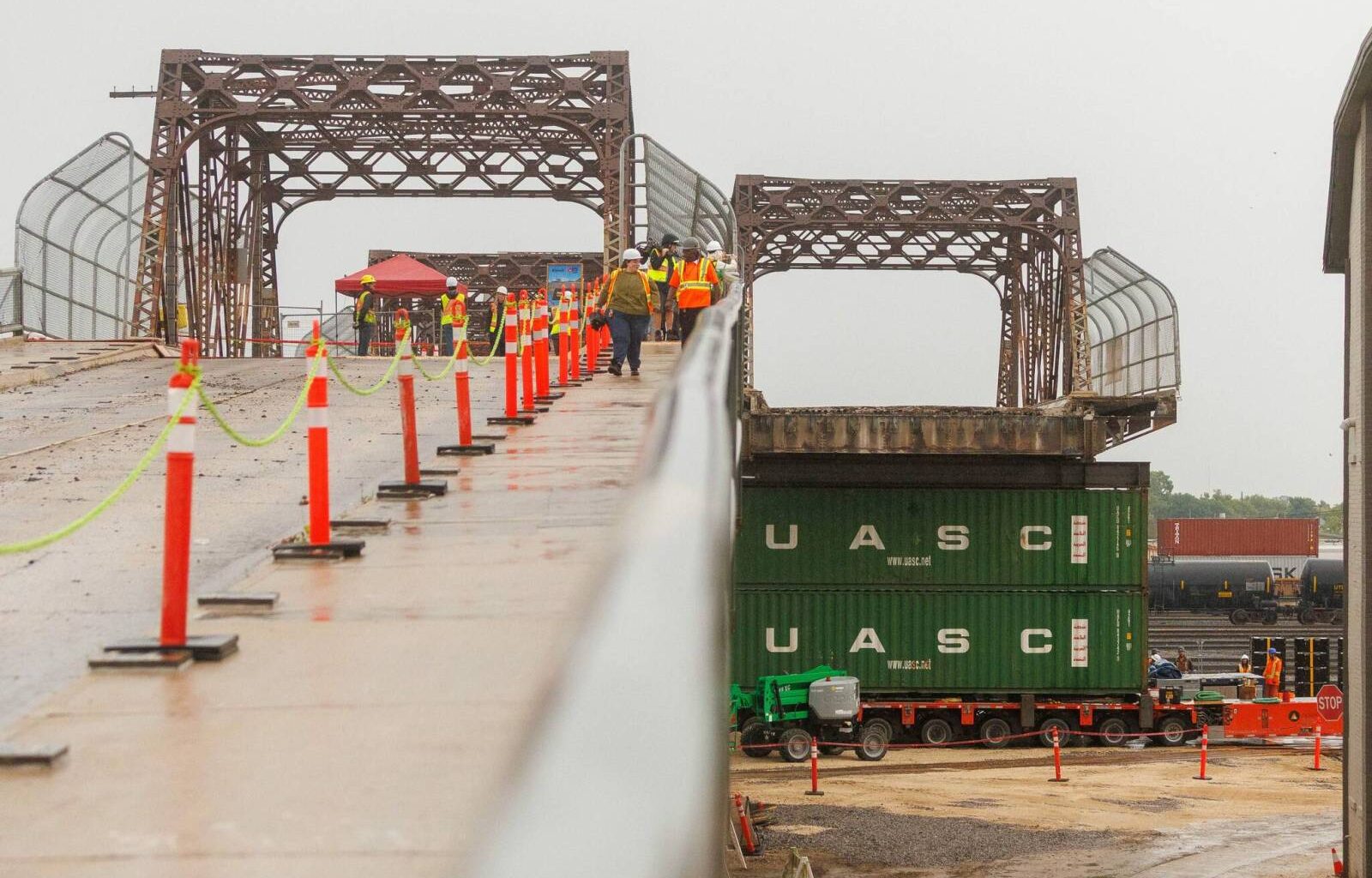
The first pieces of the Arlington Bridge, a long-deteriorating Winnipeg landmark, were removed Thursday morning, nearly 115 years after it was built.
A portion of the city’s longest bridge directly above the CPKC railway lines was the first to be taken away as part of a two-year demolition project.
The bridge was built in 1912 and closed suddenly in November 2023 due to structural issues.
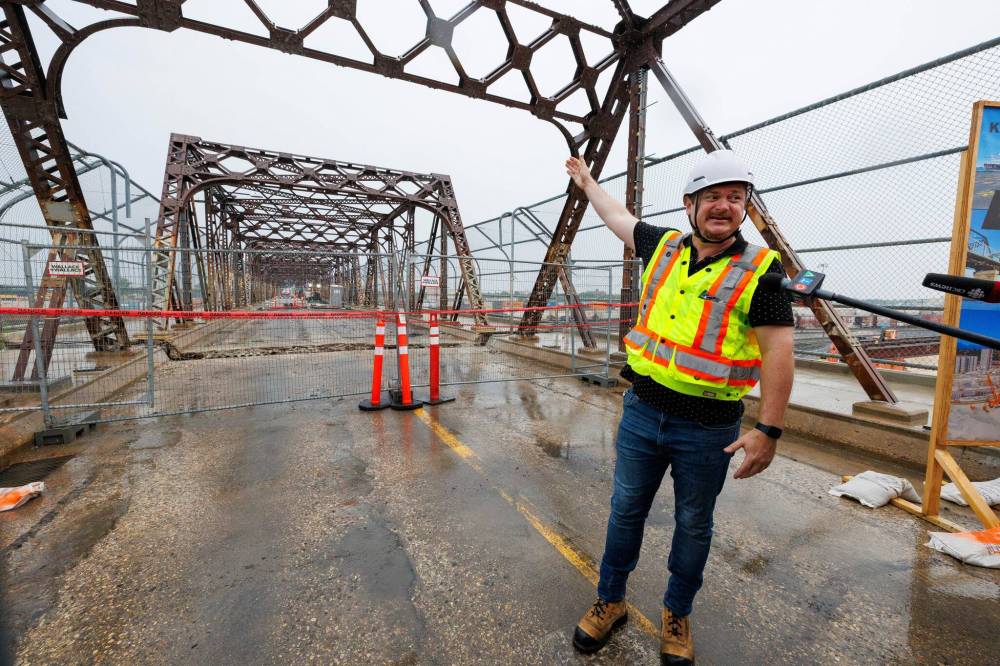
Damir Muhurdarevic, the city’s Bridge Project Engineer, tells the media how the spans are going to be removed. (Mike Deal / Free Press)
Mayor Scott Gillingham called it a “historic day” as crews worked to dismantle the bridge.
“Today marks the start of what council has decided needs to happen. The bridge needs to come down,” Gillingham told reporters near the blocked-off bridge.
Decommissioning and removing the bridge will occur in two stages. The first will involve removing the south part of the bridge from Logan Avenue into the CPKC rail yard. The second phase, slated to begin in 2027, will work north at Dufferin Avenue.
The bridge will be pulled out piece by piece, lowered to the ground and demolished, said Damir Muhurdarevic, the city’s bridge projects engineer.
The demolition will proceed in 15-minute intervals to work around the trains, which will continue operating.
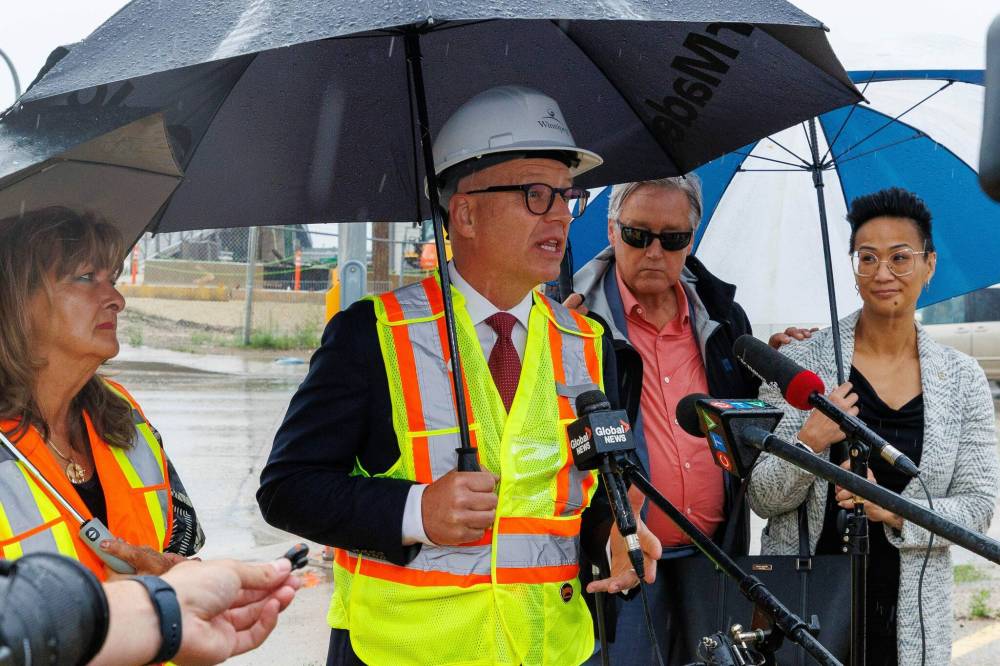
Winnipeg Mayor Scott Gillingham (centre) was on hand to watch the start of the historic bridge’s removal, talking to media with some city councillors on hand (from left) Janice Lukes, Ross Eadie and Vivian Santos. (Mike Deal / Free Press)
“It’s a challenge, the logistics of the operations of the railroad yard is complicated beyond anything I’ve ever experienced,” Muhurdarevic said.
The demolition of the bridge above the rail yard will be completed by the end of August.
“This is a very intricate project, you can appreciate there’s over 50 sets of tracks that this bridge spans that are active,” said Gillingham. “And so to take the bridge down is going to take some time.”
No full road closures are anticipated during the first phase of work. Traffic in the area of Logan Avenue and Arlington Street will be “intermittently affected,” the city said.
It has been difficult to get from the North End into central Winnipeg in the near-three years the bridge has been blocked off, said Darrell Warren, the president of the William Whyte Neighbourhood Association. He said the closure has also created regular traffic bottlenecks.
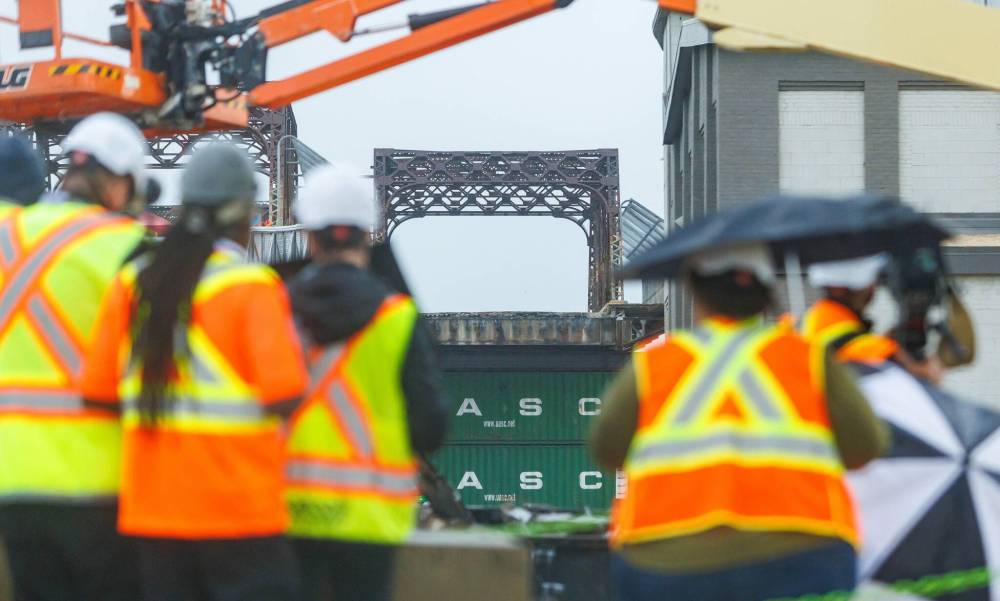
Span 15 of the Arlington Bridge is the first to be removed during the two-year demolition project Thursday morning. (Mike Deal / Free Press)
“It’s one of our main arteries, the Arlington Bridge, always was,” he said. “And now that it’s gone, McPhillips (Street) or Main Street and (the Slaw Rebchuk Bridge) is carrying the breadth of it all and causing a lot of traffic havoc there.”
He’s happy to see the project moving, but is worried that, without a timeline for when the new bridge may be funded and constructed, the wait could stretch many more years.
“Who knows, it could be two years or maybe 10 years, or maybe never, I don’t know,” he said.
City council approved $17 million to decommission and remove the bridge in January 2025, and $5 million to begin designing a new bridge.
Design work and funding to construct a new bridge will be considered by council in the future.
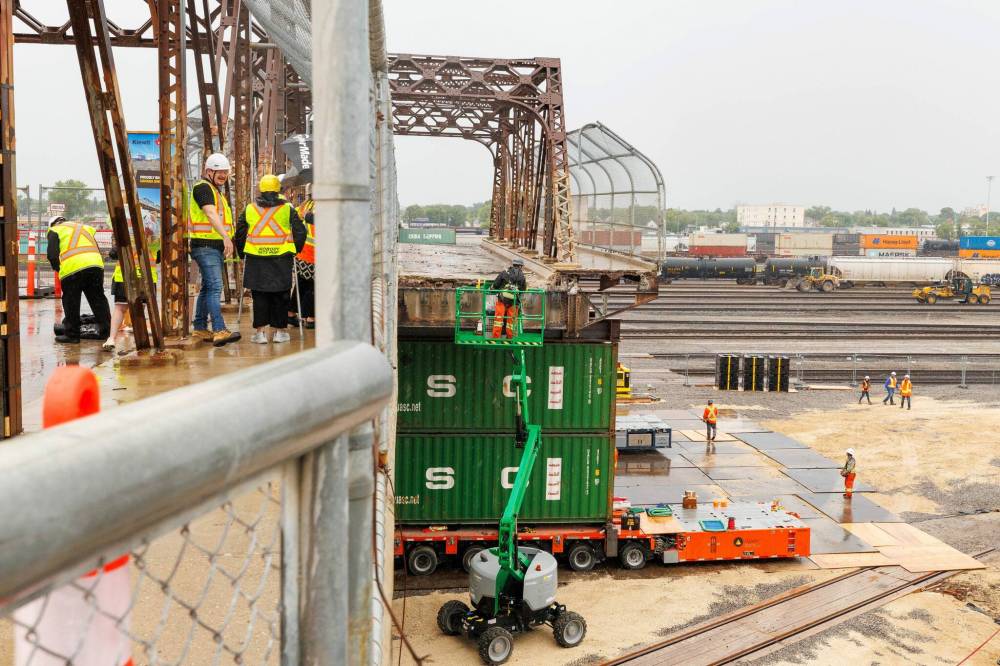
The bridge was built in 1912 and closed suddenly in November 2023 due to structural issues. (Mike Deal / Free Press)
Winnipeg Free Press | Newsletter

Public works chair Coun. Janice Lukes won’t be around for those considerations — she announced she would not seek a fourth term last month — but said the project, like any other that requires buy-in from the provincial and federal governments, comes with “high anxiety.”
“The real question is, where does it fit in the list of the city priorities of bridges? … There’s only so many hundreds of millions to go around, even from other levels of government, right?” she said.
“The good news is, we’ll have the design and everything all ready, because we’re refining the design.”
The city has suggested constructing the new bridge could take four to five years once it is funded.
malak.abas@freepress.mb.ca

Malak Abas is a city reporter at the Free Press. Born and raised in Winnipeg’s North End, she led the campus paper at the University of Manitoba before joining the Free Press in 2020. Read more about Malak.
Every piece of reporting Malak produces is reviewed by an editing team before it is posted online or published in print — part of the Free Press‘s tradition, since 1872, of producing reliable independent journalism. Read more about Free Press’s history and mandate, and learn how our newsroom operates.
Our newsroom depends on a growing audience of readers to power our journalism. If you are not a paid reader, please consider becoming a subscriber.
Our newsroom depends on its audience of readers to power our journalism. Thank you for your support.