
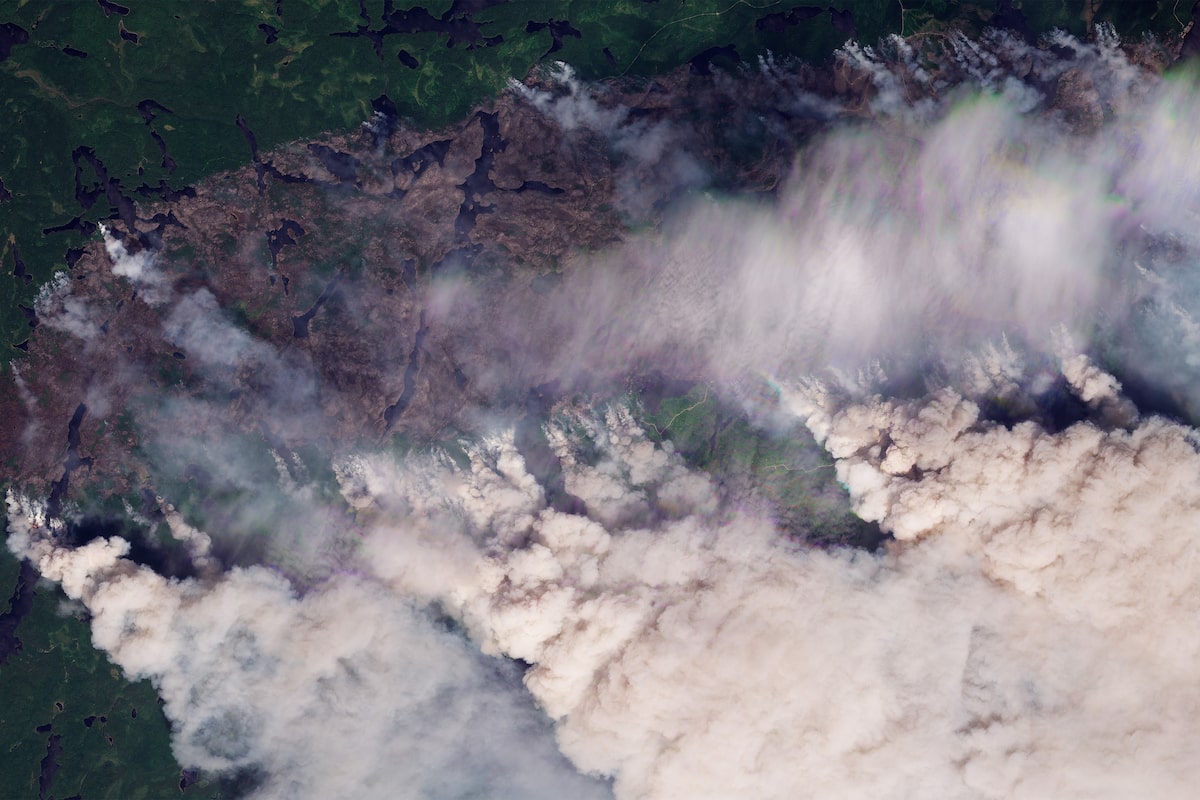
July 14 satellite imagery of the Fort Frances 14 wildfire, located roughly 130km northwest of Thunder Bay, Ontario.Supplied
Jeffrey F. Collins is the inaugural director of the Palmer Institute for Canadian Leadership in Charlottetown and author of the 2024 book Canada’s Defence Procurement Woes.
Alex Cool-Fergus is a political organizer and climate strategist.
As we surveyed the sickly yellow sky in Toronto on Wednesday, coloured by out-of-control wildfires up north, we thought back to the burning season of last year.
In August, 2025, wildfire did to the village of Kingston, N.L., what two centuries of wars, economic depression and storms could not: wiped much of it off the map. Facilitated by drought (itself a rarity on an island known for fog and drizzle) the Kingston wildfire was one of six raging simultaneously across the province that summer. The fires taxed people and equipment alike, especially the decades-old provincial water bomber fleet.
Typically equipped with five of the famous Canadian designed and built Canadair CL-215 “super scoopers,” provincial authorities were down a plane due to repairs. In fact, pilot shortages and cost constraints saw the province not operating a full water bomber fleet between 2018 and 2025. Yet even if it were available, five water bombers would not have been enough last year. The Kingston fire alone required nine to hold it at bay. It took borrowing and renting additional airpower from across the continent to make up the difference – hardly a recipe for proactive wildfire planning.
Ontario appeals to Ottawa for help with potential wildfire evacuations
It’s a different situation in Ontario today. Premier Doug Ford said 50 firefighting aircraft have been deployed. But the fires grow year after year, and so must our fleets of water bombers.
The question, of course, is who will pay for this, and the answer might surprise you: The cost should come out of our defence spending. Here’s why.
Where they were previously concentrated in certain swaths of the Canadian boreal forest, severe climate change-induced wildfires are now ubiquitous, invoking a new term in this country’s lexicon: “wildfire season.”
This year, Western Canada and the United States are facing extremely low snowpacks and warmer-than-usual weather. When fire season begins, local, provincial and federal authorities will have to move quickly. Factor in other wildfire hotspots such as southern Europe and the eastern Mediterranean and the sum impact is a growing demand for water bombers. Hence why the latest version of the workhorse of Canada’s various public and private water bomber fleets for decades, the DHC-515 (often referred to as a “Canadair”), is in high demand.
Manufactured by De Havilland Canada near Calgary, and capable of operating in remote regions in a myriad of climates, Canadairs are a popular wildfire fighting asset at home and abroad. In response to France’s 2022 wildfires, President Emmanuel Macron declared, “We need more Canadairs.” De Havilland consequently secured 22 orders from European Union member states.
Fires across northwestern Ontario force evacuations, trigger air quality warnings
This is obviously good news for a Canadian company, domestic jobs and national pride but less so for those provincial governments seeking to beef up their own aging fleets amid growing financial constraints. It did not have to be this way, however. The lack of local demand in the 2010s shuttered Canadair water bomber production for the better part of a decade. Now with the Europeans moving first, domestic orders, such as Manitoba’s contract for three Canadairs, won’t be delivered until the early 2030s.
With a now healthy order book, De Havilland will need to boost production capacity to deliver Canadian-made water bombers.
Fortunately, Prime Minister Mark Carney’s pledge to boost defence spending to the NATO target of 5 per cent of GDP by 2035 and reinvigorate the defence industrial base provides the financial coverage and policy framework to do just that. Under the NATO target, Canada can dedicate 1.5 per cent of the 5 per cent annual spend to “critical infrastructure…civil preparedness and resilience.” Water bombers to protect communities from wildfires easily meet this requirement.
The government’s recently announced Defence Industrial Strategy likewise identifies aircraft production, maintenance, training and simulation as constituting four of Canada’s 10 “key sovereign capabilities.” With the strategy, the government can prioritize defence spending in those areas where Canada is already an established leader in order to reduce supply chain vulnerabilities and boost exports. As the world’s first purpose built water bomber, the entire Canadair series represents a globally recognized brand in service throughout the world.
The federal spending power and physical footprint through billions in northern military infrastructure spending enables Canada to re-imagine what national defence means in the 21st century where the existential threats to many local communities are not Russian hypersonic missiles but climate-change driven wildfires. The Ontario fires this week must spur us to action.