
This week, Bill encounters reindeer, alpacas and goats and the interesting characters who keep them
I went looking for reindeer, and Santa.
And you most likely had to read this in high school.
Animal Farm is a satirical metaphorical novella by George Orwell that critiques totalitarianism through the story of a farm where animals overthrow their human owner, only to face the same under their own leaders.
Part of this could happen within our global geopolitics today. Nearby I might add. Enough said.
But if you are travelling to or through northeastern Ontario this summer you can encounter some very diverse animals on the back roads, and in unique contexts.
You will also be overwhelmed by a different form of animalism.
If you are wagering, there were three different experiences plus a double bonus, originally called the Timmins trifecta. But then it became a house full of cards, better than three of a kind.
Reindeer Guy
I did not know of Steve Walasek (val-a-sik), “the reindeer guy.” There remain many secrets on the back roads.
A couple of Back Roads Bill followers from Sarnia stopped by the Canadian Ecology Centre to tell me of their tour of northern Ontario taking in many destinations from my stories.
This included going on a day trek with Mylène Coulombe-Gratton (Follow Her North) to the Cold War bomber/fighter jet crash site. An epic story. They went on to visit a number of other tourism Back Roads Bill finds.
Near Matheson, by chance, they said they encountered “the reindeer guy.”
“Who? And I would like to meet him,” said I. They explained and gave up Steve’s business card which read “Reindeer Way Station.”
There’s a difference though, kind of. Caribou and reindeer are the same species and share the same scientific name, Rangifer tarandus.
Caribou are what the species is called in North America and reindeer are what they are called in Eurasia. All caribou are wild animals, whereas reindeer can be wild, semi-domesticated, or domesticated. Though there are generalized similarities between caribou and reindeer, their appearance can vary from individual to individual, as it is influenced by diet, environment and, in the case of reindeer, selective breeding.
It is all in the Ministry of Natural Resources definition, Steve says.
I was about to find out more than I imagined with “the reindeer guy.”
If you go north on Route 577, north off Highway 101, you cross the Driftwood River and then, by chance, you pass the sideroad Caribou East. Fortuitous.
On the west side you see a long fence bordered by a densely forested hedge like barrier. You can see some open land in behind. Pastures. You are in Mennonite country. Slow down and you will see the large caribou insignia on the welcoming gate. It is called the Reindeer Way Station.
You call out for Steve; I had prearranged the visit.
Steve is an elderly gentleman. Now 84, you would not know it: spry and friendly, likeable right from the get-go.
He is not really a reindeer herder or farmer, and the animals are not raised for meat; pets and companions they are. There are 35 in the herd.
He’s a retired professional geologist – graduate of Michigan Tech. University, (former Texas Gulf and Sulphur employee, an early Timmins mining giant – “got laid off there”), taught computer science at Northern College, and is a registered Ontario College of Teachers educator, graduated from Nipissing University’s Faculty of Education.
He also has a master’s degree in business. He raised five children on his own, he hails from near Lansing, Mich., he has five grandchildren, some in the USA. He’s been up this way for about 46 years. He was a former big game hunter/guide.
After a few steps, the newborn reindeer/caribou who were born in May greet you. What else but cute, but they are wary of these strangers. I was with Back Roads Bill friends Liz Mulholland and Brian Emblin, from Timmins.
At the time of our June visit, the caribou were molting while looking a little mangy. Steve explains their coats are double-layered and provide excellent insulation when in cold climates. It consists of a woolly undercoat and an outer layer of hollow guard hairs that trap air, keeping the caribou warm in cold temperatures.
Caribou molt, or shed their coat, during the winter months to get rid of the old fur and grow a new, thicker coat for the warmer months.
There are 420 acres, 15 of pasture. The animals move from one pasture to another.
He kind of fell into this hobby in 2003 when he picked up two males and a female in Saskatchewan.
“What better place to raise them than being approximately halfway to the North Pole and jolly old fellow,” says Steve.
He says this is not really a farm or a business.
I was eventually invited into the two story, expansive ranch style type of chalet wooden house which he built. That would be another story in itself.
At the back entrance you step around some caribou antlers. Oh, by the way, the males lose their racks right after the rut and the females keep them until the birth of their calves. At the time, you could feel that velvet, so soft to the touch.
There’s a photo on the wall that catches my attention. Steve is a Civil War reenactor. These are volunteers who engage in reenactments sometimes referred to as “living historians” or “impressions.” These individuals recreate the appearance and behaviour of soldiers and civilians from the Civil War era. They honour the legacy of those who fought and died during the conflict. It is an American heritage thing.
Steve pulls out a photo and his drum; he is a Gettysburg Colonel in uniform with the cavalry swords. He’s been to countless parades and events.
He also knows the ways of a taxidermist. There is a range of pelts representative of wild fur bearers on the wall next to the upstairs bannister. Then there’s the vast collection of North American wild animal skulls in a display case. Ostrich feathers from when he raised those, and hundreds of caribou antlers from those that died of old age on the farm. He has his very first caribou on the wall, like you would see at a tourism lodge. It is akin to a personal but well curated museum.
Just call Steve at 705-273-2604, donations are appreciated. He will welcome you and he has a bed and breakfast option.
They are so well cared for. Reindeer on the back roads. Who knew?
They Don’t Spit
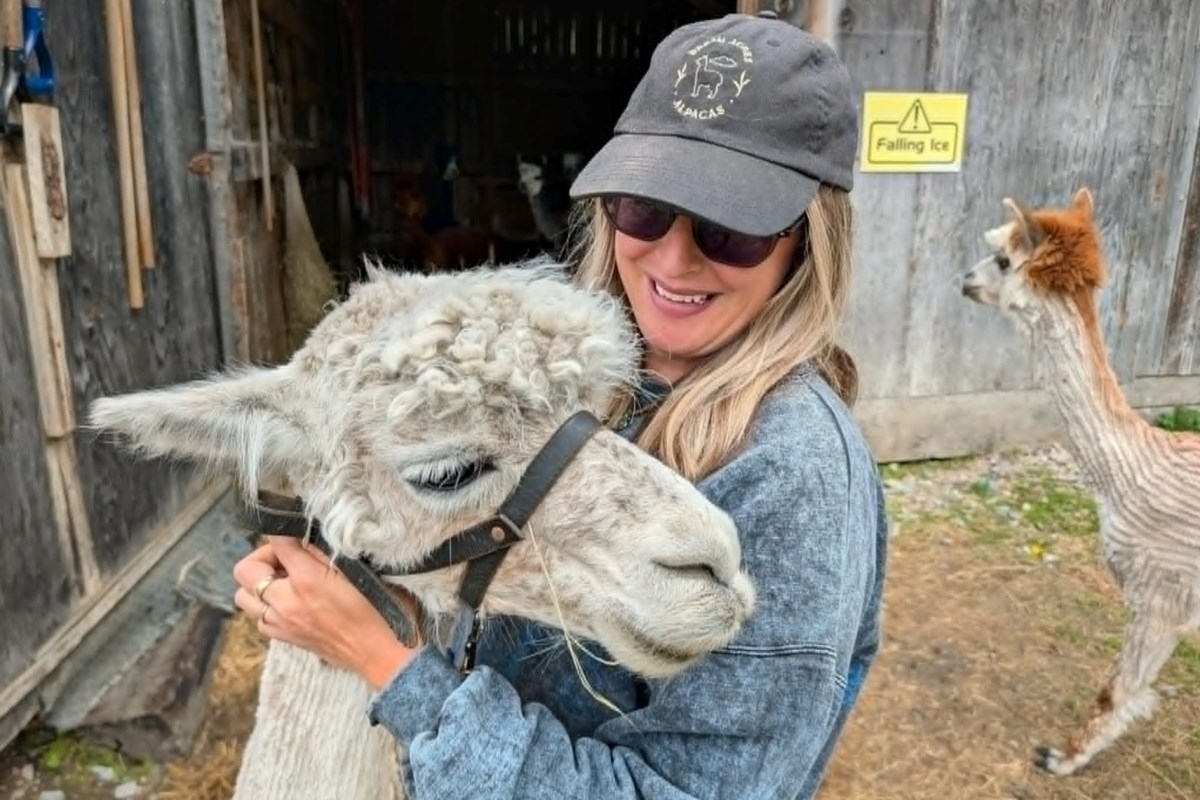
You don’t have to worry. One of the things I learned from this stop is that llamas and alpacas both can spit, but there are some key differences in their behaviour
Alpacas tend to spit more frequently than llamas, often as a means of establishing dominance or resolving social disputes. But alpacas are more likely to spit at other alpacas, while llamas may spit at humans if they feel threatened or annoyed. There are 22 distinctive colours of these animals, originally from Peru.
Dream Acres is also on Highway 101 East between Matheson and Timmins. It had its beginnings in 2008.
When I turned into the driveway off of Highway 101 East the first thing observed was a Sasquatch sign so I immediately knew I was in the right place. Then I met one of the owners, Danielle Piquette.
“We (co-owners Gary and Joanne) had joked about getting alpacas when we finally did settle down but really never imagined that this was achievable. Well, ‘if you can dream it, you can do it’ and we did! Our second summer, we bought our first nine male alpacas. What a joy these boys have been. We decided to get males only in order to focus solely on the production of 100 per cent Canadian-made quality alpaca products. We strive to educate our surrounding communities and to take full advantage of the stress release that these animals bring to us,” said Piquette.
(More on the stress release to come.)
“We offer private tours, where you can visit and feed the animals, while learning the ins and outs of raising these animals and also the benefits of wearing alpaca,” she said.
This is what I liked: the chance to be up close.
“We also offer the very unique experience of walking the alpacas in our trails. There are now at 23 alpacas, 18 females and 5 males,” she said.
Why I liked it was that on their website you meet all the residents, by name and portfolio photo. Then, when I arrived, I was kind of familiar with them.
When I was there at the end of June, Madison Bell was there with her Grade 5 class from Cochrane Public School.
There were a number of special needs/exceptional type of students. She is a beginning teacher but recognized this kind of school trip was best for them.
As an educator for a long time, I could sense the calmness of the group of students because of their curiosity with the llamas, and the nature of the animal itself. It was an interesting watch. They were a bunch of animal lovers, engaged throughout.
It is not wool. At Dream Acres they shear the animals every spring, get the fibre carded and spun.
“The yarn returns and then the production begins,” said Piquette.
There is a chance to shop for alpaca fibre with a host of products including cozy socks and mitts.
“It is luxurious, five to six times warmer than wool, free of lanolin and hypoallergenic,” Piquette explains. “It’s naturally water repellent, fire retardant, temperature regulating, moisture wicking and has no itch! No harsh chemicals are needed or required during the processing of the fibre, which means it has less environmental impact than other types of wool.”
I bought a “so” soft toque for an upcoming gift.
Take a look at their website for appointments and times. You can enjoy an overnight farm stay at the Paca Shack and pretty much have the place to yourself. Imagine this: You can stay near the pen overnight and wake up to adorable furry friends peeking through your window.
On to the next stop, it was one of those back roads days. Four stops. We’re only halfway through.
Coffee with Goats
When I heard about this title, I just had to visit Trussler’s Farm in the west end of Timmins.
Beware though: they try and eat just about anything.
Nigerian Dwarf goats are small, friendly, and versatile goats prized for dairy production, companionship, and brush clearing. I saw two of the three attributes.
There are a miniature breed originating from West Africa, brought to the United States in the 1950s. Initially, they were feeder animals for big cats in zoos, but those not used became popular attractions and were selectively bred for their temperaments.
The owners are Kara and Joe. She is from Iroquois Falls, Joe from Matheson. They are both farm raised and teenage sweethearts.
By their own volition, “You can’t take the farm out of the farmer.”
That’s the premise of what they now do. The family also owns Trussler Metal Roofing, operating since 2004 and specializing in premium metal roofing systems designed to withstand harsh Canadian weather conditions.
The goats are simply adorable. They surround you and there’s a soft chorus of bleating.
And people know them as “celebrity goats.” They all seem to have entertainers’ names like Beyonce, Beeber, Brittany, Mar-Kate and Ashley and so on it goes. They are “Queenies,” Kara says, “not meat goats at all.”
She is affectionately known as the “crazy goat lady.”
When you go to their website, check out the logo. They actually do dress up the goats for parties, just like Barbies, wearing brides’ dresses and tights – all within a fashion show. There’s a colourful wardrobe rack to choose from.
She also takes the little ones on the roads to seniors’ homes. There’s also a soothing effect with animals like this.
She describes the diminutive goats as being “like teenagers” — they eat a lot and have lots of misspent energy.
Kara described another unique program called Sip & Paint with the goats. (The sipping is the wine.)
“What a success! The goats loved it, the people loved it, and the smiles said it all,” said Kara. “It is another unforgettable night at Trussler’s Farm!
Just imagine this: Yes, there’s Goat Yoga and Chair Goat Yoga with the Baby Goats.
“This unique experience always fills up fast, and we only offer it on select dates throughout the season,” said Kara.
They surround you while doing the upward dog asana.
There’s Trussler’s Pantry and the “Organic Harvest.” They have seven acres for certified organically grown products with different sizes of “Person shared boxes” full of fruits and vegetables.
“The Pantry offers Health food that are 100 per cent gluten free from organic non-GMO sources. We support our local farmers who also farm ecologically and have grass fed organic meats,” said Kara.
Also ask about the juice cleanses.
Kara has a regional network of organic farms (many Mennonite) where she collects, sorts and markets these boxes and provides mobile food delivery service. Kara is a well-intentioned intermediary type of entrepreneur. She’s good at this.
And yes, you can come by early in the morning and have your coffee with these little goats. They are endearing.
Bonus
If you have the time and some extra coins, consider sleeping with the wolves, or the alternative wilderness tour.
What? Yes, you can.
There is a similar place in Quebec but this is the only one in northern Ontario. Cedar Meadows Resort offers an extraordinary adventure. It is one the north’s most prestigious lodges, located on 175 acres.
Nestled amidst their rural landscape enclosure, this unique experience has five upscale glass chalets with an expansive view of the wolves’ habitat.
Established in 2000, the Cedar Meadows pack includes eleven wolves, plus recently born pups.
These wolves used to live in a zoo but now have their own 10-acre enclosure with two dens and a great deal of natural space.
I contacted Cedar Meadow’s General Manager Richard Lafleur.
Love must have been in the air in early May.
Two of the wolves — ‘Smoke’ and ‘Raven’ — brought four pups into the Cedar Meadows world on May 2.
“We had a litter of two black ones and two greys: two males and two females; we see them every few days,” said Lafleur.
As a less expensive alternative, there is the 3 p.m. first come, first served tractor pull tour that takes you right past the wolf enclosure where you’ll have the opportunity to see Canus lupus up close.
Visitors can see various wildlife, including moose, elk, bison, deer, and mountain goats.
If you drive around the boundaries of the property on city streets there is a good possibility of seeing the elk, bison and deer in the fields on Lafleur Drive. I saw the swans as I drove to the front entrance off of Norman St.
There were bald eagle eaglets in a high nest, close to the road, along Norman St, closer to the Lafleur St. bridge and Mattagami River.
More than a double bonus: Drive a little further north to Cochrane and Polar Bear Habitat to see Ganuk and Henry.
I talked to Brooke Etherington, supervisor at the habitat, which “concentrates on conservation and education initiatives.”
“Our shared goals are to learn more about polar bears and how we can care for them, both in human care and in the wild,” she said.
The habitat spans more than 24 acres of pristine sub-arctic terrain, providing a natural environment for polar bears. It was originally founded as an orphanage for polar bear cubs and now serves as a destination for wildlife enthusiasts, featuring a spring-fed lake and various enrichment activities for the two bears.
It opened on Aug. 25, 2004, and the reason I know this is as a consultant through the Canadian Ecology Centre (CEC) I researched the potential visitation for such a tourism attraction, working alongside the Toronto Zoo, who were consulting on the habitat.
Benoît Serré was the Member of Parliament at the time, before the Charlie Angus reign; the CEC was hired through a FedNOR project. J.P. Oulette was the town’s Chief Administrative Officer, a proponent of the community economic development project, alongside the leadership of the late Mayor Don Génier.
I have seen polar bears in the wild though, in fact way too close.
So, four stops that day. More to come: stay tuned. There’s lots to do in northern Ontario.
Here is the map with the five locations.
Unfortunately, there was no Santa at this latitude. About six more months to go.
And, unlike Animal Farm, you won’t meet a negligent farmer like Mr. Jones — where the animals rebel against him. These farmers are caring ones.
You won’t see the Battle of the Cowshed, where the animals defend their territory against Jones’s attempt to retake it. The animals here are happy and content. They graze and play.
On these back roads farms you will know the animals have names as they do in the novella. There is no power, corruption, and betrayal here, just wonderment and fun. Just different and unique settings.
Worth going for a drive. You can bet on it.