
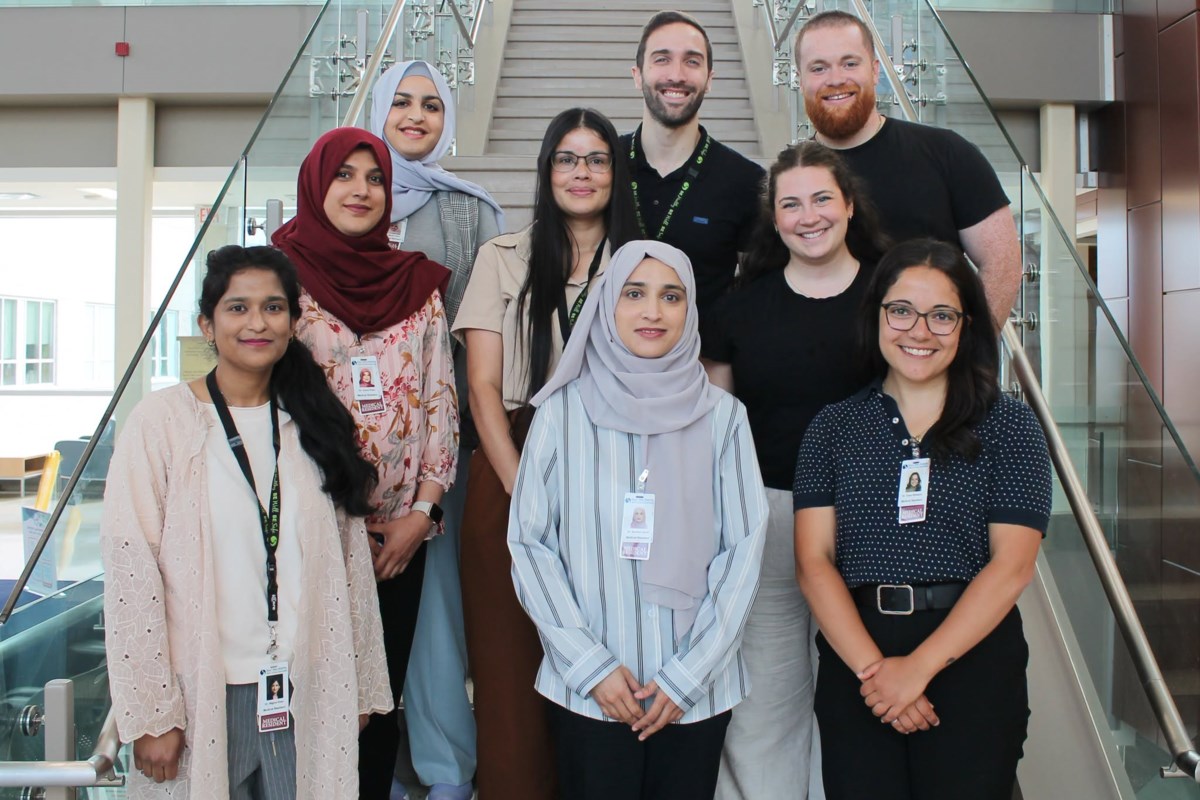
‘My end goal was always to come home and give back to the village that raised me,’ said new doctor who recently returned to the Sault as part of a cohort of 15 medical residents
While Tiana Bressan was completing her education away from home, she saw a growing need for doctors in Sault Ste. Marie – so she went and became one herself.
The born-and-raised Saultite and Northern Ontario School of Medicine University graduate recently began her medical residency in the city, learning the ins and outs of a profession she knows is desperately needed in her hometown and across northern Ontario.
“My end goal was always to come home and give back to the village that raised me,” she told SooToday.
Becoming a doctor is not a path Bressan always envisioned. She originally graduated from a biomedical engineering program at University of Guelph – but when she saw jobs in the field were concentrated in southern Ontario, she started thinking about what was needed at home.
“When it really came to what is needed in the Sault, and how I can contribute meaningfully locally … it was really about coming home and serving that need,” she said.
Bressan did not come back alone. She’s part of a cohort of 15 residents who began training in Sault Ste. Marie on July 1, and one of 28 now learning in the city – the highest total on record.
It’s a welcome influx during a time when Sault Area Hospital saw its average occupancy spike from 262 patients in 2023-24 to 303 through 2025-26, while many community members were left scrambling for family physicians after Group Health Centre abruptly dropped 10,000 patients in 2024.
Hospital officials hope the residents will become practicing doctors who live and work in the community. The stats back up that hope: 55 per cent of NOSM U graduates go on to practice in northern Ontario once they complete their residencies.
“Residency training is an important opportunity to introduce physicians to the benefits and opportunities of practicing in Northern Ontario,” said Brandy Sharp Young, director of corporate affairs and patient engagement.
“Throughout their training, our physician recruitment team works with residents to help them explore opportunities to continue practicing in the community and understand what a future career in Sault Ste. Marie could look like based on their individual interests, specialty, and career goals.”
Just two weeks into her residency, Bressan spoke highly of the first weeks back in her hometown.
While residents in larger urban hubs contend with other learners for experience, she said training through NOSM in Sault Ste. Marie provides medical residents with a variety of hands-on opportunities in settings as wide ranging as the hospital’s emergency room, Group Health Centre, or Algoma Public Health.
“That’s the beautiful thing about training with NOSM. Just this week alone, I was in Group Health, and then I was able to finish a clinic day, and then go into emerge,” Bressan said.
“One of the real benefits of NOSM and Sault Area Hospital is that our hospital is big enough that you see a lot of things and you get really good learning, but small enough where all of my learning is one-on-one and it’s very hands-on.”
The new doctors are training in a variety of specializations – from family medicine, pediatrics, psychiatry and more – in health care settings around the community as they work to become fully-fledged physicians over the next one to five years
The new cohort includes two pediatric residents who, for the first time ever, will have Sault Ste. Marie as their home training site, and the group arrives on the heels of a $2 million federal funding package that will expand training facilities and double the number of learners at NOSM U over the next several years.
It’s a boost that Young said is part of “the continued growth and evolution of medical education and residency training opportunities in Sault Ste. Marie and across northern Ontario.”
“Building on a strong foundation of established residency programs, Sault Ste. Marie continues to expand opportunities for medical learners through our partnership with NOSM University,” she said.
“This growth includes additional residency positions, new training opportunities, and innovative programs that support the education of medical learners across Canada and the development of future physicians.”
Existing doctors also play a big role in the growing cohort of residents, Young said, as learners rely on “the dedication of physicians who serve as teachers and preceptors.”
For Bressan, who sees the need in the Sault and across the North Shore, her desire to contribute to her community is matched by the hands-on experience she’s being given in her residency – and she hopes to go on to bolster health care both in the city and around the Algoma region.
“It’s no secret that every week we see a Thessalon emerge closure or a Richards Landing closure or Blind River closure, and that also impacts Sault Area Hospital because then we get all of those patients,” she said.
“It’s not fair that just because we live in Northern Ontario and the geography that we live in, that we should have any sort of reduced access to that care.”
Bressan expects emergency medicine to be a big part of her future practice, but she hopes to maintain her family medicine skills throughout her career – which she expects will unfold in communities around the region.
“Sault Ste. Marie, for sure, that’ll always be my home base, but I think between Wawa and Elliot Lake, and like the Algoma region, like I absolutely plan on … filling in shifts in those areas,” she said.
“I think to be able to give back to the community in some small way and hopefully train others or encourage people to do the same is the best that I can do. I couldn’t imagine a more fulfilling career.”