


Listen to this article
Estimated 4 minutes
The audio version of this article is generated by AI-based technology. Mispronunciations can occur. We are working with our partners to continually review and improve the results.
After two years in Toronto’s shelter system, Magret Gumoshabe says being able to call Hope House her home has given her something she hasn’t felt since she first moved to Canada from Uganda: peace of mind.
“Living here, the experience is that this is finally a home,” she said.
St. Felix Centre officially opened Hope House one year ago on Augusta Avenue in downtown Toronto.
The rent-geared-to-income supportive housing residence is dedicated to women and children experiencing housing instability and domestic violence. St. Felix Centre says it offers not just a roof, but wrap-around support designed to help women and children rebuild their lives with dignity.
The residence is part of the city’s strategy for to create more affordable and long-term housing solutions. Meanwhile, many are still being turned away from shelters every month, and the city says it has a long way to to meet its targets.
Gumoshabe described the experience of bouncing around to different shelters as “chaotic” and said it felt overwhelming and nearly impossible to think about going back to school without having a safe and comfortable space to study.
“Here, you can do your own thing and you’re free. I have a space to study, and now I’m back in college,” she said.
‘We’ve seen amazing transformations’: executive director
Brian Harris, executive director of St. Felix Centre which runs Hope House, says many of the women who moved into the units came from shelters and encampments, and some were fleeing domestic violence.
“In that year, we’ve seen amazing transformations,” he said.
There are also seven children who live in the building, he said, and having a safe place to give birth and raise a child has been life-changing for some of the women.
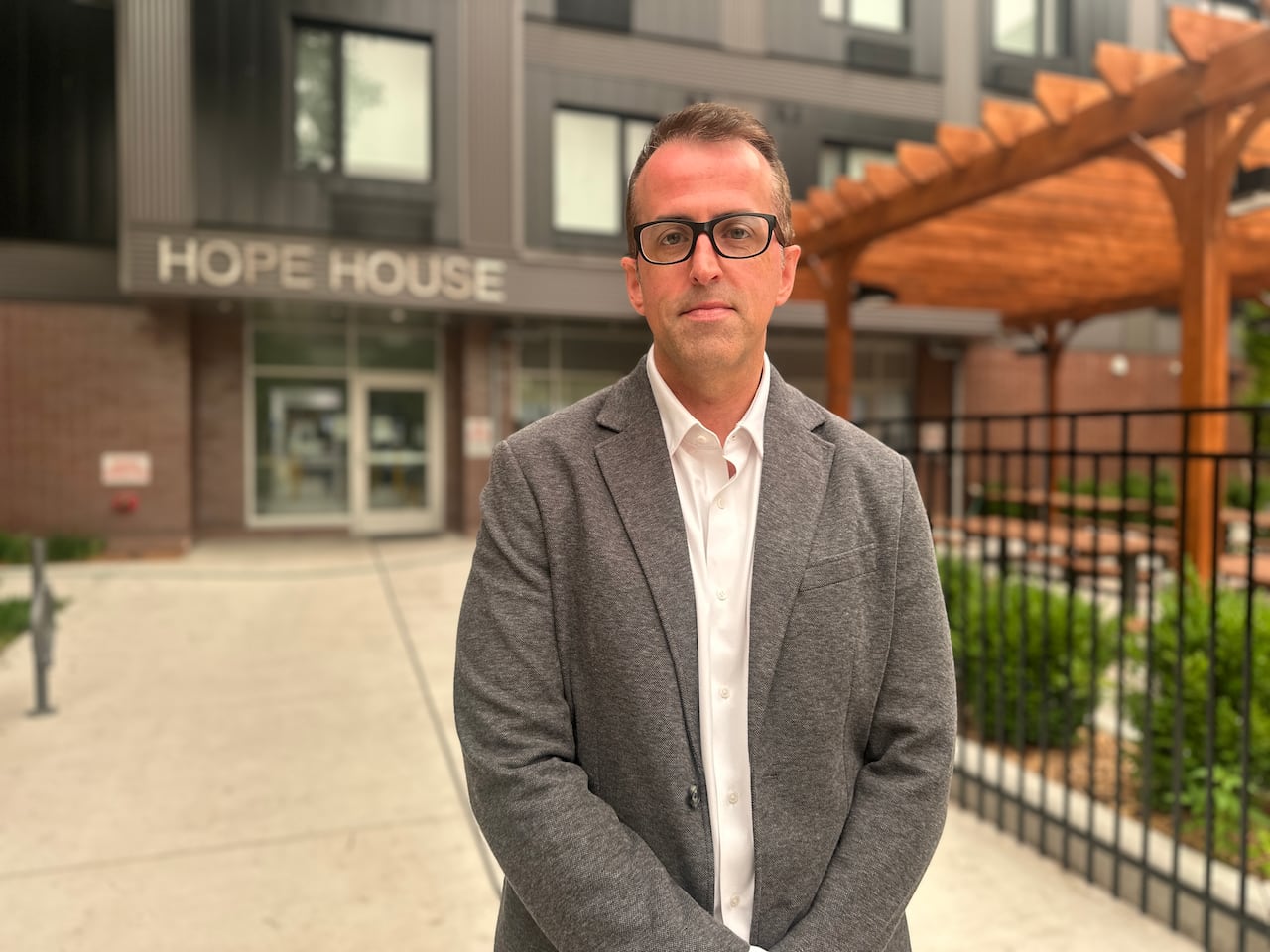 Brian Harris is the executive director of St. Felix Centre, a non-profit providing services to support marginalized communities who are experiencing housing insecurity. (Talia Ricci/CBC)
The space offers 31 fully furnished suites alongside access to meals, health-care support, counselling resources and professional development services.
Harris says it was about two years between the demolition of the old building to moving the first tenant into the new building, and the project was supported by all three levels of government.
“I think it was a really good example of when there is the political will and when there are resources made available, we can really build supportive and affordable housing really quickly.”
From emergency shelter to long-term housing
Hope House originally operated as an emergency shelter. St. Felix Centre said when it rebuilt the site as supportive housing, it relocated the emergency shelter beds to a facility at Bathurst Street and Adelaide Street W. so there no beds lost in the shelter system.
Sarah Blackstock, director of tenant access and support with the Housing Secretariat at the city of Toronto says the city has a great need for both emergency shelter beds and supportive housing.
“Homelessness is a very significant crisis in Toronto and across the country,” she said. “We need shelter beds, but we also need to have places for people to go to leave the shelter.”
Blackstock says the city is working towards a target to approve 18,000 new supportive homes by 2030.
“We have about hit about 2,000 since 2020. So we have a long way to go,” she said.
“We’re not getting there fast enough, but we know how to get there.”
Blackstock says 1,300 supportive housing units have been completed within the last six years and around 600 are currently under construction.
“We’re working very closely with the provincial and federal governments to get those numbers bigger and bigger,” she said.
Along with stability, Gumoshabe says she’s also found community within the walls of Hope House. Now, her goal is land a job that allows her to give back to people who have faced the same challenges that she has.
“I decided to do social work because I have a passion for helping people,” she said.