
The Sault Ste. Marie Public Library looks through the archives and finds a puzzling fad of ‘epidemic’ proportions
From the archives of the Sault Ste. Marie Public Library:
In February 1933, the Sault Daily Star reported that a new craze was sweeping the Soo: Jigsaw puzzles.
This was hardly a new invention: the oldest known jigsaw puzzle dates back to the mid-1700s. But throughout the 1930s, their popularity soared in North America.
How popular were they? The Star noted that “some hundreds of jigsaw puzzles are now coming into the city every week,” with factories in Guelph and Kitchener running around the clock to supply puzzlers with their next challenges (Feb 3, 1933).
Stores quickly jumped on the bandwagon. Some increased their stock of puzzles to try to keep up with customer demand. Others used them to entice prospective buyers. Canadian Department Stores noted that their candy was “an added treat when solving the latest jig-saw” (February 16, 1933). Barnes Drug Co. offered 15 cents off a 25 cent jigsaw puzzle – what they called “The Rage of the Age!” – if customers also bought their Smiles ‘n Chuckles Chocolates (February 18, 1933). Economy Stores offered a free 75-piece jigsaw puzzle as a gift with each one-pound tin of fluffo pastry shortening purchased (February 13, 1933).
By February 21, 1933, the Sault Star reported that 2,500-3,000 jigsaw puzzles had been sold in the Sault. However, they also noted that in Sudbury, less than 1,000 had been sold, implying that the craze hadn’t hit there yet. The Soo was quicker to pick up the trend, it seemed.
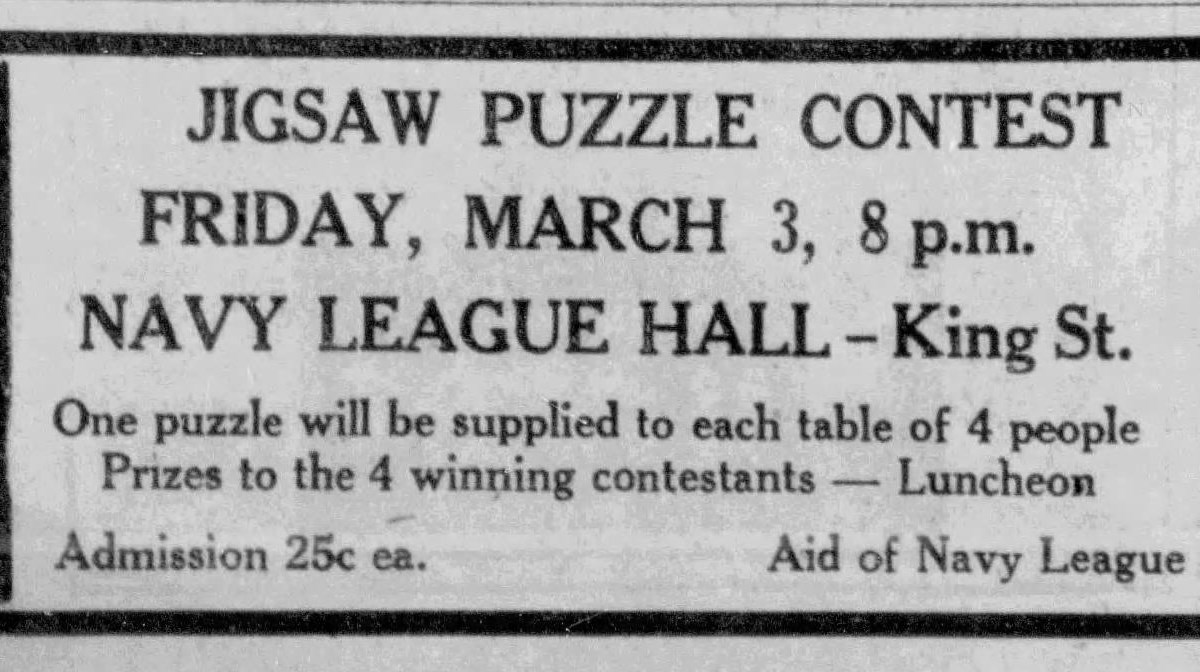
While completing a jigsaw puzzle was largely seen as an activity to complete at home, there were a few social activities as well. On March 3, 1933, the Navy League Hall held a puzzle contest. Participants could sign up in groups of four or be assigned to a team when they arrived. Regardless, each table of four people was given a puzzle to complete; these puzzles were “special ones, imported particularly for this occasion” and “of the type requiring an hour and a half to two hours to complete” (March 3, 1933). Prizes were awarded to the table that completed their puzzle the fastest. Admission cost 25 cents and included a buffet lunch; proceeds supported the Navy League.
While many were caught up in the jigsaw puzzle craze, others were less enthused. In the column The Wagin’ Tongue, one Sault Star writer bemoaned the effects of doing jigsaw puzzles: “Have you, too, caught jig-saw puzzle fever? Even your best friends won’t tell you, because, after you have started working jig-saw puzzles, you have no best friends. Throughout the land people are neglecting their business, if any, skipping meals, losing sleep and forgetting to change their underwear – all because of the mania for fitting little hunks of cardboard together . . . Of course, the epidemic has its advantages. It is keeping people off the streets and is diverting their minds from contemplation of conditions. In fact, it is believed that when everybody has succumbed to the jig-saw puzzle craze they’ll forget all about the depression. And then, of course, when they have forgotten about the depression, the depression will no longer exist.” (March 7, 1933).
In fact, the Depression was one of the reasons that the popularity of jigsaw puzzles took off, with unemployed or cash-strapped people looking for affordable and escapist activities. As another Sault Star article opined, “One should at least be thankful that this jig-saw puzzle craze descended upon a defenceless country at a time when plenty of people are possessed of all the leisure the pastime requires. Otherwise complete disruption of business and industry might result.” (March 8, 1933).
Jigsaw puzzles continued to appear in the news: as activities at parties and weddings described in the social pages, as giveaways that businesses used to attract customers, and as the subject of occasional fretting by people concerned that puzzling represented a psychological issue. The Soo Canal was even reported to be the subject of a new puzzle (March 28, 1933). Jigsaw puzzles continue to be a beloved hobby today – although perhaps not with the fervor that struck in 1933.
This article was written using information compiled from the Sault Star Collection at the Sault Ste. Marie Public Library.
Each week, the Sault Ste. Marie Public Library and its Archives provide SooToday readers with a glimpse of the city’s past.
Find out more about what the Public Library has to offer at www.ssmpl.ca and look for more “Remember This?” columns here.