
The UK telecoms regulator, Ofcom, has today decided to implement their plan for allowing Low Power Indoor (LPI) Wi-Fi and outdoor mobile broadband (4G, 5G etc.) networks to “share” access to the Upper 6GHz radio spectrum band (6425 to 7125MHz). The UK will thus become the first country in Europe to adopt this, but mobile networks won’t be able to harness it until after 2030.
Just to recap. The Lower (5925 to 6425MHz) part of the 6GHz band is already available for Wi-Fi, such as under the latest Wi-Fi 6E and Wi-Fi 7 standards (here). But the Upper (6425 to 7125MHz) part of this band has remained the subject of some debate. Mobile operators want it (licensed) to deliver faster 5G and future 6G based data speeds, while others argue it should go toward licence-exempt consumer Wi-Fi. Existing users of the band (e.g. fixed services, satellite, radio astronomy etc.) have also expressed concerns over the risks from interference.
NOTE: Some people will inevitably think 6G mobile and the 6GHz band are the same thing, but they are not. 6G in mobile refers to the 6th Generation of mobile technology, not a specific spectrum frequency band.
Both sides of the debate fielded strong arguments and Ofcom has ultimately decided to implement their compromise proposal, which calls for a type of “hybrid sharing” that will allow both Wi-Fi and mobile operators to harness the Upper part of the 6GHz band. But while this will bring performance benefits to both, there are some compromises needed in order to support co-existence without causing interference (more on this later).
In short, Wi-Fi services will be the first to have access to the Upper band, with mobile following in the 2030s. As part of today’s decision, mobile will get priority in the Upper 540MHz of the band, while Wi-Fi services will gain priority access to 160MHz part of the band, and non-prioritised access to the 540MHz too.
A Wi-Fi priority portion in the lower 160 MHz of the band (6425–6585 MHz); and
A mobile priority portion in the upper 540 MHz of the band (6585–7125 MHz).
Ofcom will thus make the Wi-Fi priority portion of the band available on the same licence exempt basis as the Lower 6 GHz band. This includes low power indoor use and very low power use such as mobile hot spots or AR glasses. Outdoor and higher power use is also permitted (i.e. primarily needed for WiFi cover in sports stadiums, factories and hospitals), but only where devices operate under the control of an Automated Frequency Coordination (AFC) system to protect other users from interference.
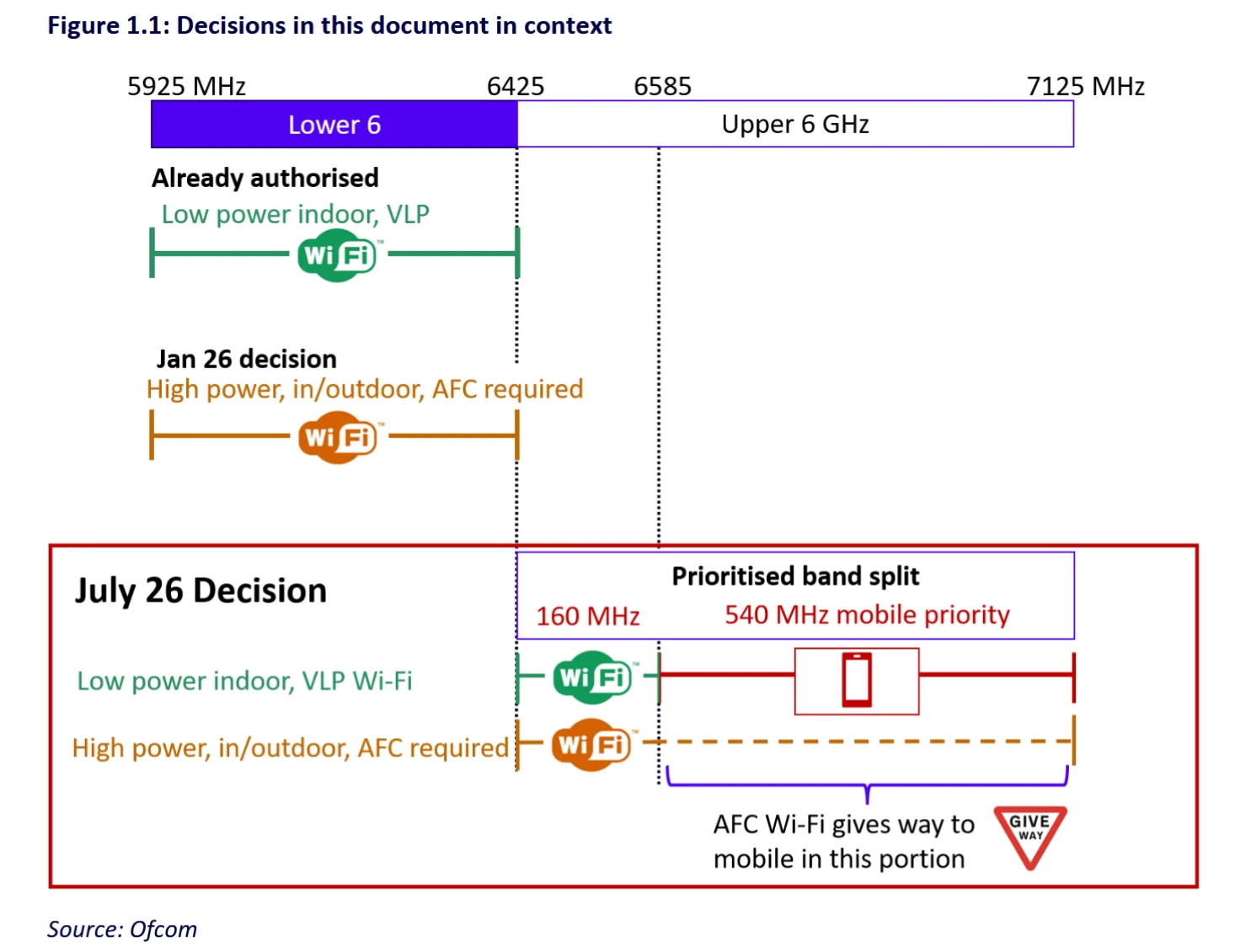
The change will also allow licence exempt Wi-Fi access to the mobile priority portion, albeit only for those devices under the control of an AFC system. “This will enable Wi-Fi use of the full 6 GHz band while ensuring that such use can be managed as mobile deployment occurs,” said Ofcom’s full statement.
David Willis, Group Director for Spectrum at Ofcom, said:
“Everybody in the UK wants faster Wi-Fi and better mobile performance. Our decision today will allow mobile and Wi-Fi services to share the airwaves in the future, helping make this need a reality.”
Ofcom are, however, currently still finalising their plan to adopt a sub-national licensing approach for mobile in the Upper 6GHz band (“the mobile priority” portion), which will award mobile licences in “high density” areas of the UK and will implement a local licensing arrangement (on a first come, first served basis) outside those high density areas.
“We also decided in January 2026 that any mobile award for the Upper 6GHz band will be subnational. This is because the physical characteristics of the band makes it well suited to areas where high volumes of data traffic are concentrated in a relatively small geographic footprint, predominantly urban areas. We will use an approach similar to what we used in the mmWave award by defining geographical “6 GHz high density areas”, which will be the locations where Upper 6 GHz mobile licences are awarded,” said Ofcom’s original announcement.
The consultation on how to define those high density areas (here) is ongoing, although Ofcom plan to publish a final statement outlining their decisions in the autumn (2026). In any case mobile operators won’t be using this until the 2030s and that’s partly due to the lack of hardware support, both in terms of network kit and consumer devices. Plus existing users of the band, such as sensors for sea surface temperature (SST) measurements, will need time to gradually adapt.
Depending upon your perspective, Ofcom’s approach may seem like either a good or bad move, since neither mobile nor Wi-Fi will be able to fully benefit from the Upper 6GHz band in every location. But we’ll need to see how much of an impact hybrid sharing has in the real-world before really being able to judge.