
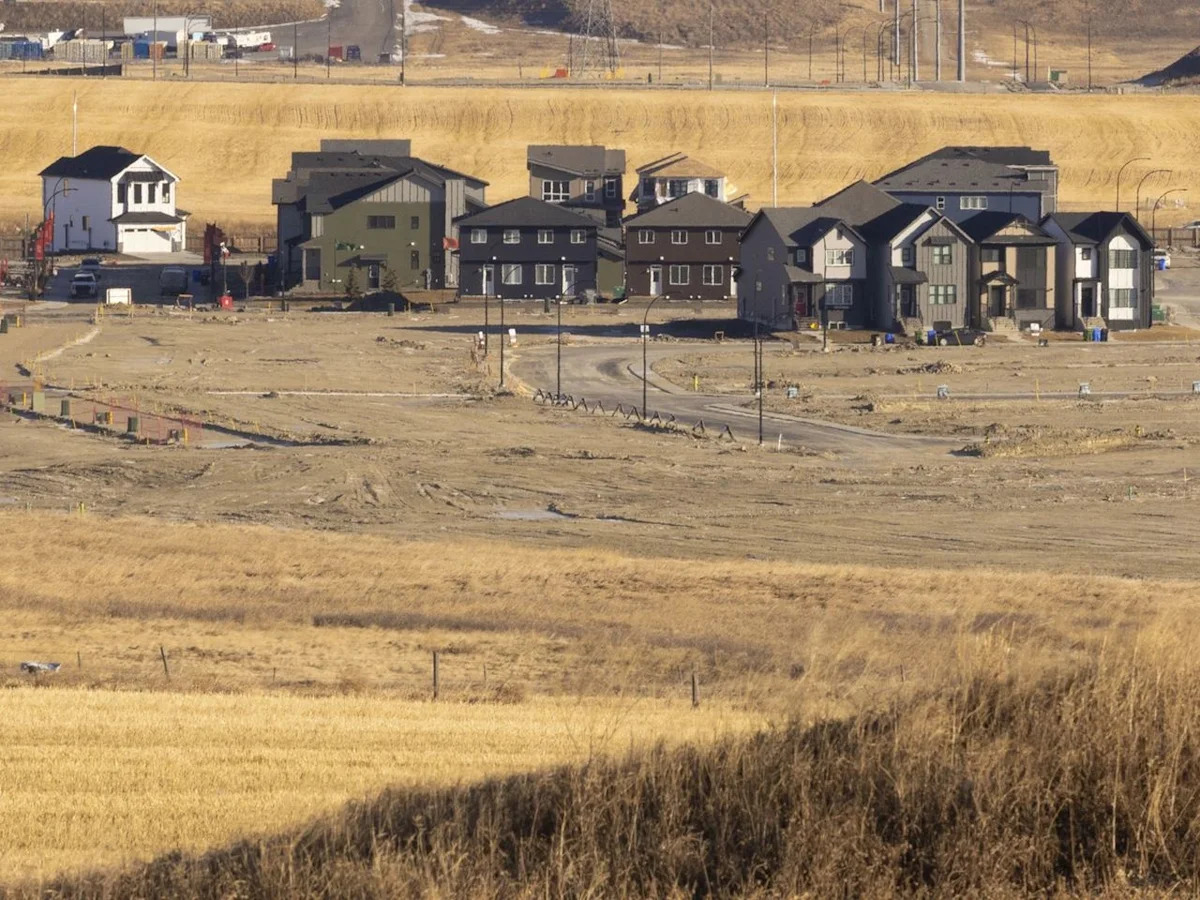
While developers in Alberta’s major cities are building fewer homes than last year, one homebuilder says the market still hasn’t caught up with demand brought on by waves of newcomers to the province.
Over the past several years, Alberta has experienced extraordinary population growth due to both immigration and interprovincial migration. Katrina Rowe, president of communities at Cantiro Homes, says developers simply couldn’t build fast enough to meet demand.
“There definitely was a shortfall,” Rowe said in an interview. “We’re continuing to address that, and it’s hard to pinpoint exactly when we’ll hit a balance.
“I think we’re getting closer and closer to satisfying the built-up need,” she said.
In Calgary and Edmonton, where the Alberta-based developer builds over 500 homes per year, fewer homes got underway in the first six months of this year than in the previous year, when the province was smashing records.

Construction crews work on row houses near Granville Drive and Glastonbury Blvd., in west Edmonton, on Feb. 13, 2026.
The industry started building 22,000 homes in Alberta over the first six months of the year, down 21 per cent from a year earlier, according to data from the Canada Mortgage and Housing Corp. The homebuilding industry across the country has slowed, due in part to weak demand, but activity in Alberta remains relatively strong.
“A slight slowdown in growth is a good thing,” Rowe said. “But we don’t want it to stop entirely either.”
Slowing population growth slowing housing demand
Charles St-Arnaud, chief economist of Alberta-based Servus Credit Union, said the slowdown in new home construction is in line with lower population growth.
“With population growth slowing meaningfully, we don’t need the same pace of supply coming on to the market,” St-Arnaud said.
This year’s construction so far puts the province on track to start pouring concrete for 47,000 homes by the end of the year, before potentially declining further to 35,000 by 2027, according to ATB Economics.
Despite the slower pace of building this year, the number of homes that started in the first six months of the year is still the third highest the province has seen in two decades, according to ATB.
St-Arnaud said the stabilization of new home construction in the province raises questions for builders in the coming years.
“You start to wonder: Are we now at a more kind of a new steady state?” St-Arnaud posed.
The record-breaking building numbers in 2025 were “way too strong,” and some degree of fall-off was expected, according to St-Arnaud.
For builders like Rowe, having balance might be a good thing.
“We’d love to see a bit more stability in Canada’s immigration instead of having a ton of immigration and then turning it off completely,” Rowe said.
“Change and growth can be hard when it happens at the speed at which it’s happened over the last few years,” she said. “But growth is still important to our economy, and our major cities in the province need to continue growing and growing responsibly.”

Katrina Rowe, president of communities at Cantiro Homes, in Edmonton on March 4, 2025. She said a slowdown for new construction is a good thing, but there should not be a stop.
Canada’s record-breaking growth in the wake of the pandemic was driven in part by federal government policies that allowed more people into the country on student visas or as temporary foreign workers. Ottawa was trying to resolve pandemic-era labour shortages, but when it opened the floodgates, many other challenges emerged, including a sharp rise in housing demand.
The federal government later pulled the plug on the strategy by capping the number of non-permanent residents allowed into the country as public opinion toward immigration soured amid rising housing prices and cost-of-living concerns.
While the country’s population has declined over the last three quarters, Alberta’s has continued to grow — albeit more slowly than during the post-pandemic boom.
“The last few years have been incredibly busy,” Rowe said, adding she expects demand for new builds to continue, but more slowly, through this year and beyond.
“The boom and bust that Alberta is known for isn’t the best for residents or for business people, builders, or developers,” she said. “Some stability and consistency would be nice.”
Construction needed to slow down from ‘white knuckle’ pace
Bill Black, chief executive of the Calgary Construction Association, said the “white knuckle” pace of construction was not sustainable in the long term.
“Builders are like farmers,” Black said. “It’s either raining too much or not raining enough. It’s never just the perfect amount of precipitation.”
Still, builders he’s spoken to hold a mixed bag of views on the pace of new construction.
“It depends on which homebuilder you speak to, as to whether they are gloomy or shrugging it off,” Black said. “Some of them are like, we kind of needed it to back off a little bit.”

Bill Black, president & CEO of Calgary Construction Association.
Rowe said that affordability remains a selling point, particularly in the Edmonton region, where Cantiro’s townhouses under $500,000 often sell the fastest.
“There’s starting to be a lot more supply of that product, and so demand is moderating a little bit,” Rowe said, adding that Calgary has seen more people opting for single-family homes.
Mark Parsons, chief economist at ATB Financial, said the slowing housing starts could be a good thing.
“It’s slowed, but from a very high level, unsustainably high level,” Parsons said. “It’s important that it has because we’ve already seen prices correct a little bit and rents fall.
“It’s a really good news story that the housing supply is catching up to the population,” he said.
FP West: Energy Insider brings you behind the closed doors of the oilpatch, with exclusive insights from insiders every Wednesday morning. Sign up now.