
By Hollie Younger / Staff writer, with CNA
If one partner in a married couple has dementia, their spouse is at significantly higher risk of developing dementia themself, Taiwanese researchers found in a study published yesterday.
A nationwide cohort study of nearly 1 million married people in Taiwan from 1998 to 2022 showed that women were 74 percent more likely to develop dementia if their spouse has dementia, compared to 69 percent for men.
The study titled “Spousal Dementia Exposure and Risk of Dementia” was published in the international journal JAMA Network Open yesterday.
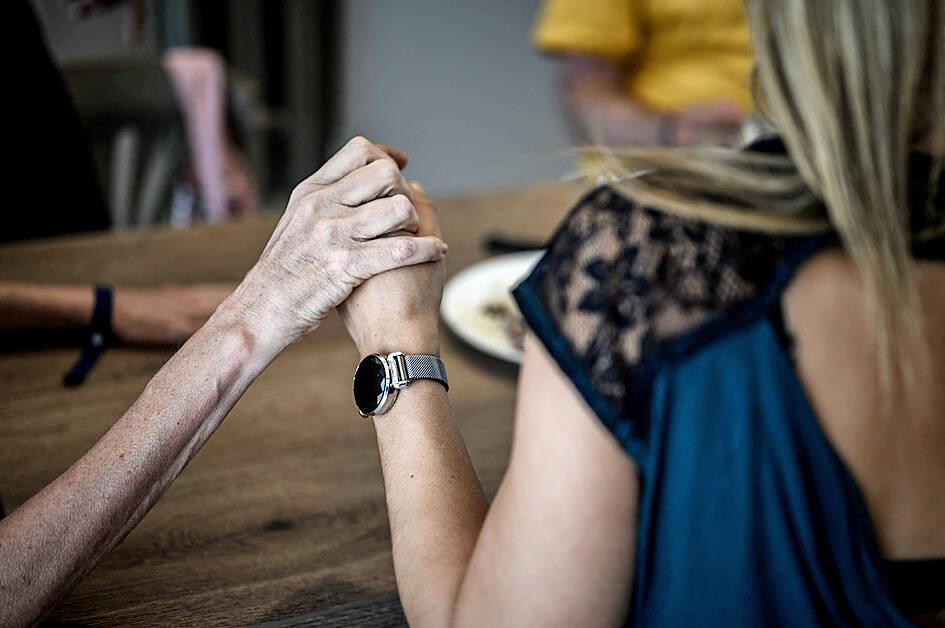
Photo: AFP
Researchers including Wang Shi-heng (王世亨), an associate researcher at the National Center for Geriatrics and Welfare Research under the National Health Research Institutes, analyzed data from the National Health Insurance Research Database of 955,000 married people.
Among spouses whose partners did not have dementia, about six out of every 100 men and three out of every 100 women were diagnosed with dementia.
However, if a spouse developed dementia, those figures rose to nine out of 100 for men and six out of 100 for women over a five-year period.
Similar associations were also found for Alzheimer’s disease and vascular dementia, the researchers found.
Relative risks were more prevalent among younger spouses, while the absolute increase in dementia cases was greater among older spouses, they said.
The researchers suggested possible explanations, including assortive mating — in which people tend to select spouses with similar educational background, socioeconomic status and health behaviors — alongside shared environmental and lifestyle exposures accumulated over the course of their lives.
Moreover, the link may be due to caregiver distress, depression, sleep disturbance, social isolation, metabolic dysregulation, inflammation and adverse health behaviors from living with a spouse suffering from cognitive decline, they said.
Lower-income households and those with fewer children had larger absolute risk differences, they said.
The study does not suggest that caring for a spouse with dementia causes dementia, but rather that these people are in a statistically high-risk group that requires more attention, Wang said.
The link likely reflects shared lifestyle factors, overall health status and the long-term stresses associated with dementia caregiving, said National Health Research Institutes senior attending physician and researcher Wu Chi-shin (吳其炘), a corresponding author of the paper.
Once a person is diagnosed with dementia, healthcare support should extend to include their spouse, including assessments of cognitive function, depression, sleep quality and chronic disease management, the researchers said.
Priority should be given to low-income families, households with fewer children and families lacking alternative caregivers, they added.