
Admit it, you clicked this article quicker than my others. It’s OK, I can handle it. I don’t blame you for looking forward to the days when I have to face the music a little. It comes with the territory.
If there’s one thing I’ve learned in my time at The Athletic, it’s that many of our readers are as interested in reading about the process of our work on the prospects side as the actual product of the work itself. If you’re going to pay to read that work, you need to be able to trust it, too. And nothing builds trust like transparency.
To that end, I’ve endeavored over the years to pull back the curtain on my work through regular reviews of old lists in an effort to highlight my mistakes, check my biases and blind spots, study what I’ve over-/under-emphasized in my evaluations, and hopefully learn from my prior self and get better at the work I do over time.
As you can imagine, after almost a decade and a half of work in the draft space, there’s a long list to choose from. Here are five more players I was either too high or too low on.
As always, just try not to enjoy it too much.
Previous editions: 2025 | 2024 | 2023 | 2022 | 2021
Can Gabe Perreault get to Nikita Kucherov’s level?
Scott Wheeler, Corey Pronman and more
Shane Wright, C, Seattle Kraken (2022 NHL Draft)
Drafted: No. 4
My final ranking: No. 1
The 2022 draft is the class I’ve had the hardest time with in all of my years of doing this work. The players lost all or most of their 16-year-old year (arguably the biggest developmental year in a player’s career) in 2020-21 to the pandemic. Wright was viewed as the projected No. 1 prospect heading into their draft season but had a good but not no-doubt-first-overall kind of year, posting 94 points and finishing eighth in the OHL in scoring. And a vanilla game that lacked a dynamic trait and the feistiness scouts wanted to see from him at times allowed for three players — Juraj Slafkovský, Šimon Nemec and Logan Cooley — to pass him down the stretch. I strongly considered ranking both Nemec and Cooley at No. 1 (I eventually put Slafkovský, a previous focus of this project, in their tier but wouldn’t have taken him No. 1), but neither of them felt like first-overall picks to me either, and so I came back to Wright. He has become a good player, but he may not reach the 30-goal, 70-point ceiling I set for him at the end of my report that year, and Cooley and Slafkovský are already there while he’s in trade rumors. They had the defining attributes you couldn’t find in Wright (Cooley’s skating, pace and puck game, and Slafkovský’s sheer size and puck protection), too.
I think there was a missing je ne sais quoi in Wright as well. I’ll never forget the combine that year, where Slafkovský walked around the hotel in Buffalo like he owned the place and Wright looked like he was forcing it, trying to defend the status he once held. There is something to that — the aura — with the truly world-class athletes.
Eduard Sale, LW, Seattle Kraken (2023 NHL Draft)
Drafted: No. 20
My final ranking: No. 14
The skilled but mercurial, low-compete, low-pace perimeter winger who comes with a top-six-only profile is always one of the hardest players to slot in a draft class. It was the same story this year with Marcus Nordmark, whom the Ducks ultimately took in the late first. And it’s a player type that often busts or ends up as an AAAA type: think Dominik Bokk, Noel Gunler, Arthur Kaliyev. Slotting and projecting Sale came with even more risk because of his record-setting production in Czechia’s junior league, a league that doesn’t produce many first-rounders. There have been a few, though, including Jakub Voracek and Tomas Hertl, whom he out-produced. In hindsight, where I ranked him in the end, and where he went, were both too early to assume that risk, even if his shot, puck skill and touch were all eye-catching at times in his draft year. Some of the translation challenges he has faced in the North American game were predictable.
Dmitri Simashev, LHD, Utah Mammoth (2023 NHL Draft)
Drafted: No. 6
My final ranking: No. 35
If I’m re-drafting 2023 today, I’m still not taking Simashev at No. 6. But he goes a heck of a lot closer to there than he does to where I had him ranked, and there are a couple of things to be learned from my slotting of him as a bubble first-round guy that year. The first is that I gave too much emphasis to the Russian factor in 2022 and 2023 after Russia invaded Ukraine. The second is that the rangy, smooth-skating D is a mid-rounder all day and, if the offense comes, and it has come more than I thought it would for Simashev, he’s a top-10 pick all day in today’s game.
Easton Cowan, RW, Toronto Maple Leafs (2023 NHL Draft)
Drafted: No. 28
My final ranking: No. 97
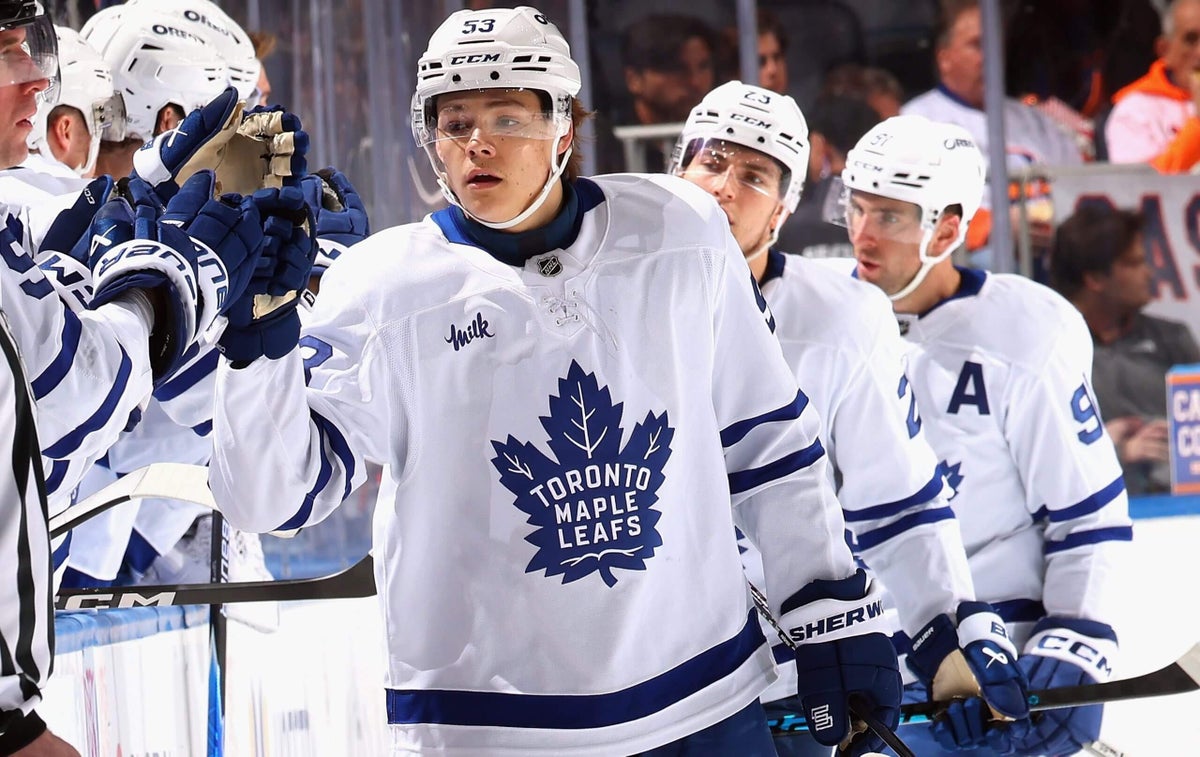
NHL Central Scouting had Cowan listed as a 5-foot-10.5 winger and at No. 51 on their final list of North American skaters for the 2023 draft, and several teams I spoke to thought the Maple Leafs took him early when they drafted him at the end of the first round in 2023. But in hindsight, Kyle Dubas and Wes Clark picked him more or less exactly where he belonged. He really took steps as that year progressed, too, and his line with Denver Barkey and Ryan Winterton was excellent in the OHL playoffs. The Leafs were quick to appropriately recalibrate his progression and projection on the back of those playoffs, trusting that his work ethic and instincts would help him overcome some of the decision-making and IQ pieces that were just OK at the time.
Cowan went on to win an OHL Most Outstanding Player award and OHL Playoffs MVP, put together a historic points streak, finished his career as one of London’s most decorated winners ever and became an NHLer at 20. And while his game can still tunnel vision at times, he has looked like a first-rounder since the very first games he played post-draft back in London.
Beckett Sennecke, RW, Anaheim Ducks (2024 NHL Draft)
Drafted: No. 3
My final ranking: No. 16
On June 26, 2024, in my last piece before the draft, I wrote two things about Sennecke:
1. That I’d move him up two spots from No. 16 on my final list past Michael Hage (No. 15) and Michael Brandsegg-Nygård (No. 14).
2. “One name I’ve had tossed around twice now in the final hours with the Ducks is Beckett Sennecke. I believe Sennecke’s firmly in the mix starting there, and I think the Ducks are considering him.”
I haven’t moved late risers quickly enough on my lists over the years, lingering too long on my initial assessment and projections of guys at times, but Sennecke stings in particular because Oshawa is right in my backyard, and I saw him play more than any other prospect in that class. I had also spoken to a ton of people about him, from the Gens to those who’ve trained him and even Toronto Marlboros staff. And I think that exposure and some of what I’d heard, including the frustrations they’d had with him just that fall, made me too reluctant to slot him where he belonged on talent and upside. I’d also seen, a year prior, how much strength he needed to add and wondered if he’d maximize the runway he had. But the talent and upside were clear, and I should have couched it in continued upward progression in his game and his maturity level, both as a person and physically. He had among the best hands in the class, and he had them in a rapidly growing package. I’d seen his skating start to straighten out, too.
Most importantly, as a lesson, he found another level month to month, and my slotting didn’t keep pace with how quickly he was putting it all together.
It was right there in the first sentence of my scouting report, too: “Sennecke is a high-skill individual player with size who, after an up-and-down start to his draft season, became a game-changer from the CHL/NHL Top Prospects Game on and finished on an emphatic note with an excellent playoff performance with the Gens, regularly pulling people out of their seats.”
He should have been in my Tier 3 (which ran from Zeev Buium at No. 4 to Konsta Helenius at No. 11) and not Tier 4, and I needed to have a shorter-term memory in my process.