
Prime Tire Newsletter | This is The Athletic’s F1 newsletter. Sign up here to receive Prime Tire directly in your inbox twice a week during the season and weekly in the offseason.
Welcome back to Prime Tire, where today I spent several hours traveling along a Belgian highway, contemplating the confusing race at Spa, which was impressively won by Mercedes driver Kimi Antonelli.
It’s not the most beautiful of routes along the pan-European E40 (a 5,000-mile road connecting France with northeast Kazakhstan, of all places), once the stunning hills of the Ardennes Forest are in your rearview mirror.
And that about sums up where F1 is right now, with its baffling new cars.
I’m Alex, and Madeline Coleman will be along later.
Spoiled: Are classic tracks worth it in the modern era?
“It sucks. I can’t really say it any other way than that,” said McLaren driver Oscar Piastri.
“When you’ve got qualifying grids decided by computers behaving or misbehaving … it’s a pretty crap way of going racing.”
As we covered in PT after the British GP, Piastri had been glum on the prospect of driving the previously fearsome Circuit de Spa-Francorchamps with the engine-electrical-energy-starved new F1 cars. And that was before he even arrived for the race which he won impressively in 2025.
Midway through the Spa weekend, Piastri was decrying a new element of how the engines work, costing him valuable time against his teammate Lando Norris.
McLaren also suspects this is what is hurting Mercedes driver George Russell against Kimi Antonelli, according to what it can see in its data.
“This seems to be pretty much the same across the two Mercedes cars. When you overlay Antonelli and Russell, it looks like Lando and Oscar,” McLaren team principal Andrea Stella told reporters after Spa qualifying.
This all centers on how the engine control units are essentially studying how a driver has acted on one lap, then adjusting how the electrical energy is deployed for top speed in real time on the next. The teams can’t simulate it — the engines are doing it by themselves.
We’re going to be getting into this in greater detail in the coming weeks on The Athletic’s website, as it’s a hideously complex topic that requires proper explanation.
There’s another neat summary of F1 2026.
But my biggest gripe with this is that there’s a line in F1 sporting rule B1.8.1 that states: “The driver must drive the F1 car alone and unaided.”
Is an engine deciding itself how much power a car should have unaided? I don’t think so. This is the very flummoxing thing with these cars and engines, and F1 overall in 2026.
These same machines at the Circuit de Barcelona-Catalunya last month were predicted to deliver a snoozefest due to the high overtaking challenge for drivers with how the aerodynamics worked on previous generations of cars. Instead, it was a classic.
If a formula can turn Barcelona into an intriguing race with plenty of overtaking at the front, it clearly has merits. But how it also neuters the challenge of legendary tracks such as Spa highlights its considerable downsides.
When I came to the Belgian GP during the COVID-19 impacted season in 2020, the track was empty.
I stood alone at the fence overlooking the final corners for all three practice sessions and regularly, as the drivers braked from around 200 mph down to just 45 mph for the Bus Stop chicane, there were thrills and spills: snatched brakes and cars running wide, lurid slides as a driver tried too much apex speed, the stunning motion of the majestic, downforce-laden Mercedes W11 as it swung easily from apex to apex.
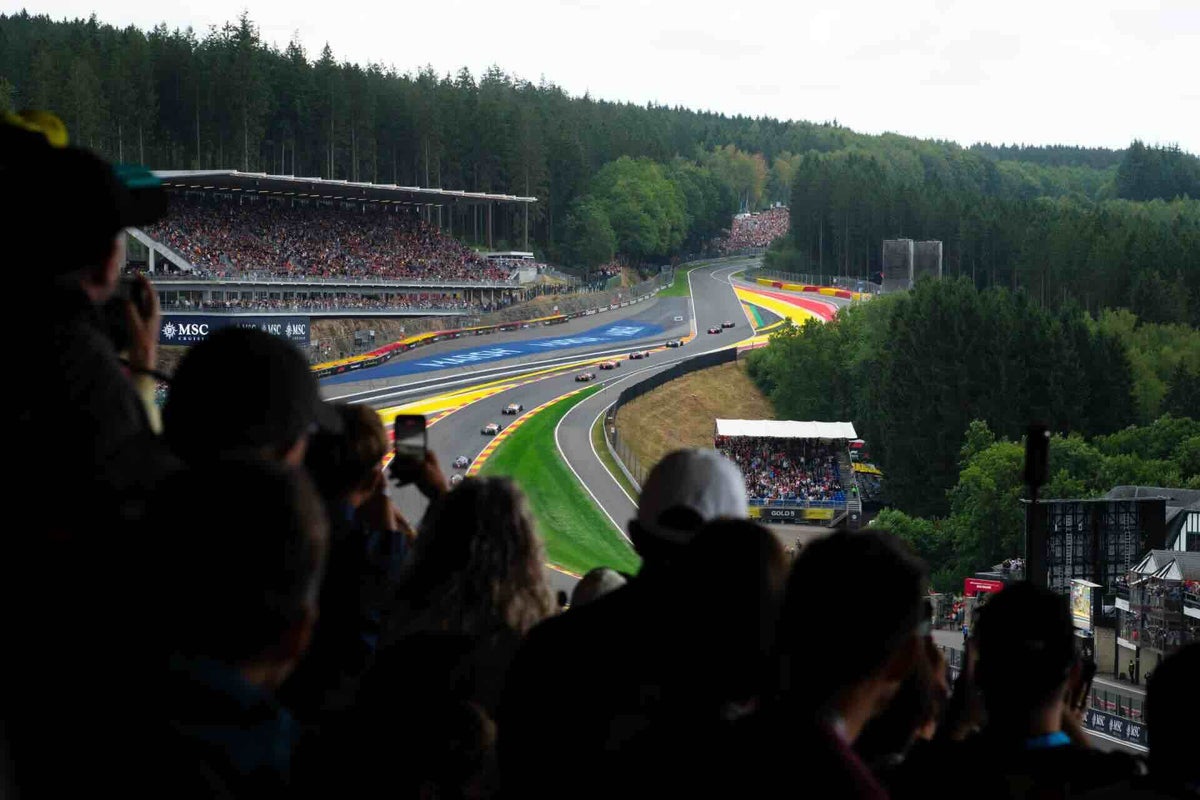
Watching from behind the catch fencing in front of the same sequence for qualifying at the 2026 Belgian GP (pictured above), I saw none of that. Why? Well …
The cars had depleted their engine energy way back at the start of Spa’s third sector, and so the drivers simply had to brake at the same point each time and gently turn in for the chicane.
Every lap, supposedly at the moment drivers should be at the ultimate limit of their speed in qualifying and therefore at high risk of errors, looked identical. And dull.
Yet at Spa, watching at Eau Rouge/Raidillon for opening practice the day before, the new, slightly more nimble cars of this season looked a treat. They were jinking around on the savagely steep hill’s compressions and bumps at high speed. Because here the engines were deploying electrical power.
F1 2026 giveth and F1 2026 taketh.
I really hope the rule changes coming for 2027 and 2028 make a difference in reducing the swings between good racing and bad. And if not, I guess I’m just going to have to accept that not every race can be a classic, as was the case in previous F1 eras. It really stands out right now that duds are coming at tracks that used to be celebrated and loved.
And that’s confusing, even in a season of extreme bafflement.
Take nothing away from Antonelli though, he’s doing an excellent job at the front of the field. Antonelli (204 points) leads Ferrari’s Lewis Hamilton (159), teammate George Russell (154) and Ferrari’s Charles Leclerc (126) in the drivers’ standings. Now let’s throw it to Madeline to go over Ferrari’s prospects.
Inside the Paddock with Madeline Coleman: Will Ferrari be fast in Hungary too?
The simple answer would be … 🤷. Like so many times this season, what is said before a race weekend may not be accurate come Sunday.
The Belgian GP is a great example.
Leclerc finished last Sunday’s race in second, his fourth podium finish of the season, and he reminded everyone during the post-race news conference that Ferrari was “expected to be very far back, maybe to the extent of four or five tenths” compared to Mercedes.
This prediction held true in qualifying, where Leclerc qualified fifth (and 0.532 seconds slower than pole-sitter Antonelli) and Hamilton qualified sixth.
The race was a different story, as Leclerc battled Antonelli late and ultimately finished just 1.952 seconds behind the Mercedes after 44 laps. This followed Leclerc’s victory in the British GP, and both Silverstone and Spa were anticipated to be tracks that wouldn’t suit the Ferrari car particularly well.
But not only has the team taken a step forward, so has Leclerc, who struggled to find a rhythm while Hamilton appeared stronger just a few races ago.
“I’m confident in saying that I made a step forward. Whether I’m at the level where I want to perform, (the answer is) not yet,” Leclerc said. “There are still things in the car that I need to drive around. I cannot drive completely naturally, and that is slowing me down in some parts of the race.”
As far as what to expect of Ferrari in Hungary later this week, Leclerc is remaining cautious. The technical Hungaroring track won’t be as energy starved as Silverstone or Spa, and the drivers can simply just drive, as they did in Monaco.
“It’s very difficult to predict the level of performance of every team,” Leclerc said. “I recall the overall feeling before Monaco very well. We arrived and were underperforming compared to what everybody thought we would …”
Back to you, Alex.
‘Another Step’: Red Bull team boss praises Hadjar
Red Bull team boss Laurent Mekies was clearly in a hurry to leave the Spa paddock on Sunday night.
When his post-race news conference took place, almost two hours after the race concluded, Mekies had changed into his unbranded team-issued traveling kit. And before the final question was asked, Mekies rose back up and attempted to say his goodbyes, before media personnel said he wasn’t quite done.
Mekies’ time at the team’s facilities during these back-to-back race weeks will be short. Mekies will have just a few days debriefing the Belgian events in Red Bull’s Milton Keynes factory north of London before flying over to Budapest for the Hungarian GP.
It’s been a tough second half to his first calendar year as Red Bull team boss — after his predecessor Christian Horner’s axing last July.
In 2026, Red Bull launched its first engine on Mekies’ watch, but, as we covered a few weeks back in PT, the pressure on the Frenchman to deliver a big performance step with its 2026 car package is now huge. This will ultimately determine if Max Verstappen sticks around through the end of his current contract, through 2028.
But one thing Mekies hasn’t had to deal with in 2026 is the drama over Red Bull’s second seat, which plagued the end of the Horner era. Isack Hadjar has stepped up to both dutifully assist Verstappen when required and back the Dutchman up with good race results of his own.
This is exactly what happened at Spa.
After Hadjar helped Verstappen gain critical time to start on the front row alongside Antonelli, with perfectly executed tow tactics in qualifying, he started 21st as a result of a penalty for taking more engine components than drivers are allocated in a whole season.
But Hadjar bounced back to finish an impressive sixth last Sunday.
He gained with pitstops under both the race’s real and virtual safety car periods, and did great work keeping his tires alive and holding off the charging Norris at the finish.
Mekies called it Hadjar’s “best race with us, no question,” after his fellow Frenchman joined Red Bull from its junior team, Racing Bulls, for the start of the 2026 campaign.
“Honestly, it’s not only a spike (of raised performance),” Mekies said of Hadjar. “He’s been just a little bit better every single race for speed. He’s bringing some speed every time he’s driving.
“Today is another step.”
Outside the Points
🏆 Luke Smith broke down Antonelli’s mighty win at Spa, with insight from Mercedes team boss Toto Wolff.
🐎 Madeline explained why Ferrari was handed a fine for its botched pit stop during the Belgian GP, where Hamilton accidentally hit a mechanic.
🤓 ICYMI, you can read about all the major moments from the Belgian GP, as well as everything Luke and I spotted behind the scenes, in our race-day liveblog.
📫 Love Prime Tire? Check out The Athletic’s other newsletters.