
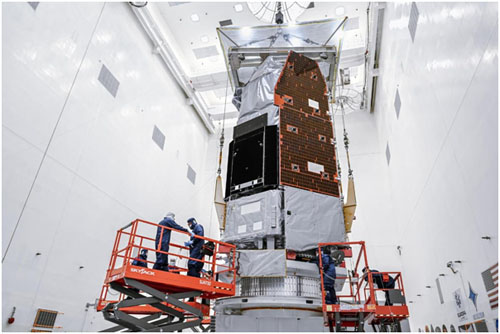
 Technicians and engineers at NASA’s Kennedy Space Center in Florida use a crane to lift the agency’s Nancy Grace Roman Space Telescope to a specialized work stand June 26, 2026, as the mission prepares to launch nine months ahead of schedule. [ NASA/Sydney Rohde (Rocz)]

Tuesday July 21, 2026 | WASHINGTON, DC [Posted at 5:16 pm PDT]
by Mary P Brooke | Island Social Trends
The Nancy Grace Roman Space Telescope mission will be previewed by NASA on July 29.
The Nancy Grace Roman Space Telescope mission is scheduled to launch from the agency’s Kennedy Space Center in Florida on Sunday August 30.
The mission is preparing to launch nine months ahead of schedule.
The Roman Space Telescope will offer a field of view at least 100 times larger than the Hubble Space Telescope’s, resulting in deep, sweeping explorations of the cosmos.
July 29 briefing:
NASA will stream this event live through a variety of platforms, says NASA Headquarters in Washington, DC.
The July 29 briefing about the mission and its status will include:
Shawn Domagal-Goldman, director, Astrophysics Division, NASA Headquarters in Washington
Jackie Townsend, Roman telescope project manager, NASA’s Goddard Space Flight Center in Greenbelt, Maryland
Julie McEnery, Roman telescope senior project scientist, NASA Goddard
Jeremy Perkins, Roman telescope integration and test scientist, NASA Goddard

Panoramic view:
Named after NASA’s first chief astronomer, the Nancy Grace Roman Space Telescope will have a deep, panoramic view of the cosmos, generating never-before-seen pictures that will revolutionize our understanding of the universe, said NASA in a statement today.
“The observatory will usher in a new era of cosmic surveys, unveiling troves of celestial objects and shedding light on some of the universe’s most profound mysteries, including phenomena we can’t see,” says NASA.
“Roman also will showcase cutting-edge technology, including a test of the most advanced technology ever flown in space to directly image planets around nearby stars, a key step in NASA’s search for life on other worlds,” says NASA.

Managed in southern California:
The Roman telescope is managed at NASA Goddard with participation by the agency’s Jet Propulsion Laboratory in Southern California; Caltech/IPAC in Pasadena, California; the Space Telescope Science Institute in Baltimore; and a team of scientists from various research institutions. The primary industrial partners are BAE Systems Inc., L3Harris Technologies, and Teledyne Scientific & Imaging.

International contributions:
Contributions to Roman also are made by ESA (European Space Agency), JAXA (Japan Aerospace Exploration Agency), the French space agency CNES (Centre National d’Études Spatiales), and the Max Planck Institute for Astronomy in Germany.

===== RELATED:
NEWS SECTIONS: AEROSPACE | ARTIFICIAL INTELLIGENCE | NASA