
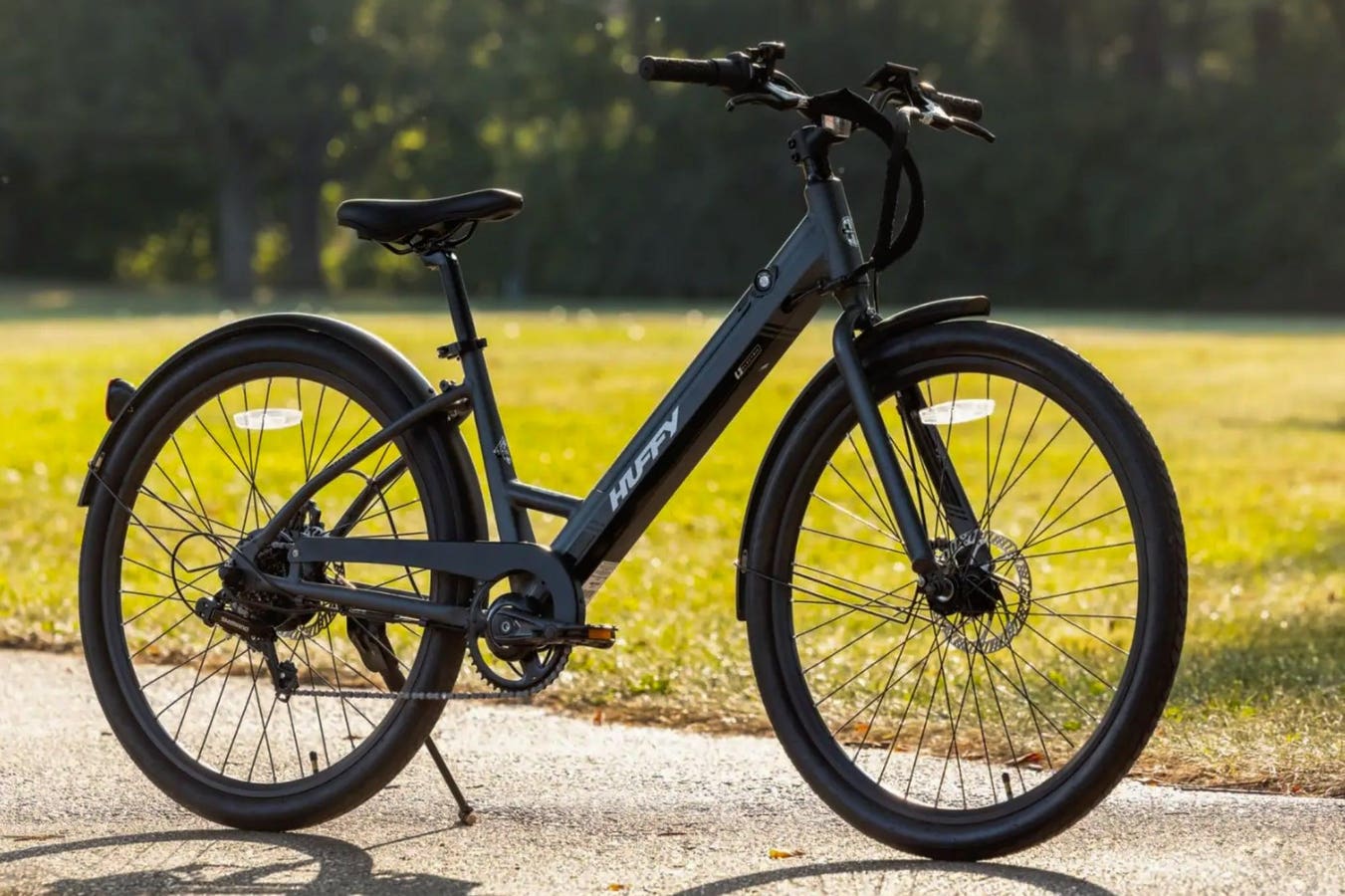
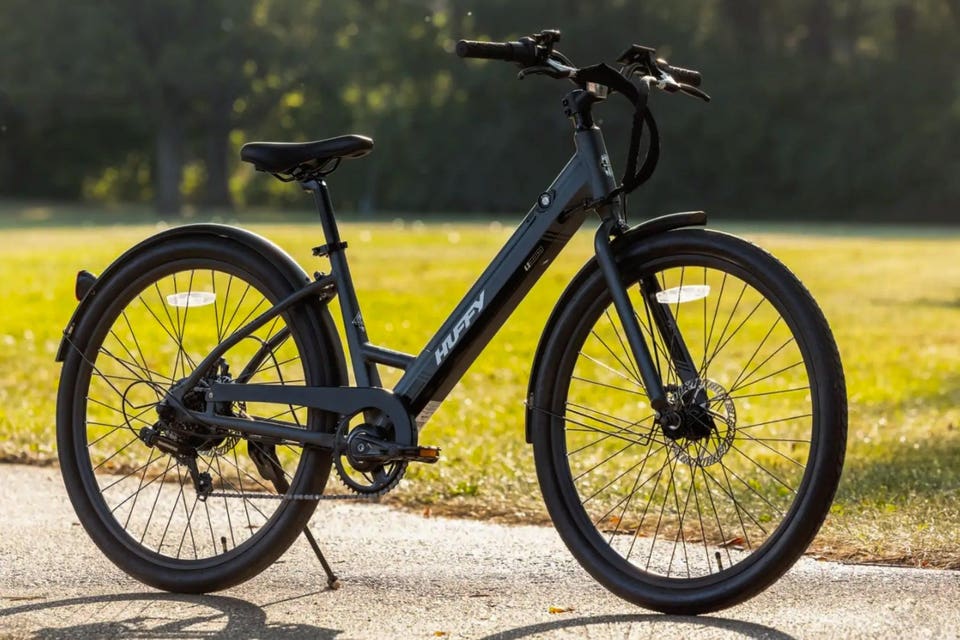
My review bike arrived with a matte black finish that made daytime photos…. challenging.
William Roberson
Back in the 1970s, I was just another kid riding BMX bikes, and there was no shortage of aspirational bike brands. We all wanted that new, super-lightweight FMF, a PK Ripper, or a chromoly Mongoose (which I eventually attained). And, in truth, we scoffed at the kids riding lowly Huffys. Riding a Huffy meant you were either ignorant of all those “better” bikes, or your parents were too poor (or didn’t care) to get you something “better.” But very often, the Huffy riders had the last laugh. Huffys weren’t fancy, lightweight, or “cool,” but they were damn near impossible to break. And never mind that, historically, they were the No. 3 bike maker in the U.S., and riders in the 1984 and 1988 Olympics raced them to podium finishes (the bikes were actually built by Serotta in cooperation with Huffy, but they said “Huffy” on the frame, as below).
Huffy/Serotta race bikes from the 1984 Olympics look a bit…. odd, but they were good enough to win a gold medal.
Huffy
But eventually, cheap off-brand department store bicycles sapped Huffy sales, and in 2004 the company filed for bankruptcy. Today, Huffy operates under the Untied Wheels umbrella, which is operated by Hong Kong-based Covation Holdings Limited, which also owns Niner, Batch and Buzz e-bike brands, among others.
Today, of course, Chinese-made bicycles and e-bikes of all stripes are common at every price and performance level, and under Covation, the Huffy brand soldiers on, over 125 years after it was founded. In 2020, Huffy began making electrified bicycles, aka “e-bikes,” and today offers a dozen different e-bike models, none more expensive than $1,299, and most well under $900. And while the 10-year-old in me would have loved to try out an eThunder e-bike, the 6-foot-1, 220-pound adult me recently received a Huffy Vienna step-through, which sells for a very reasonable $599 MSRP. Would it be the same old story: Can the Huffy stand up to and perform as well as current aspirational e-bike brands? After a simple, quick assembly to get the Vienna road-ready, it was time to find out.
Huffy Vienna Tech Overview
The Huffy Vienna looks simple because it is. But it’s also fun to ride and easy to work on.
Huffy
Once assembled, the Huffy Vienna immediately hit a soft spot with yours truly. A decade ago, I bought my first e-bike (for over $1,500), and the Vienna’s specs and components are nearly identical: a 350-watt rear hub motor, a backlit LCD display, a 6-speed Shimano rear gearset with a twistgrip shifter, a thumb throttle, and cable-operated disc brakes. My first e-bike had a standard frame, while the Vienna is a step-through design with a lower spar for added frame rigidity, making it more accessible to more people. Also, the Vienna’s 36-volt, 7.8Ah battery is a bit larger than the power pack on my first bike (which had to be charged off the bike, by the way), and the Huffy rolls on more modern 27.5-inch wheels instead of my OG bike’s 26-inchers.
The small display packs a lot of information, including motor power output, battery level, assist level, odometer, and more.
William Roberson
The Vienna’s display is also more comprehensive, with a power output graph, a trip meter, and a ride timer. The brakes, while cable-operated, do an effective job of slowing and stopping the Vienna. A bike bell comes standard.
My review of Vienna did not include a headlight or tail light (there is a reflector on the rear fender), so I mounted the excellent OutBound Lighting Detour headlight and the radar-equipped Garmin Varia RTL515 tail light, which communicates with my smartyphone and is securely held on the handlebars by a Peak Design Mobile Out Front phone mount.
Ride Review
The Huffy Vienna is right at home wandering the neighborhood – or laying down a solid commute.
Huffy
When reviewing e-bikes, the first “test” I usually perform is to see how the e-bike rides unpowered, that is, how it works as a regular bicycle. Many e-bikes are now so heavy as to be almost useless without some assist engaged, but the Vienna again echoed my original e-bike in that it rides quite nicely (and normally) with no power on, or with the electrics activated but assist set to off. Yes, it’s heavier than a straight analog bike while in “analog” mode, but until a serious hill is encountered, the gears, brakes, pedals, and so forth perform as you would expect a normal bicycle to.
Ease on the power (there are five levels of assist), and the ride improves as the pedals combine with the rear hub, which is nearly silent at lower settings and emits only a slight whir at full power. The Vienna uses an old-school cadence sensor, but because the rear motor is only 350 watts at maximum, engagement is smooth and unobtrusive.
Heading up my hill test, I set the assist to maximum and geared the Shimano rear derailleur to first gear. The Vienna climbed the hill at a decent pace while I sat on the seat and pedaled with a modicum of effort. Once at the top of the mile-long climb, only one nit had come off the battery, and the Vienna flew down the backside of the hill at over 30 mph with confidence. I was worried the lower-end, cable-operated disc brakes would be overwhelmed by the higher speeds on the downhill, but they brought the Vienna to a halt without drama or noise. No complaints!
It’s unusual for a $600 e-bike to come with fenders, let alone the metal full-coverage splash guards on the Vienna.
William Roberson
Back in the flat, I again set the assist to maximum, stopped pedaling, and pinned the thumb throttle on the left bar. The Vienna accelerated to its 20 mph limit without issue and held that speed for several miles on my long ride home.
Despite being a step-through, the Vienna exhibited little frame flex thanks to a small bracing bar at the bottom of the frame. Indeed, the Vienna rode quite well thanks to its larger wheels, fairly wide tires, and neutral geometry. This is a bike you can ride all day in comfort. Even the seat was well-shaped and comfortable.
I rode the Vienna for several weeks, sometimes running errands, but mostly just rolling around the neighborhood and enjoying the spring and early summer weather. The Vienna is the kind of e-bike that keeps it simple and just works, letting the rider focus on the journey rather than the bike. It shifted cleanly, ran quietly, and stopped predictably. It was fun to ride, and that’s probably the biggest compliment I can give any e-bike.
Conclusion – Who Is The Huffy Vienna E-bike For?
The Huffy Vienna is a nice-looking bike with solid build quality and just the right amount of power for first-time e-bike riders – or analog purists who need a bit of help on the hills.
William Roberson
It was refreshing to get out on the Huffy Vienna, a simple e-bike that cuts to the core of the cycling experience and then adds a bit of electrical frosting to extend the ride and stir in some fun. This is a great e-bike for anyone curious about e-bikes but unwilling to drop huge money on one, but it’s also a solid choice for anyone who’s been off bikes for a while and looking to go riding again, whether as a commuter or just for fun.
There’s nothing exotic here, no app to connect to, no complicated technology, just a well-built bike that’s affordable, fun, and ready to go pretty much out of the box; just add a headlight and taillight.
Unlike my original e-bike, the Huffy includes metal fenders, a metal chain guard, and a battery that can charge in or out of the bike – all for a third of the price of my old bike. It goes farther than my old bike, rides better, and is quieter under power. It’s comfortable and highly rideable, with bonus points for the simple but informative display and quiet operation.
If I could change anything, I’d tell Huffy to upgrade the brakes to hydraulic, add LED lighting, and tack on $50 (or $100) to the price and call it good. But overall, the Huffy Vienna is an affordable option for first-time e-bikers, or anyone looking for a bit more zip in the pedal power while staying on budget.
Thank you for reading. Subscribing to Forbes.com allows you to leave comments and supports contributors like myself. You can also follow me on Facebook and LinkedIn.