
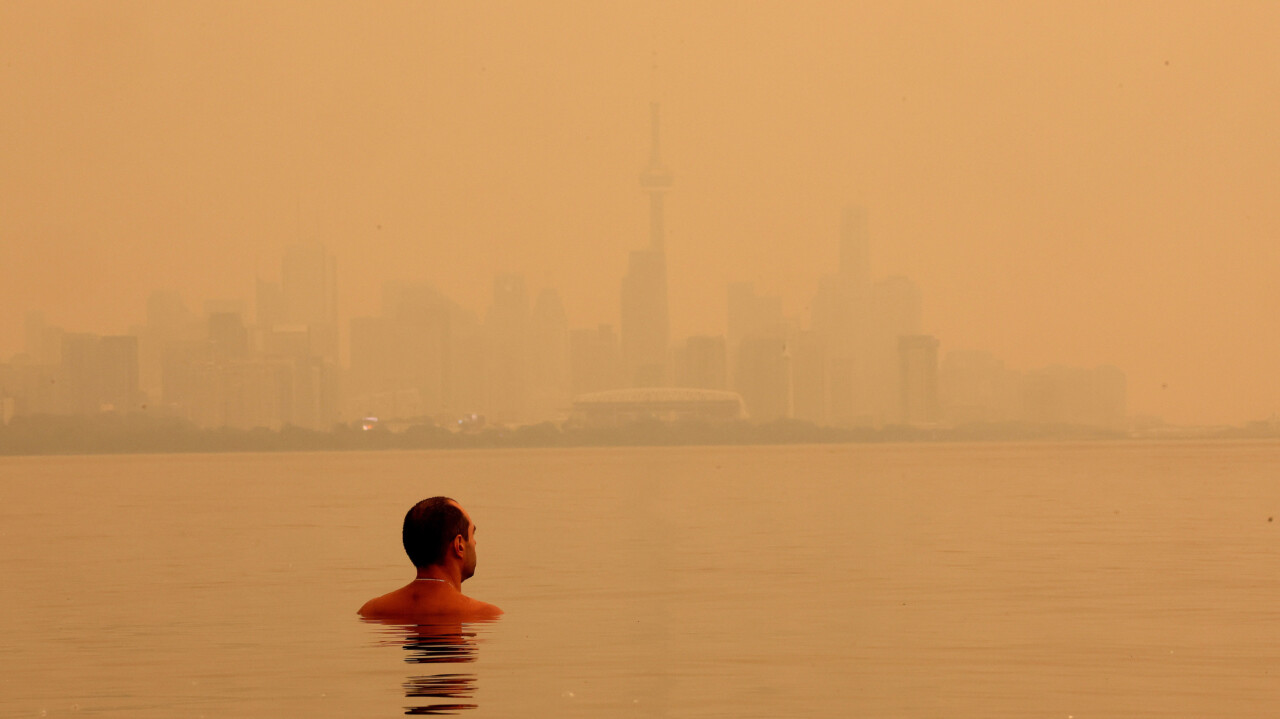
As wildfires continue to burn throughout western Ontario, decimating the sacred territory of two First Nations communities, turning skies Halloween hues, and pushing toxic wildfire smoke as far east as Maine and New York City, President Donald Trump has come up with a unique remedy: taxing our neighbors to the north.
Trump posted on Truth Social last Friday—two days before he was set to stand next to Canadian Prime Minister Mark Carney at the World Cup final—that the United States had been “invaded” by dirty air, and that the “cost of this pollution must of necessity be added to the TARIFFS Canada is currently paying.”
There’s a lot to dissect from Trump’s dizzying proclamation.
First, there’s the fact that while Canadian fires have burned at least 1.8 million acres—leading Toronto, New York City, and Washington, D.C. to record some of the worst air quality levels in the world over the weekend—Canada is far from the only source of wildfires.
Utah, Oregon, and Washington are all experiencing an intense wildfire season, with active blazes that have burned 270,000 acres, 400,000 acres, and 100,000 acres, respectively, thus far this year. A fire in Northern Minnesota has burned 63,000 acres so far, which forced the Boundary Waters Canoe Area Wilderness to close and added to the hazy smoke mixture.
Nearly 41,000 fires have burned more than 3.9 million acres across the U.S., with some blowing north into Canada, according to Canadian officials. Officials in British Columbia warned residents on Saturday of smoky conditions arriving from across the border.
Then there’s Trump’s call to price pollution. It’s a pretty interesting refrain, given that it’s the Environmental Protection Agency’s job to set limits and evaluate the economic and social costs of air pollution. And yet, Trump has actively worked during both his terms to weaken those obligations.
One of the clearest examples is an announcement from January that the EPA will no longer factor the cost of human life into cost-benefit analyses for new air pollution rules. For decades, the agency used the “value of a statistical life”—currently estimated at $11.7 million—to justify regulations that prevented premature deaths. That value effectively became $0.
Lastly, there’s the question of what caused these fires in the first place. U.S. fires out west are largely a result of an abysmal snowpack last winter, termed a “snow drought,” which led to an extreme summer drought and created perfect conditions for raging fires. The Canadian fires are being attributed to a combination of lightning strikes, human activity, and extremely dry and hot conditions. Rising global temperatures are worsening wildfires, according to NASA, whose data shows that extreme wildfire activity has more than doubled worldwide over the last 21 years.
Another cause for concern is the readiness of firefighters. Part of the issue, critics say, is a strain on wildland firefighter resources. Across the U.S., 20,939 firefighters and support personnel are engaged in fighting fires, according to the National Interagency Fire Center. The Forest Service staffs up in the summer season, but a hollowing out of full-time staff last year—along with the White House’s proposed budget cuts to the service and a planned headquarters move that is expected to lead to layoffs—has led to incredibly low morale.
And here’s a kicker: Trump’s Truth Social tweet argued that Canada’s fires were due to “not properly maintaining their Forests, and Brush therein.” But the very agency the Trump administration is aiming to shrink budgets of by 75% is the same one responsible for forest and brush management in the U.S. The Forest Service’s Pacific Wildland Fire Sciences Laboratory in Seattle, run by fire behavior scientists, is also on the chopping block.