
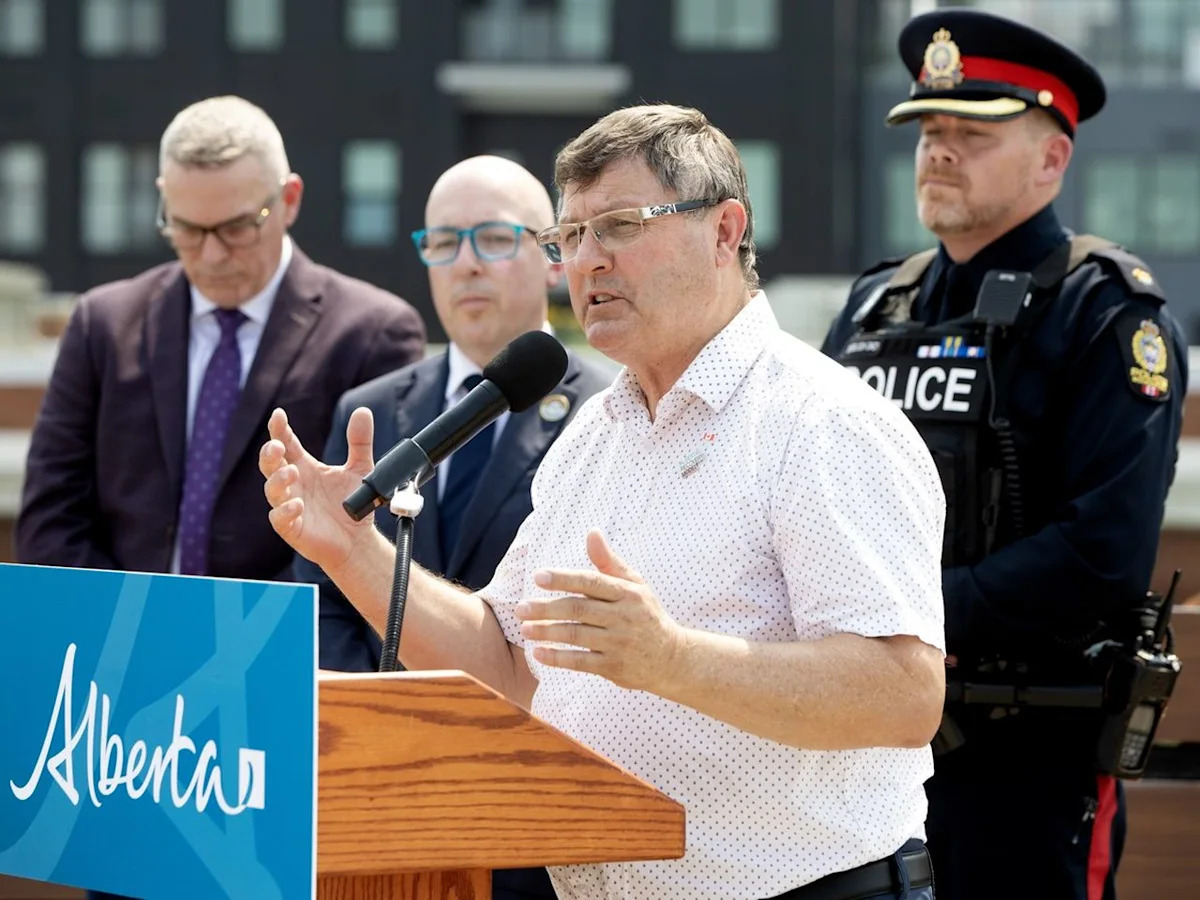
One siren after another sounded outside the Hope Mission on Wednesday as hopeful city and provincial officials met to announce a $30-million package for addiction recovery.
In the mix, a new capacity for involuntary intervention to spare beds in existing facilities and 400 new beds for recovery — as well as a high-tech short-term integrated stabilization centre at Edmonton police headquarters, and a 105-bed involuntary intervention facility for youth to open late fall or early next year.
Involuntary intervention plans
“Right now, we can only hold kids for up to 10 days, another five if we get permission. We need to have more time, so we got the legislation changed and we’ve got the building made where we can actually hold kids for up to 90 days,” said Mental Health and Addiction Minister Rick Wilson said.
Now the other supports are in place, the province can roll out involuntary intervention, Wilson said, pointing to spare beds at existing facilities to help.
“We’re going to be taking some beds from other facilities that were underutilized, and we’ll be starting compassionate intervention,” he said.
It is an occasion for both hope and honesty, said Wilson.
“Edmonton’s facing serious pressures related to addiction, mental health, and housing instability. Too many people are struggling, and too many are facing several of these challenges all at once. And the data — it’s alarming — when I first got in here, I found it almost overwhelming. More than half of all opioid deaths in Alberta — sorry, mayor — they happen right here in Edmonton, along with nearly two-thirds of all emergency health services responses,” Wilson said.
Wilson pledged $30 million for “new and strengthened outreach, navigation and stabilization services, recovery-oriented addiction treatment, mental health care, emergency shelter spaces, supportive housing, and much more.”
“Supports must work together so people can move from crisis to stability, and from stability to recovery,” Wilson said, touting expanded access to “recovery-oriented” care through the Alberta recovery model for mental illness and addiction, an approach that’s been controversial in some quarters.
Wilson said the 400 promised beds doesn’t even include the involuntary intervention that’s been a bone of contention amongst social activists.
He cited 75 new recovery beds at Enoch Cree First Nation, 40 per cent of them for women. Additionally, the Enoch Cree have a drop-in centre Downtown, and the Métis Nation of Alberta has a recovery community at Métis Crossing on the river, and a New Beginnings centre Downtown.
Construction is underway on brand new 150-bed buildings in Edmonton and Calgary, Wilson said.
“As we keep rolling this out, that’s going to start impacting the whole province. You’re going to start seeing a real, noticeable difference where we’ve been able to actually get people into treatment quicker. Before if somebody wanted to go into treatment, we’d get them started, and there’s no place for them, and then they’d go back on the street, and then they’d go back into detox, and it’s just kind of a roller coaster,” he said.
Calgary a model
Wilson pointed to a rapid-access addiction medicine clinic and virtual office options and Calgary’s success with wrap-around services for individuals in recovery.
“When I was down at Calgary Stampede, I took a walk around and went to all the different businesses, and they were just so thankful to be able to get their businesses back. These people have invested their life savings into these businesses, and and we need to support them as well,” he said.
Lethbridge previously had the highest opioid death rate and now has the lowest, Wilson said, attributing the improvement to a drug called Sublucade.
“It takes away the ability for the drug to actually, in most cases, kill people, and takes away their want for it, their need for it, the addiction of it,” Wilson said.
Oxford House in Calgary will be coming to start its pre-treatment program at Hope Mission in Edmonton, Wilson said.
A nod and a wish list
Mayor Andrew Knack praised the province’s investment, happy not to have to “go it alone” to solve the city’s tumultuous issues.
“Today is a major step forward in achieving that this work, and also I think marks a refreshed relationship between the City of Edmonton and the provincial government, which is very exciting,” Knack said.
The mayor pointed to the success of the city’s most recent community health hub pilot which saw a 321 percent increase in visits by youth over a six-month period.
“So I’m excited about the opportunity to work directly with the provincial government on how we fund those community health hubs together as part of our upcoming four-year budget deliberations later this year,” Knack said.
“And our investments in supportive housing provide long-term solutions for those in recovery, and we can amplify this together.”
Detention detox
Opening later this summer, the Edmonton Police Service will have 18 recovery beds for detainees under the influence, 24-7 on-site medical support from Recovery Alberta, and a state-of-the-art body scanner to detect drugs or weapons.
Each room is equipped with a non-intrusive biometric sensor to monitor heart rate, respirations, temperature and movement as individuals “sleep it off” and detox.
Once stabilized by the Recovery Alberta medical team under involuntary detention, the intention will be diversion away from the justice system, connecting individuals to voluntary treatments and supports, said Edmonton police Insp. Michael Dreilich.
Frontline officers are frequently the first responders to individuals in crisis, bearing witness to the profound human impact of addiction and the growing strain on emergency services and the impact on community, he said.
“EPS has recognized the urgent need to pivot our response and reimagine our approach to addiction, overdose, and social disorder linked to this crisis,” Dreilich said.
Related
Bookmark our website and support our journalism: Don’t miss the news you need to know — add EdmontonJournal.com and EdmontonSun.com to your bookmarks and sign up for our newsletters.
You can also support our journalism by becoming a digital subscriber. Subscribers gain unlimited access to The Edmonton Journal, Edmonton Sun, National Post and 13 other Canadian news sites. The Edmonton Journal | The Edmonton Sun