
Lana Putnam was already doing something that made her feel small: climbing onto a Vancouver bus without fare money and hoping to get where she was going before anyone noticed. Then she tripped.
Putnam, a 70-year-old Cree Elder, was carrying her belongings when she fell in front of the other passengers. She wasn’t helped up; she was scolded. “Some of the people were saying, ‘Everybody pays,’” she said. “Instead of being worried about my fall.”
Putnam’s experience is what a new clean-mobility pilot program in Vancouver is trying to address: how to make everyday travel more affordable and usable for lower-income urban Indigenous residents in one of Canada’s most expensive cities while also cutting transportation emissions.
In Metro Vancouver, a single fare covers 90 minutes of travel after a rider taps in. Longer trips can mean paying again and anyone without valid proof of payment can face a $173 fine.
Putnam now carries a free Compass card through the pilot program, which gives 50 residents in her BC Indigenous Housing Society building six months of free public transit.
Putnam found out about the card through a program worker who regularly comes to the building with coffee and Timbits, sets up in the common area and talks with tenants as they pass through. Since the cards arrived, she has noticed mothers with children, older women and other neighbours using the bus more easily.
“I notice a lot of people are happier,” she said.
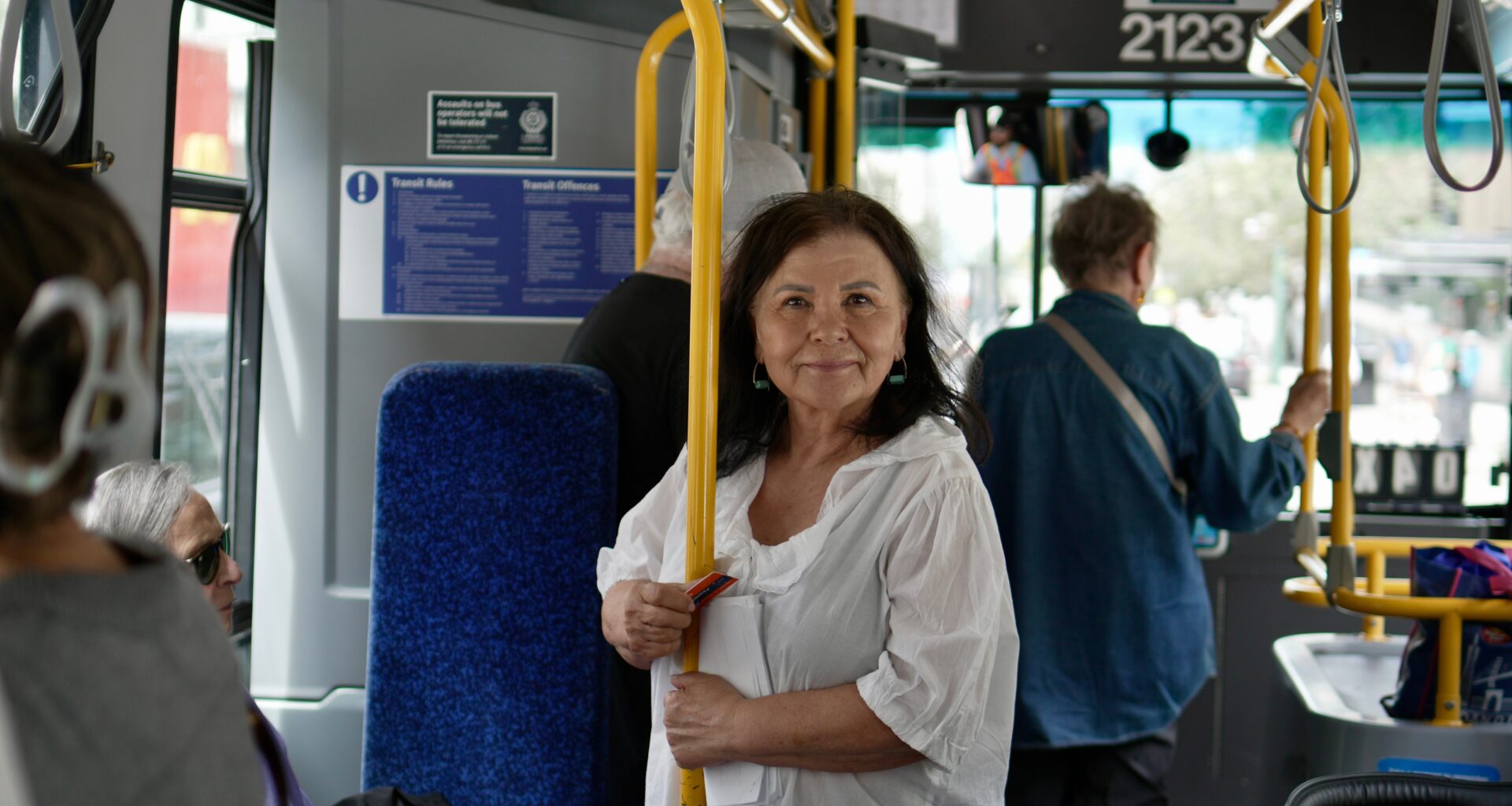
 Lana Putnam waits for a TransLink bus in downtown Vancouver. Photo by: Sonal Gupta / Canada’s National Observer
It’s also delivering material results.
The transit stream launched last December, with residents joining on a rolling basis. By the end of June, participants had taken 4,096 trips by TransLink bus, SeaBus and SkyTrain, according to Kambo Energy Group’s Create Climate Equity, which runs the project in partnership with BC Indigenous Housing Society and the Aboriginal Housing Management Association.
The program also includes a shared electric vehicle parked at the building and booked through Modo, the BC car-share co-operative. Since the car arrived in April, residents have taken 155 rides as of July 9, with 11 drivers registered to use it. Residents can reserve the car through the Modo app up to 10 days in advance and participants who do not drive can get rides from volunteer neighbours.
Mobility pilot built into housing
The pilot is backed by $500,000 from Natural Resources Canada, with support from BC Hydro.
Kambo Energy Group said the funding covers the design and delivery of the multi-year pilot, which involves cross sector partnerships. It does not disclose internal budgets, funding allocations or financial arrangements beyond the information already shared.
Along with the free transit cards and shared EV, the project includes workshops, gatherings and weekly drop-in booths where staff answer questions, provide updates and collect feedback from residents. Organizers are also planning a Ride & Drive Day at the end of August — a block-party-style event intended to connect residents with local partners and give them hands-on experience with EVs.
Andrea Reimer, a former three-term Vancouver councillor and adjunct professor at UBC’s School of Public Policy and Global Affairs, said Metro Vancouver already has a mix of fare-relief programs: children 12 and under ride free, many post-secondary students receive U-Pass BC through school and the BC Bus Pass program serves eligible low-income seniors and people receiving disability assistance.
What makes the Indigenous clean-mobility pilot different, she said, is that it brings several supports directly into one housing community instead of relying on residents to find a program, prove eligibility and apply on their own. She added the issue is not only affordability for Indigenous residents but building confidence with options they may not have had before and enabling them to use those options free from harm or discrimination.
“For Indigenous folks, when they come to the city, providing opportunities for them to have access to transit, for sure, but even when they have access, almost like an invitation onto it,” Reimer said. “These options haven’t existed for Indigenous people in their communities.”
Reimer said Vancouver has used transportation supports including car-share, bike-share and transit passes tied to some developments as parking requirements were reduced. Those measures can help reduce car dependence and support lower-emission travel, but they share the weakness of many pilots: the benefits often expire while the need remains.
Broader free transit would require senior governments to replace lost fare revenue, Reimer said, because transit agencies are already under funding pressure and cannot absorb free fares while also being expected to maintain or expand service.
Claris Canta, project manager with Create Climate Equity, said the project began after the federal government started looking at electric-vehicle education for urban Indigenous communities. Rather than begin with an EV and build a program around it, Canta said, the organization wanted residents to define the problem first.
During consultations, residents described transportation as expensive and sometimes hard to navigate with some people needing help understanding available programs. Their research also pointed to whether transportation programs were culturally appropriate and respected “the unique needs of Indigenous communities,” Canta said.
Rivers Stonechild, a single father from Muscowpetung Saulteaux Nation in Saskatchewan and a longtime Vancouver resident, is another participant in the pilot. Before moving into the BC Indigenous Housing Society community, Stonechild and his son had been sharing a cramped studio apartment in Gastown, just outside the Downtown Eastside.
When Stonechild’s car began breaking down over the winter, the shared EV helped him keep up with groceries, errands and trips to his son’s school in East Vancouver, preserving the continuity of a school community his son has known since kindergarten.
 Rivers Stonechild, stands beside the Modo shared electric vehicle used by residents in the Vancouver mobility pilot. Photo by: Sonal Gupta / Canada’s National Observer.
The car also gave Stonechild his first chance to try an electric vehicle, something he had not previously had access to, just as conflict between Iran and the US was pushing up oil prices, he said. And it made a trip to Seattle that he and his son had talked about for more than a year possible; he said he likely would not have taken if it meant spending around $200 on gas.
But the drive showed him the weak points in the charging network. The shared vehicle uses a BC Hydro card that works at BC Hydro and FLO stations in Canada; in the US, it works only at FLO stations and drivers may have to pay out of pocket if the card is not accepted. Near Seattle, Stonechild ended up on back roads in the rain looking for a charger that had only recently been repaired after two weeks out of service. On another trip to Kelowna, a stop in Hope took nearly three hours to bring the battery to 80 per cent.
“It’s a little tricky, though, because of the infrastructure,” he said, noting that charging stations are often out of service. “I believe we’re still playing catch-up.”
Stonechild said the pilot made him consider switching to an EV, both for the savings and because climate change, wildfires and his son’s future are often on his mind. “What’s going to happen to our kids when we’re gone?” he said. “What type of world are we going to leave them?”
The Indigenous clean mobility pilot is expected to run until December and Stonechild worries about losing it after residents have begun building routines around it. “It would be heartbreaking,” he said.
Project partners say they are still looking for funding to keep the pilot running. Kambo Energy Group did not clarify whether the initial federal funding reflects what it would cost to continue the program.
Putnam, who moved to Vancouver from Whitehorse five years ago, said Vancouver has been a hard place to be visibly Indigenous. People are quicker to look away and stereotypes follow Indigenous people onto buses, into stores and through housing in a way she did not experience in the North.
The free transit card cannot undo that, but it lets her board the bus without bracing for judgment, leaving a little more of her pension for better food after rent is paid. She said meeting people where they are makes the biggest change.
“I don’t have to sneak on the bus,” she said. “It’s helped me to be able to feel okay.”
Sonal Gupta / Local Journalism Initiative / Canada’s National Observer.