
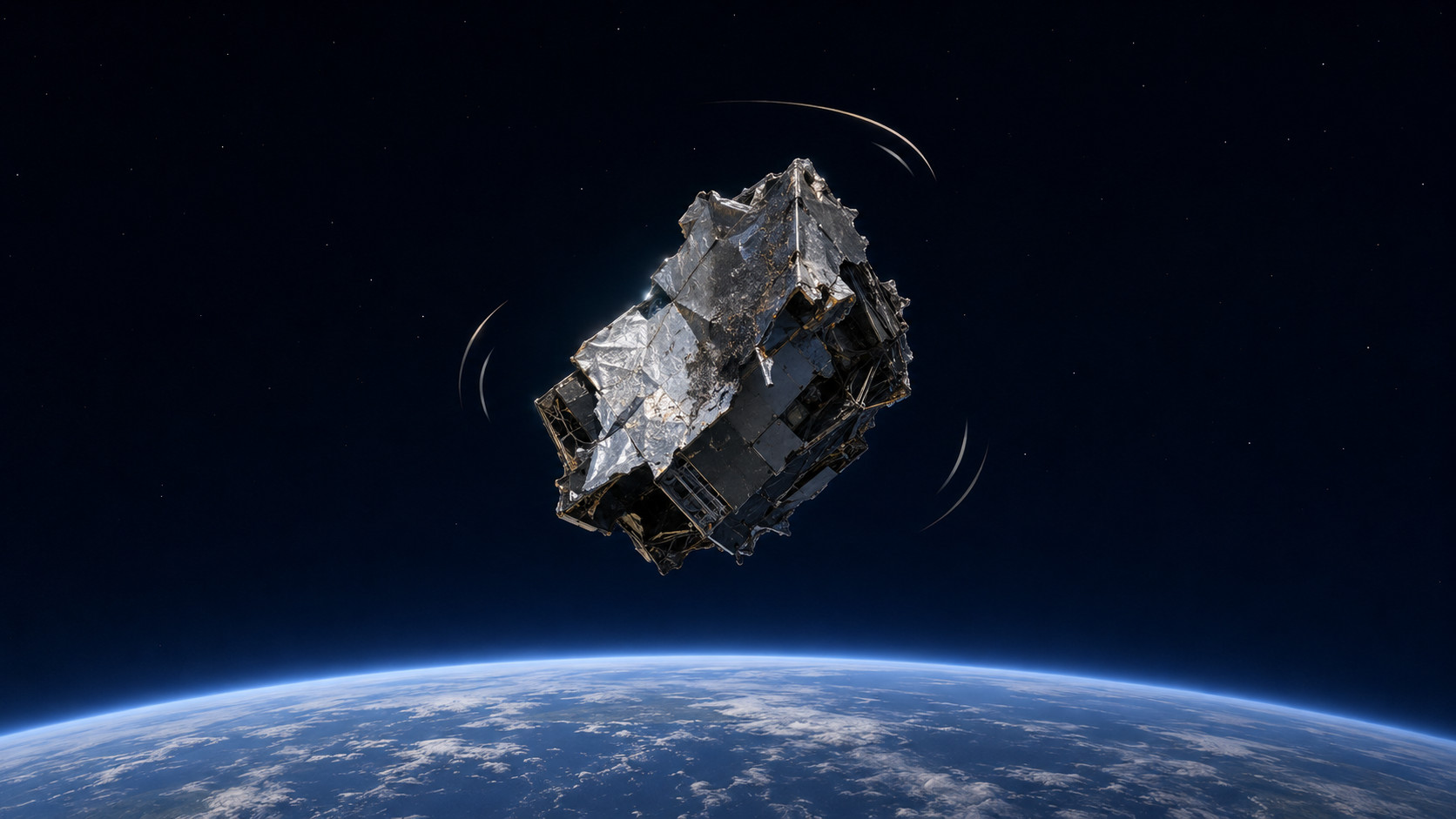
 An artistic depiction of the roughly 66-centimetre fragment tumbling in geostationary orbit. Not to scale.
Astronomers have measured a suitcase-sized piece of space junk as it tumbled about 36,000 kilometers above Earth.
The fragment, roughly 66 centimeters across, came from Intelsat 33e, a communications satellite that broke apart in 2024. Researchers fired radar pulses from Massachusetts and caught the faint echoes with Jodrell Bank’s Lovell Telescope in England. From those echoes, they worked out that the debris rotates once every 15.6 seconds.
Even more remarkably, they did it with a telescope built to study distant stars and galaxies—not debris orbiting Earth.
A satellite shattered without warning
Intelsat 33e was a 6.6-ton communications satellite launched in 2016. It operated in geostationary orbit, the narrow region above the equator where satellites circle Earth at the same rate that Earth rotates. From the ground, they appear to hover over the same spot.
On October 19, 2024, Intelsat 33e suffered an anomaly and broke apart. The company declared the spacecraft a total loss, while tracking organizations began detecting fragments spreading through the geostationary belt. Commercial sensors eventually reported roughly 500 observable pieces. But those were only the fragments large and bright enough to track consistently.
An analysis published by the European Space Agency’s Space Debris Office estimated that the breakup could have created about 16,000 fragments larger than one centimeter. That’s thousands of uncontrolled objects moving through the same region as valuable commercial, military and weather satellites.

In low Earth orbit, atmospheric drag slowly pulls debris downward until it burns up. Geostationary orbit is different. At about 36,000 kilometers above Earth, there is essentially no atmosphere to slow objects down. Unless someone removes them, many fragments can keep circling Earth for thousands of years.
So the obvious question is: how do you track something that small, that far away?
×
Thank you! One more thing…
Please check your inbox and confirm your subscription.
A telescope becomes a space radar
Radar works by transmitting radio waves and listening for the echoes reflected by a target. The longer the signal takes to return, the farther away the object is.
Phoebe Ryder, a PhD researcher at the University of Manchester, wanted to test whether radio telescopes built for astronomy could help detect and characterize small debris in geostationary orbit. She presented the results at the UK National Astronomy Meeting (NAM2026) in Birmingham.
The experiment connected two instruments on opposite sides of the Atlantic. MIT Lincoln Laboratory’s Millstone Hill Radar, near Boston, transmitted radio pulses toward the debris. The 76-meter Lovell Telescope at Jodrell Bank, near Manchester, listened for the returning echoes.
This setup is called bistatic radar because the transmitter and receiver are in separate locations. A conventional radar system usually sends the signal and receives the echo from the same site.
The distance made the experiment particularly difficult. A radar signal weakens as it spreads toward its target, and then weakens again as the reflection travels back to Earth. By the time an echo returns from geostationary orbit, it can be almost lost in the background noise. But the Lovell Telescope was designed to detect extremely faint radio emissions from distant stars and galaxies, making it an unusually sensitive radar receiver, and there’s also an advantage to this approach.
 Millstone Hill transmitted radar pulses toward the debris, while Jodrell Bank’s Lovell Telescope captured the faint reflected echoes. Artistic depiction, not actual telescopes, and not to scale. Credit: ZME Science.
“The fact that the receiver is separate to your transmitter means that you can you don’t need to switch between transmit and receive, which means that you can have a lower overall system noise, which also increases the sensitivity, and this increase in sensitivity is really needed,” Ryder said during her NAM2026 presentation.
“So without any additional cost, you can increase the sensitivity of your radar setup,” Ryder added. She was referring to the sensitivity already built into the telescope, rather than suggesting that the wider experiment itself was free.
With this approach, they were able to image a remarkably small piece of only 66 cm (26 inches) at 36,000 km away.
An image that’s not exactly an image
The result isn’t a photograph. The fragment is far too small and distant for that.
Instead, the telescope recorded faint radio echoes. Those echoes proved the object was there. More importantly, they changed in a repeating pattern.
As the fragment tumbled, different edges and surfaces reflected different amounts of radar energy back toward Earth. Sometimes the echo grew stronger. Sometimes it faded. The pattern repeated every 15.6 seconds.
The researchers followed those frequency changes through multiple rotations. Each moment gave them a slightly different radar view, because the tumbling fragment kept presenting a new side to Earth. They then combined those views mathematically.
“It’s not necessarily an image… This is a bit like a CT scanner,” Ryder said during her NAM2026 presentation. Of course, there’s a twist.
A medical CT scanner takes measurements from several angles and combines them into a view of the body’s interior. In this experiment, the telescope remained on Earth while the fragment’s own rotation supplied the different angles.
Can we use this practically?
Ryder’s team observed the Intelsat fragment in February 2025 and analyzed the recorded echoes afterwards. That was enough to prove the method worked, but debris moving through an operational satellite belt cannot wait for weeks or months of processing.
Operators need to know where a fragment is heading while they still have time to act, and the wider project has now moved closer to that goal. According to the University of Manchester, this was only the first live demonstration of this long-baseline multistatic radar technique and things have progressed. “We actually do this in real time now,” Ryder said at NAM2026.
Future networks could connect Lovell with additional radio telescopes and communications antennas in Britain and other countries. Each receiver would view the same object from a different direction, helping researchers narrow down its position, calculate a more accurate orbit and determine whether it is tumbling or breaking apart.
Such a network could also respond rapidly after a satellite failure. It could search for newly created fragments, help identify which detections belong to the same debris cloud and direct other radars or optical telescopes toward objects that require closer attention.
Of course, tracking alone won’t remove the problem of debris. As more and more satellites go into orbit, the risk of unmonitored pieces flying randomly increases substantially.
Yet, the 66-centimeter fragment is proof of what may be possible. Astronomers turned a telescope designed for distant galaxies toward a far more immediate problem—and showed that some of the small, long-lived hazards around Earth may not have to remain invisible.
The paper’s abstract can be read here. It has not yet been peer-reviewed.