
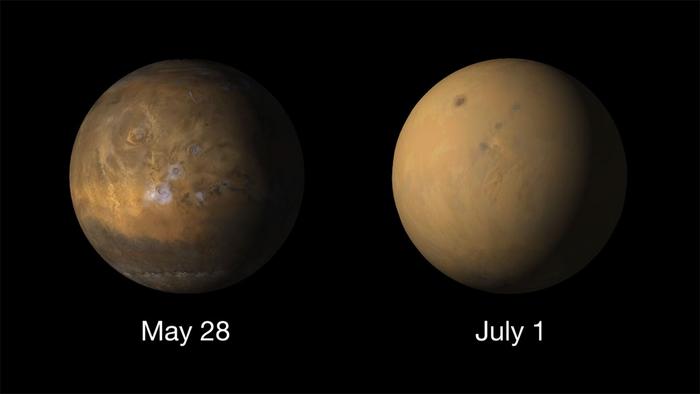
How does space weather influence Martian weather? This is what a recent study presented at the Royal Astronomical Society’s National Astronomy Meeting in Birmingham (NAM2026) hopes to address as a team of scientists investigated a connection between space weather and Martian weather. This study has the potential to help scientists better understand external processes that could influence Martian weather, which would impact current and future missions to the Red Planet. The talk “Do Solar Energetic Particle events impact lower-atmospheric temperatures on Mars” can be found in the NAM2026 conference program at 14:15 BST on Tuesday 21 July 2026 in room TLC PW117.
For the study, the researchers studied five separate space weather events called solar energetic particle (SEP) events that impacted Mars with the goal of ascertaining how space weather influences the Martian weather in its lower atmosphere. The primary motivation behind the study was to ascertain the long-term impacts of space weather events could influence Martian weather in the lower atmosphere, which is where the everyday weather occurs on Mars. In the end, the researchers found that four of the five events resulted in no influence on Martian weather.
However, the fifth event occurred during a global dust storm in June 2018 with the researchers identifying increased temperatures in the Martian lower atmosphere. This global dust storm was the one that unfortunately resulted in the ending of the Opportunity rover mission, as the massive dust cloud prevented the small rover from charging its batteries.
“Dust storms were not originally part of our investigation, so finding one happening at the same time as the heating was unexpected,” said Lana Williams, who is a PhD student at Lancaster University and lead author of the study. “It suggests that Mars’ atmosphere and weather may respond to several events acting together, rather than each source of heating operating independently.”
What new insights into space weather and Martian weather will researchers make in the coming years and decades? Only time will tell, and this is why we science!
As always, keep doing science & keep looking up!
Sources: Royal Astronomical Society’s National Astronomy Meeting, EurekAlert!
Featured Image Credit: NASA/JPL-Caltech/University of Arizona