
D
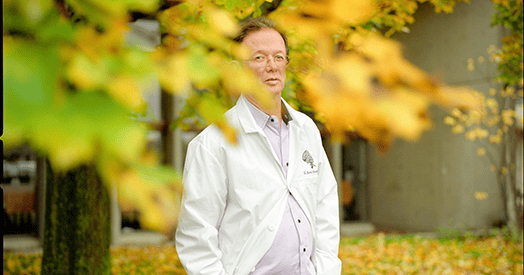
unbar was born in Birmingham, England, on 4 January 1956 to Irish parents who had emigrated for work. But the family returned to Ireland not long after, and Dunbar attended Presentation College Bray for secondary school, where “he was always the little nerd in the family” and in school, Petitto says. He was passionate about science but also had interest in literature and the human mind.
He attended University College Dublin to earn a B.A. and then an M.A., both in psychology and logic. He needed to take the Graduate Record Exam to continue his graduate studies, but when he showed up at the exam site, there was only one remaining test available for both him and another waiting student. They flipped a coin, and Dunbar won. He enrolled at the University of Toronto the following year, where he earned his Ph.D. in psychology.
In 1986, McGill University had an opening for a faculty position studying “the discipline of higher cognition,” says Petitto, who was assistant professor of psychology there at the time. When he was hired, “his office was put right next to mine,” she says. They married three years later and eventually had three daughters together.
At McGill, Dunbar put his focus on studying the scientific mind. He found that unexpected results were not rare detours from the scientific process but a central part of it, he told Wired in 2010. Where unexpected results led depended on how researchers interpreted them: as errors to be discarded or an “anomaly” worth pursuing, he said.
Those observations sparked a broader interest in the cognitive processes behind scientific discovery. “I think the thing that he was excited most about was, even with the scientific reasoning work where he studied the scientists in the lab, was the use of analogies,” Fugelsang says.
I don’t know anyone else in the field who has performed such a rich analysis of the real-world scientific reasoning process.
—
—
Jonathan Fugelsang
D
unbar and his family moved to New Hampshire in 2001 so that both Dunbar and Petitto could take positions at Dartmouth College. There he began exploring the neural basis of conceptual change, asking experimental questions such as whether physics training changes how the brain responds to motion that violates Newtonian physics, says Fugelsang, who collaborated with him on the work.
In trained physics students, the anterior cingulate cortex—which detects conflicts between expectation and reality—responded to videos showing physically impossible motion but not to videos of Newtonian motion, a pilot functional MRI study revealed. In non-physics majors, however, the results were reversed.
The findings also implicated a brain region associated with executive control. The dorsolateral prefrontal cortex lit up in the physics students when they watched the non-Newtonian video, suggesting they were actively suppressing an intuitive but incorrect belief. That the cortex was involved was already known, Petitto says, but the experiment “helped polish the diamond.”
Dunbar’s interest in how people generate and evaluate ideas also led him toward a related question: how those cognitive processes could be understood—and supported—in educational settings, which led to the creation of the Center for Cognitive and Educational Neuroscience at Dartmouth in the 2000s. In 2004, Petitto and Dunbar published one of the foundational papers in educational neuroscience.
“Now the discipline is solid. There are textbooks in it; there are Ph.D. programs in it,” Petitto says. “He helped take the field from nothing to something.”