
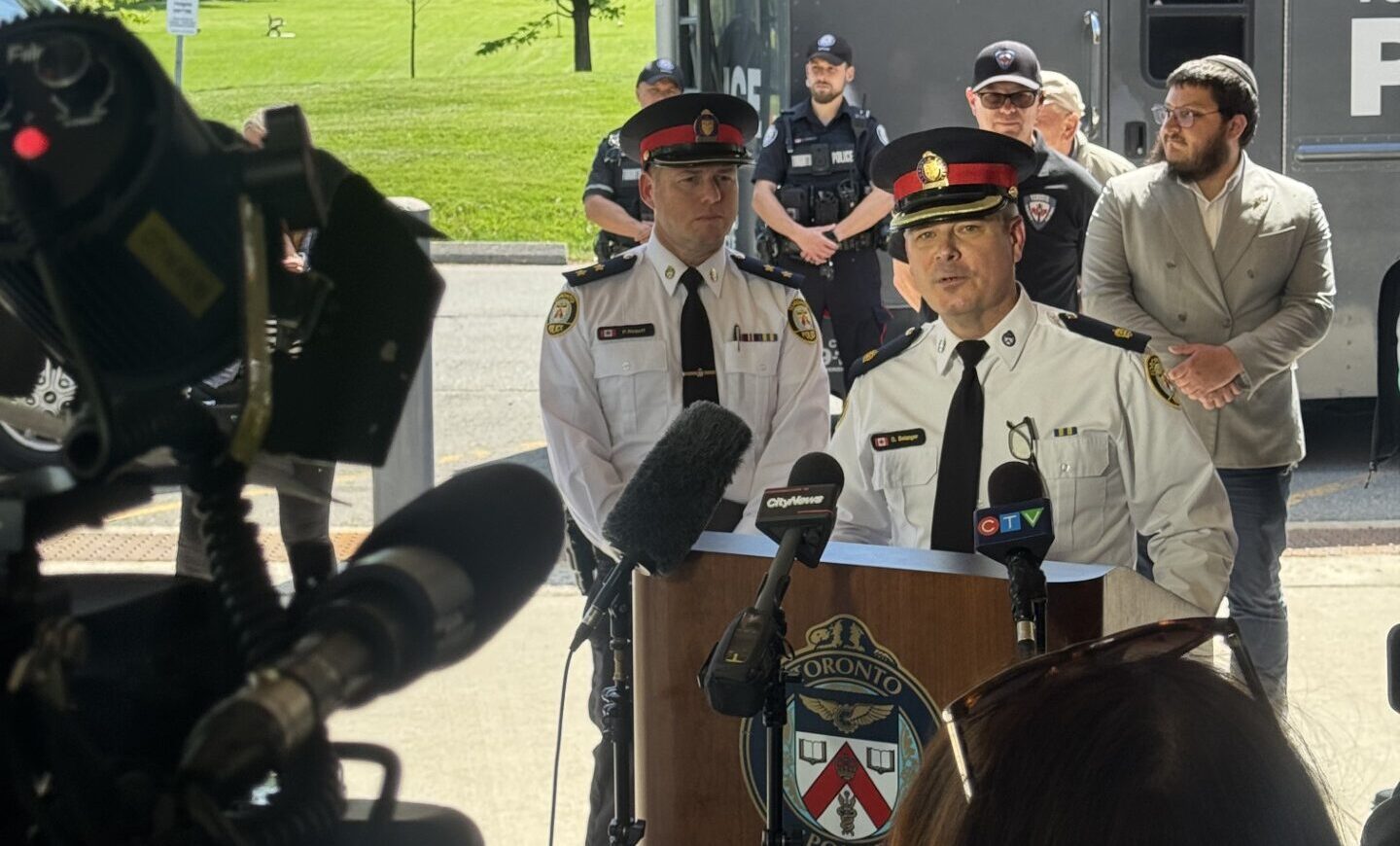
Shomrim Toronto became the public face of the massive volunteer effort to help Toronto police search for 14-year-old Esti, an autistic Jewish teenager who went missing from her home for two weeks in May.
Hundreds of volunteers from the Jewish community and beyond came out to help in the civilian-led search, putting up posters and flyers, bringing food, supporting the family, and raising funds for a $25,000 reward for information.
On May 28, Toronto police announced they’d located her, safe and sound, in a basement apartment many kilometres away from her home. While there won’t be any charges laid, and police have now said the case is closed, the impact of the mission—their biggest ever since their founding five years ago—has left a deep impact on Shomrim Toronto’s volunteers.
In this exclusive interview with The CJN’s North Star podcast, host Ellin Bessner sits down with Avi Grinberg and Kevin (Menachem) Silver of Shomrim Toronto, who explain how they became the hub of the massive community civilian search, how Esti’s family is doing now, and how the experience will shape the organization’s future.
Related stories
Learn about why Shomrim launched, in The CJN.In 2024, Shomrim and other volunteer security groups were profiled for helping protect Jewish Toronto and York Region, both in the community and, in some cases, on campus, in The CJN.How North Star covered the successful search for Esti in May 2026.To volunteer or learn more about Shomrim, check out their website.Transcript:
Joseph Naft:
The reason that some of these stories end in the child coming home is because of people like you in this room and the organization that you guys are supporting. But before they come up here, I want to say one last thing.
As a father who stood on the side of this that no one ever wants to stand on, what these people do is not an idea. It’s not a nice cause. It’s not abstract.
One day, God forbid, if you ever need them, if that day ever comes, you’re going to want them to exist. You’re going to want them trained and equipped and awake at two o’clock in the morning on an ordinary Tuesday, when the rest of the world is asleep and no one else is coming.
Ellin Bessner:
Those were the words of Esti’s father, Joseph Naft, speaking at a Thornhill synagogue recently during an event to honour the Shomrim Toronto safety organization and how its volunteers mobilized and coordinated many hundreds of community members who helped Toronto police search for Naft’s missing autistic teenage daughter during 13 harrowing days in May.
The search for 14-year-old Esti captivated the city and the Jewish community here and abroad, from the night she ran away from home without shoes, a coat or her phone on May 15; to the search through the ravines of Earl Bales Park; to early sightings at a fast-food restaurant and on a Toronto city bus. Then came a weekend of anger, when we learned that posters of her were being torn down by antisemites.
While Toronto police handled the official search effort, Shomrim Toronto swung into action on the civilian side. A command post went up at the Naft family’s own synagogue, Petah Tikva Anshe Castilla. A few days later, Shomrim moved into donated office space on Wilson Avenue, where volunteers were given grids and maps, sent out with new flyers, and spread across the city all the way down to Lake Ontario. A donor offered a $25,000 reward. Community members and politicians came out every day for nearly two weeks—even on Jewish holidays—to look for her.
Then, on May 28, Toronto Police called a media conference at Earl Bales Park to announce they had found Esti alive in a basement apartment in Etobicoke. How she managed to get there, we were never told. Police said no charges would be laid and that the case was closed.
The family asked for privacy and for people to remove Esti’s photo from social media. But the impact of the search hasn’t gone away, especially for the people who helped look for her.
Now we’re taking you behind the scenes of the largest community rescue effort Shomrim has ever run. What was it like, hour by hour, during those difficult weeks?
Avi Grinberg:
I didn’t sleep more than two hours a night, if I was lucky. There was constantly something. Information was coming in. Someone had to keep relaying information, passing information, receiving information. It was a nonstop operation.
Ellin Bessner:
I’m Ellin Bessner, and this is what Jewish Canada sounds like for Friday, July 24, 2026.
Welcome to North Star, the flagship podcast of The Canadian Jewish News made possible thanks to the generous support of the Ira Gluskin and Maxine Granovsky Gluskin Charitable Foundation.
Shomrim Toronto was founded in 2021, five years before Esti went missing, in response to the disturbing anti-Jewish protests and threats in Toronto that erupted when Israel and Hamas fought a brief war that spring. They started with about 20 volunteers who patrolled by car around Toronto and York Region synagogues and neighbourhoods.
Shomrim Toronto is modelled on similar Jewish safety patrol groups in the U.K. and the United States. Its members are not armed. The organization is separate from UJA Federation of Greater Toronto’s own Jewish Security Network. And although you’ve likely seen Shomrim volunteers at the Walk with Israel or escorting Jewish leaders, their profile has grown exponentially because of their frontline work leading the Jewish community’s civilian search effort for Esti.
Today, we’re sitting down with Shomrim Toronto founder Avi Grinberg and director Menachem Silver to talk about that extraordinary effort, the lessons they learned, and the evolving role of Shomrim in helping keep Toronto’s Jewish community safe.
Ellin Bessner: It’s an honour to meet both of you. Welcome to The CJN podcast.
Avi Grinberg: Thank you for having us.
Menachem Silver: Thank you for having us.
Ellin Bessner: Well, first of all, congratulations on receiving this Community Service Award. I want to go back to that night at the synagogue because the words come from the Psalms, right? And it’s a line many of us have heard. הִנֵּ֣ה לֹֽא־יָ֭נוּם וְלֹ֣א יִישָׁ֑ן שׁ֝וֹמֵ֗ר יִשְׂרָאֵֽל / Heenay lo yanum ve’lo yeeshan shomer yisrael
When you heard Esti’s father speak about everything Shomrim did for his family and say that line, what was it like to hear those biblical—or those Hebrew—words, not just the community words?
Avi Grinberg: It was extremely emotional to hear Esti’s father get up in front of a crowd that he probably didn’t know the majority of and speak so highly of us. Even though what we do, we do for anyone that calls, just hearing those true words come out of his mouth after the two weeks that we all had together was truly inspiring.
From the moment we met Joseph Naft, given the circumstances, it was not the most pleasant scene you would want to be a part of. You’re obviously not in the right headspace when you’re in a crisis like that. But being able to give Joseph a hug once Esti was found, and him acknowledging—he didn’t have words to express what it felt like for him as a father to have so many hundreds and thousands of volunteers come out to help search for a stranger that some of us had never even met before.
I personally had no idea who Esti was prior to this. I had no idea who Joseph was or who his wife was.
That’s the difference—or that’s what’s so unique about our community. When someone’s in crisis, we’re all in crisis. I think it was Rabbi Neft who said it best: we treat a missing person as one of our own, as a sibling, as a relative. Whereas the general public doesn’t have that same strong connection that we, as the Jewish community, have with one another.
Being able to be a part of it, and essentially lead the community side of things, was a huge honour. Something on this scale is not something we’ve ever done before, but we are grateful for the opportunity and the trust that was instilled in us.
At the end of the day, not all stories end the way this story ended, and we are beyond grateful that we had a very big part in Esti’s safe return home.
Ellin Bessner: Shomrim is not armed police officers. You don’t have the powers of police. So what can you do when you arrive at an incident like this? What’s your job?
Avi Grinberg: We’re no different from average civilians. We’re an organized group, obviously trained, but as far as powers go, we don’t have any more powers than an average civilian, just like you or anyone else.
Because we’ve been working at this now for five years, we come in essentially as the middleman between the community and law enforcement.
When Esti was first reported missing to the police, everything was chaotic. The parents couldn’t think straight. Community members started getting involved. Everyone wanted to do something, but there was no coordination.
When we got involved, that’s when everything started to fall in line. We took the lead on the coordination. We brought in another organization to help the family process the crisis while we took the lead on coordinating volunteers, coordinating other efforts and constantly being in contact with law enforcement throughout the entire operation.
We essentially became the middlemen between law enforcement, the community and the family. So anytime there was information the police wanted to share with the community, we were the ones passing it on. Or vice versa: when information was coming in to the family or to us, we were the ones passing it on to the police.
Ellin Bessner: So you worked very closely with Toronto police as a liaison. What relationship do you want people to know you had with the police during the whole Esti search?
Avi Grinberg: We were in constant communication from the moment we got involved. It was a weekend, when she went missing, so obviously there were more limited resources.
But having relationships with different people and different levels of leadership within the different police services enabled us to reach out to resources that may have been off on the weekend or may not have been at the station or aware of what was going on at that very moment. We could explain different situations, have them assess them and potentially involve more resources if they saw fit.
At the end of the day, if you ask me whether Toronto police did everything they should have or could have for Esti’s disappearance, I can say, without a doubt in my mind, they did everything by the book. They went beyond that by extending the amount of resources they dedicated to this missing-person investigation.
In fact, we were getting comments on social media asking why the police were dedicating so many resources to Esti rather than the other missing people, dozens of whom go missing daily across the city.
It was something we had to navigate—explaining to people the difference between a well 50-year-old who went missing versus an unwell 14-year-old. Sometimes people lack context and start comparing situations and making assumptions based on that.
But given the information the police had at the very beginning when Esti first disappeared versus the information that we, among others, brought forward, it eventually elevated the severity of the investigation. That opened the door for the police to bring in extra resources, extra investigators, more patrol cars and more specialized units on the ground doing different things that not everyone necessarily saw or knew about.
Because we were speaking with them multiple times a day, we knew what resources had been assigned. We were in communication with the lead detectives.
In fact, Chief Myron Demkiw even came to visit our command centre at Petah Tikva on Danby Avenue when the search was upgraded to a Level 1. There was a press conference at Earl Bales, as you remember.
After the press conference, Chief Demkiw said, “Let’s go over to your command centre. Let me meet the dad. Introduce me to the family. Let me see what the community side of things looks like.”
He—and many members of Toronto police leadership—were blown away. Even officers we interacted with who weren’t in leadership roles were amazed to see how the community came together for someone that most of us had never even met before.
If you ask me whether they did everything they could, I believe they did everything and then some. It’s because of the relationships we’ve spent years building. It’s not like we’re calling and crying wolf asking for help. They understood, and they did what they had to do.
Ellin Bessner: Right, because there was some nasty stuff saying, “Well, you Jews, you look after your own, but what about everybody else who’s missing?” and blah, blah, blah.
But the other thing to point out is that the family didn’t—or it wasn’t released for several days—that she was on the autism spectrum, which made things more risky.
Was your role to urge that information to be put out? Is that what I’m understanding?
Avi Grinberg: Rightfully so, yeah.
A lot of the information that there was hesitancy to bring forward wasn’t just ours. It was everyone involved, whether it was the family, friends, the crisis intervention team alongside the police. Everyone had a role in the overall investigation and in helping bring Esti back.
Menachem Silver: And, you know, to be clear to anybody that complains, you’re free to start your own community organization. No one’s stopping you, right? If you need people taken care of, don’t complain about it. Go and solve it.
Avi Grinberg: In fact, I’ve offered. If other communities wanted to start something like this, I’ve offered to help.
Ellin Bessner: Before we go any further, you mentioned an organization that was liaising directly with the family—I guess, a crisis…
Avi Grinberg: Chai Lifeline Crisis.
Ellin Bessner: Chai Lifeline did for the family. Got it.
Can you tell us a little bit about what you did offer when Esti disappeared?
Avi Grinberg: So Esti went missing Friday night around 11:15, 11:30 p.m., when she left the house.
We only got a call from Esti’s family on Shabbat afternoon, about 4:35 p.m. We were already 18 hours behind Esti’s disappearance.
Given the fact that it was Shabbat, we only operate on an emergency basis, which, in this case, obviously—a missing youth at risk—is considered life and death.
At that point, we started coordinating with police to get an understanding of what they had already done, at the same time as having our volunteers start canvassing the area.
Once Shabbat ended, that’s when the outpouring of support started, when we put out a poster to the community notifying them of Esti’s disappearance.
Instead of us primarily focusing on the actual searching ourselves, we brought in two search-and-rescue organizations from New York that specialize in search and rescue, one of them being Matzil and another one being Chaverim of Rockland.
We had assistance from the community that was out hanging flyers, interacting with people, talking to people, seeing who had seen her, reviewing camera footage, while the two organizations were out canvassing the parks and tracking down leads.
Essentially, all of this led to the police upgrading the search from a Level 3 to a Level 1.
It was the lead that we, as the community organizations involved, physically brought them that pointed to her being outside of the park on that same night she disappeared, which led to the increase in priority and eventually shifted their focus away from the park. For the first four or five days, they were focused on the park, assuming she was still there. They couldn’t rule that out until they had proof she was elsewhere.
Ellin Bessner: So you’re talking about the bus footage. Let’s get granular—the bus footage, the Popeyes footage, other things too.
Avi Grinberg: The Popeyes footage came from us—Bathurst and Wilson, et cetera. All of that came from collaboration: us finding footage, letting them know, them going to gather it themselves, or us passing along different tips that were coming in to us as well.
We worked together toward the same result of bringing Esti home.
While we didn’t necessarily spend all that much time out patrolling ourselves, we were the ones following up on leads that were coming in. We were coordinating the community efforts, coordinating alongside the police, the family and the other organizations that were brought in to assist.
Everyone was doing their part—from organizations helping us print flyers, to people ordering food and dropping it off for the volunteers, to people coming into the command centre to help coordinate the volunteers.
We probably poured thousands and thousands of man-hours into this two-week operation.
I didn’t sleep more than two hours a night, if I was lucky. There was constantly something happening. Information was coming in. Someone always had to be the one relaying information, passing information, receiving information.
So it was a nonstop operation.
That also led us into Shavuot. We consulted with our rabbi, Rabbi Lowy, who, given the fact that she was still missing and in danger, gave us the green light to continue doing what we were doing throughout Shavuot.
We were grateful that over Shavuot more leads came in, and those leads continued to be followed up on after the holiday was over, eventually leading to the information that helped police find her.
Ellin Bessner: So do you want to tell us—did you have a role, ultimately, in them finding her in that house in Etobicoke?
Avi Grinberg: In that house, per se, no. But we gave them a lead earlier on, that led to them tracking her through the subway. Then, through another lead they received, they were able to track her to that house in Etobicoke.
Ellin Bessner: How many volunteers do you think ultimately took part from the community? Do you know?
Avi Grinberg: Thousands.
Whether it was kids wanting to go hang up posters, politicians coming to do their part or community members doing their part, Saturday night alone we probably had 300 or 400 volunteers show up at the command centre. That was just the first night of our operation.
We didn’t realize the outpouring of support we were going to have from the community.
This isn’t the first missing person we’ve been involved with, but it was the first vulnerable 14-year-old who had gone missing, and the community felt they needed to be part of it.
Menachem Silver: Which was actually one of our biggest challenges.
We did not anticipate that thousands of people were going to show up. We’re used to operating within our own team, assigning members tasks and responsibilities. What we had to scramble with immediately was coordinating thousands of people. How were we going to do it?
Somebody developed an app for us literally overnight that created search grids for the volunteers coming the next day so we could keep everything organized.
Because if Shomrim Toronto is going to coordinate the search, we also have to make sure the volunteers going out are safe. You don’t want it to be a free-for-all where everyone’s scrambling across the city.
So people checked in, received an assigned area, were given explicit tasks and responsibilities, and then checked back in when they were done. We also made sure they had the proper instructions and knew what to bring if they were going to be outside.
If we ever had to do something like this again, we’d love to have thousands and thousands of people show up. We’ll deal with it.
It was just as inspiring and motivating for us as it was for everybody else to see that incredible number of people. They didn’t show up just to perform tasks. They showed up with emotion. They were passionate. They were there as if their own child, God forbid, was missing.
They said, “Come hell or high water, we’re not stopping until this child is found.”
That was incredible.
Ellin Bessner: You mentioned posters, so let’s talk about that. I was there on May 24, the Sunday afternoon. It was a rainy afternoon at the command post, and I interviewed one of your colleagues, Simi, about it.
Everybody was so distraught and upset that the posters were being torn down. It had been raining the day before too, so some of them were waterlogged. You talked about emotion, so I’d like to hear about that.
Menachem Silver: Look, unfortunately, it’s not surprising.
There are sick animals in this world who will stoop to that. Actually, I wouldn’t even say they’re animals, because animals typically care for their own kind. They’re sub-animals, is what these people are.
For someone to go and tear down a poster of any missing child, I wouldn’t classify them as human beings. They might look like humans, but they’re not.
That was disgusting.
Unfortunately—or fortunately—we as Jewish people have built resilience over thousands of years. We’re not surprised. You rip one down, we’ll put 10 more up. Does it cost more money? Yeah, it does. It doesn’t matter.
So, on the one hand, it was terrible and disgusting. People were psychologically, I would say, almost traumatized. They thought, “Okay, we understand regular antisemitic attacks. This is what we’re used to. But this is a child, for crying out loud. Who cares what her background is?” For someone to go and tear down posters—that was disgusting.
It wasn’t something that was going to tear us down. They might have torn the posters down, but they did not tear any one of us down. That much I can say.
We got right back up, put more posters up, made the campaign even stronger, and made sure that if we could find these animals, we were going to find them.
Ellin Bessner: And there were a few who were also identified.
Avi Grinberg: Well, a few were identified.
It essentially fuelled the fire even more, because the more posters they removed, the more people saw what was happening, got angry about it and were motivated to come out and help.
We had groups from all across the city and from outside the city. We even had a group of teenage girls who were on a graduation trip from New York. They had come to Canada’s Wonderland. They cut their trip short to come and hang posters for Esti.
Ellin Bessner: Wow.
Avi Grinberg: It became national news. It was being talked about all across North America, in Israel and in Europe, quite frankly.
We kept getting calls from all different organizations offering assistance. People we’d never heard of or spoken to before. A Jewish child was missing, and that became everyone’s concern.
Seeing how the Jewish community operates in times of crisis is what makes us so unique. It’s unfortunate that sometimes we only remember that in times of crisis.
Ellin Bessner: Coming up: How Shomrim Toronto’s founder learned Esti had been recovered.
We were all watching social media, and it started to spread like wildfire when news that Esti had been found began to leak out. Then Toronto police announced there would be a press conference.
Where were you when you got the news, and what were the circumstances?
Avi Grinberg: I, for a change, decided to turn my phone off for an hour and take a nap.
The one time—in the middle of the day—that I decided to turn my phone off, I woke up to 19 missed calls.
Ellin Bessner: All from you Menachem, right?
Avi Grinberg: Yeah, exactly. And a few of them were from the police.
They wanted to be the ones to break the news to us because they assumed—and rightly so—that the community would be calling us to verify it.
As soon as I got that call and they said, “Be at Earl Bales…” I think the press conference was at three o’clock.
I got in the car, called the guys and said, “She was found. It’s confirmed. Meet you at Earl Bales.”
Just a huge relief.
When I saw those 19 missed calls, I didn’t know whether something bad had happened or something good had happened. My heart was in my throat.
Ellin Bessner: So they didn’t confirm anything before saying she’d been found?
Avi Grinberg: I hadn’t known.
When I woke up and saw all those missed calls, I didn’t know what to expect. So I immediately started calling people back, and that’s when I got the news that she had been found.
I was then able to confirm it with our team, who were able to put out a statement to the community because there was so much speculation going around. Yes, she’d been found. No, she hadn’t been found. Maybe…
Other than the fact that Toronto police had tweeted it, people still had thousands of questions.
Ellin Bessner: That’s why we’re doing this interview.
Avi Grinberg: Exactly.
As soon as I was able to confirm it with the police, we were able to start putting the community at ease. She’d been found. She was with the police.
The biggest relief was seeing the look on the parents’ faces. Finally being able to hug Joseph with a smile instead of tears coming down his face—that made this whole thing that much more rewarding.
Ellin Bessner: So, without breaking confidentiality, because I know there obviously is some, how much is Shomrim—or you personally, both of you—still involved with the family and the situation?
Avi Grinberg: I keep up with Joseph. I’ve stopped by myself to check in on them.
I keep in touch. I always want to be involved for as long as they want us involved. We offer our help if we can be of help.
I still chat with him. Joseph became a friend now. At the end of the day, we’re one big community.
He’s invited me to his house for Shabbat. He wants to throw a barbecue for our volunteers. Seeing firsthand the impact our volunteers had, he wants to give back where he can.
But right now, we’re letting him focus on healing from the traumatic experience of not knowing where his child was for two weeks.
Yes, I keep in touch. We became extremely close with the family and with the community, which played such a big role in helping throughout the search.
Ellin Bessner: Can you explain what role, if any, Shomrim had with the reward? Whether it was paid out, or did you just facilitate?
Avi Grinberg: The reward had nothing to do with us. It was friends of the family who decided to put the reward up.
I have no knowledge of whether anything was paid out or whether a lead someone provided resulted in Esti being found.
We’re still waiting to be debriefed and have that conversation with police.
Our priority was finding Esti, and knowing that she’s alive and well, brought our objective to an end.
When the time is right, we will sit down with police to discuss whatever they can share with us and have a better understanding of how this particular lead came about and how she was found where she was found.
Menachem Silver: And then, of course, us, just like the community—because, again, we are the community—there are always curiosities, right? Everybody has questions.
But what we have to remember, all of us, is that our objective was achieved in finding Esti.
Whatever we hear afterward isn’t just to satisfy curiosity. It’s to learn. What can we do better next time? What do we need to know that would help us if there is a next time? How can we be 10 times better?
Of course there’s a curiosity component. That’s human nature. There’s also a desire for closure.
We get those questions all the time, and what we try to communicate is that the closure people need is knowing that she was found and that she’s safe.
Ellin Bessner: What did you learn that you might do differently next time because of what you learned during the Esti search?
Menachem Silver: For sure, the first thing we learned is that our internal membership numbers are irrelevant. We have the entire city here to help.
That’s probably the biggest learning curve, practically speaking.
We now have to create protocols and plans that allow thousands of people to help.
Ellin Bessner: You do a lot of things that people may see, whether it’s at the Walk with Israel or on security patrols. Describe what you do. Is it 10 per cent personal security, 20 per cent community events, patrols up and down Bathurst?
Avi Grinberg: For starters, we’re not security. We’re a safety organization.
If you want, we can start from our founding and explain how we got to where we are today.
In 2021, right before Shavuot—I don’t know if you remember—
Ellin Bessner: I do. We went on the air that very first week. That was our first podcast week, so I remember it well.
Avi Grinberg: There was a rise in antisemitism happening. Jewish people were being called all sorts of names.
Ellin Bessner: It was because of the rise in antisemitism during the Israel-Hamas 10-day war after Mount Meron.
Avi Grinberg: Houses with mezuzahs were having rocks and eggs thrown at them.
A group of community members got together and said, “We need to start looking out for ourselves. The police can’t be everywhere. They barely have enough time to be reactive, let alone proactive.”
We thought this would last a few weeks, things would calm down and everyone would go back to their lives.
But things continued, and we realized this was an organization that had been needed in the city for a long time.
Unfortunately, Toronto—and Canada in general—is often 20 or 30 years behind other large Jewish communities around the world. We adapt to things a little later.
In New York, New Jersey, Maryland and London, Shomrim organizations have existed since the 1960s, when the first one started in Crown Heights.
Because those communities have been dealing with antisemitism and hate crimes directed at the Jewish community for much longer than we have in Toronto, we felt there was a need here for an organization made up of trained, organized individuals to serve as a bridge between the community and law enforcement.
We help law enforcement understand the dynamics of the Jewish community when it comes to dealing with crises, how to respond to them, the different religious considerations and the different parts of the Jewish community.
Menachem Silver: Primarily, we patrol.
We have a fleet of patrol vehicles. Most are marked. Some are unmarked.
We’re actively on the streets in the mornings, in the afternoons and very often at night—when people are sleeping.
It might not seem like an emergency if somebody spray-paints a swastika on your garage, but to us it is. It’s an emergency because it means you were targeted simply because you’re Jewish.
So we’re constantly trying to increase our patrols and enhance them. We recently installed cameras in all of our patrol vehicles that record continuously.
By creating a strong presence in Jewish neighbourhoods, we’re taking a proactive approach to deterring crime.
It’s not always about emergency response. That visible presence makes a huge difference.
The unfortunate thing is that you can’t measure the things that don’t happen. But if fewer incidents occur because people know we’re out there, that’s probably a strong indication that the patrols are working.
Ellin Bessner: Your website says you’ve handled more than 3,000 phone calls and nearly 2,700 reported incidents.
You mentioned swastika graffiti. What kinds of incidents are we talking about that make up those numbers?
Avi Grinberg: Anything from suspicious individuals and suspicious vehicles to hate crimes, to incidents that people, quite frankly, don’t necessarily understand the seriousness of, but that still need to be reported.
For instance, I’m sure you’ve heard about the shooting incident a couple of weeks ago outside Bobov.
Ellin Bessner: That’s when they had those BB guns—or gun-type things—Orbeez. Orbeez guns.
Avi Grinberg: Orbeez guns.
Three visibly Jewish teenagers were walking when a vehicle pulled up beside them, rolled down its window, shot at them and took off.
Those teenagers got only a vague description of the vehicle and no licence plate. They reported it to police, and together we helped canvass for video footage.
Then, exactly a week later, around 10 p.m. on Thursday night, we got a call from a community member who had just been shot by one of these guns outside a synagogue while he was talking with a few friends after evening prayers.
He called just to let us know about it. He didn’t really understand the seriousness of what had happened.
When I answered the phone, I asked, “Did you call the police?”
He said, “No. Should I?”
I said, “You were just shot at for being Jewish outside a synagogue.”
He was hesitant, so I told him, “I’ll personally come meet you.”
I had him meet me at the gas station beside the synagogue.
While I was driving there, I got another call from a community member who was driving up Bathurst Street. His wife and daughter were in the car, and they had also been shot at by the same individuals with the same type of gun.
The daughter had seen our social media post from the previous week with the description of the vehicle. She remembered it, took a photo of the licence plate, and that’s how police were able to make an arrest before 8 a.m. the next morning.
We had them meet us at the gas station as well, and we helped facilitate the police reports, made sure the information got to the right people, and notified the appropriate people within Toronto police about what had happened so they had the information they needed to do their jobs.
That’s a big part of what we do behind the scenes.
We’re constantly involved in investigations with police, whether they’re hate crime investigations or simply passing along information from community members who are hesitant to contact police directly.
We are that bridge between the community and the police.
Another example: last night I got woken up at two in the morning because a woman in the community was having a mental health crisis.
She wasn’t willing to cooperate with police unless someone from Shomrim was there.
She didn’t know the officers. She wasn’t sure why they were there. She wanted someone she trusted—someone from her own community—to be that liaison and explain her perspective to police as a Jewish woman.
Menachem Silver: And once Shomrim was there, it was resolved immediately.
There was no issue. There was no negative interaction.
She needed that sense of safety and familiarity. She recognized people she trusted, and once that happened, she was willing to cooperate.
Ellin Bessner: But you know, you talk about the police. A lot of people in the Jewish community believe Toronto police don’t care about Jewish safety.
I’m sure you’ve heard that yourself since Oct. 7.
But you’ve worked very closely with them. What’s your perspective?
Menachem Silver: One of the biggest challenges with that question—whether police care—is that very often we expect to see immediate results.
As Canadian citizens, we think something happens and we should immediately see someone arrested.
What we also have to understand—and yes, things can always be better; we’re not saying they’re perfect—is that police have protocols. They have training. They have procedures they have to follow.
Take demonstrations, for example.
People want to see arrests happen immediately. Sometimes the worst offenders are arrested on the spot. But a lot of arrests happen later because police understand that making mass arrests during a protest can actually make the situation much worse in the moment.
You’ll notice they’re always recording. There are always cameras. They collect video, and afterward, when everyone else goes home, police spend hundreds of hours reviewing that footage.
They identify individuals, determine what offences may have been committed, obtain identifications and then execute arrests afterward.
Sometimes we don’t see that work taking place.
So we assume nothing happened.
The reality is that if you follow these cases after emotions settle down, they do the best they can. Again, things can always be better, but they do work to make sure the people who should be held accountable are held accountable.
They also have to operate within the Canadian legal system, and that’s probably a whole other conversation—maybe a whole other podcast.
Ellin Bessner: But, you know, after you received your award in mid-June, you wrote something on LinkedIn.
You said you grew up hearing your grandparents’ stories about the Holocaust and antisemitism, and you wrote, “Now I’ve learned feeling safe is not a Canadian right anymore.”
That’s a very powerful statement.
Can you tell me what led you to write those words?
Menachem Silver: It’s something your grandparents tell you when they’re over for the holidays. They tell you stories about the past.
But as a child, you never imagine things like that could happen again.
Now you can.
What we’re seeing here in Canada is that we’re getting one step closer to bad things happening.
For me, that statement comes from the fact that, as a Canadian, I should feel safe no matter where I go—and I don’t.
Ellin Bessner: What happened with your son’s class? There was an incident involving Orbeez guns.
Menachem Silver: Yeah. One of the first kids who got shot was in my son’s class.
Three of his friends were walking one night, and they were the ones who were shot at first with the Orbeez gun.
The next day, I asked my son what happened. He’d been talking with his friends about it.
My first question was, “Are you okay?”
His friends had already spoken to their parents, and they were talking about it at school.
My heart broke for him because I remembered my grandparents telling me stories, and now here I was talking to my own son, asking whether he was okay knowing that his friends had been shot at with an Orbeez gun simply because they were Jewish.
To me, that was the tipping point.
That was the moment I realized: get your head out of the sand. Stop pretending things aren’t what they are.
They are.
Hearing those stories from my grandparents, I realized they weren’t just telling stories. They were educating me.
It was almost as though they knew there would come a time when I would understand the lesson, and then have to pass that lesson on to the next generation.
Ellin Bessner: I want to end by asking, since the Esti search, how have volunteer applications changed?
Are you getting more people wanting to join? Has it raised your profile?
Avi Grinberg: Throughout the entire Esti operation, the applications never stopped coming in—from men, women, Jewish people, non-Jewish people—people who just wanted to be part of it or help.
During those two weeks, we couldn’t keep up with the number of people messaging us.
Some were asking how they could help. They lived on the other side of the city. Some lived in Niagara. Others were downtown going to a concert and wanted flyers. They wanted to know where they should hand them out and who they should give them to.
Menachem Silver: On a daily basis, especially when I’m driving one of the marked patrol vehicles, at least once a day someone honks, pulls up beside me, rolls down their window and says, “Are you guys still taking applications?” or “How do I get to your website?”
Just last week, a bus driver rolled down his window and said he wanted to join and apply.
Ellin Bessner: All right, give yourselves a plug. Where can people find you?
Avi Grinberg: ShomrimToronto.org. All the information is available there.
Ellin Bessner: Okay.
It’s been an honour to go through this story with both of you.
Thank you very, very much for this extended conversation. It was fascinating.
Thanks for being with us on The CJN.
Menachem Silver: Thank you.
Avi Grinberg: Thank you.
Here’s the closing transcript, formatted to match the rest of your transcript with only light copy editing for grammar, punctuation and CJN style:
Ellin Bessner:
And that’s what Jewish Canada sounded like for this episode of North Star, made possible thanks to the generous support of the Ira Gluskin and Maxine Granovsky Gluskin Charitable Foundation.
If this conversation reminded you of the power of community, share this episode with someone who volunteered, donated or supported the search for Esti.
Special thanks to Shlomo Assayag, who provided the video and audio of Joseph Naft’s speech.
North Star is produced by Zachary Judah Kauffman and Izzie Helenchilde, who also produces our YouTube videos, with Michael Fraiman as executive producer and Alicia Richler as The CJN‘s editorial director.
Thanks for listening.
Credits
Host and writer: Ellin Bessner ( @ebessner )Production team: Zachary Kauffman (senior producer), Izzie Helenchilde (producer and video), Michael Fraiman (executive producer), Alicia Richler (editorial director)Music: Bret Higgins
Support our show