
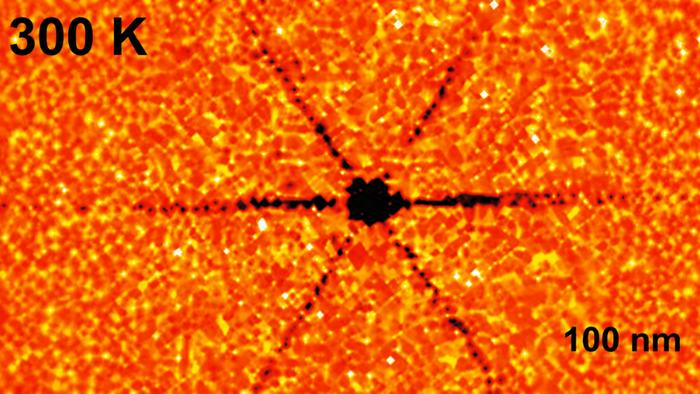
 Visualization of ray-like heat flow in boron arsenide at 300 K (80°F)
Credit H-Lab/UCLA
Researchers at the UCLA Samueli School of Engineering have observed wavelike quantum heat movement, known as phonon focusing, at room temperature for the first time
Published in Nature Physics, the experimental study demonstrates that quantum heat can be guided along focused, ray-like pathways defined by a material’s crystal structure rather than spreading out randomly in all directions.
Led by Yongjie Hu, a professor of mechanical and aerospace engineering at UCLA Samueli, the discovery establishes a baseline for room-temperature quantum thermal engineering, offering new ways to cool microelectronics, AI hardware, and quantum computing systems.
Breaking the cryogenic barrier
Heat moves through solid materials via phonons, which are quantised atomic lattice vibrations. Historically, directing heat along guided pathways was thought to require cryogenic temperatures near absolute zero (-273°C). At room temperature, phonons typically collide and scatter intensely, causing heat to lose its wave coherence and spread diffusively in a uniform circle.
The UCLA team bypassed this limitation using boron arsenide, a high-performance crystalline semiconductor that exhibits unusually weak phonon scattering:
Focused pathways:
Instead of spreading outward in a circle, heat in boron arsenide travels along guided, ray-like routes dictated by the orientation of its crystal lattice.
Micro-scale persistence:
This directional quantum behaviour persists over distances ranging from one micrometre up to tens of micrometres, a spatial scale that directly matches modern microelectronic and photonic architecture.
Symmetry patterns:
Depending on the specific crystal plane, the researchers recorded distinct fourfold, sixfold, and eightfold heat-focusing patterns that aligned with theoretical models.
Nanoscale temperature mapping
To verify the phenomenon, the researchers engineered a nanoscale temperature-mapping technique. When imaging standard materials under the microscope, the thermal output showed conventional circular diffusion patterns. In contrast, the images of boron arsenide revealed sharp, directional ray patterns emanating from the heat source.
This confirms that phonons can travel unexpectedly long distances in boron arsenide before scattering, allowing them to retain their wave-like properties at 300 K (80°F)
Implications for electronics and quantum tech
Overheating remains one of the primary physical bottlenecks limiting performance, miniaturisation, and reliability in artificial intelligence hardware, high-power semiconductors, and aerospace electronics.
By utilising boron arsenide’s guided heat pathways, future device engineers can design chip layouts that actively channel waste heat away from sensitive components along predetermined routes, much like how optical fibres guide light.
The team notes that controlling room-temperature phonon dynamics will also help fine-tune interactions between phonons and electrons, advancing the development of next-generation quantum sensors and information systems.