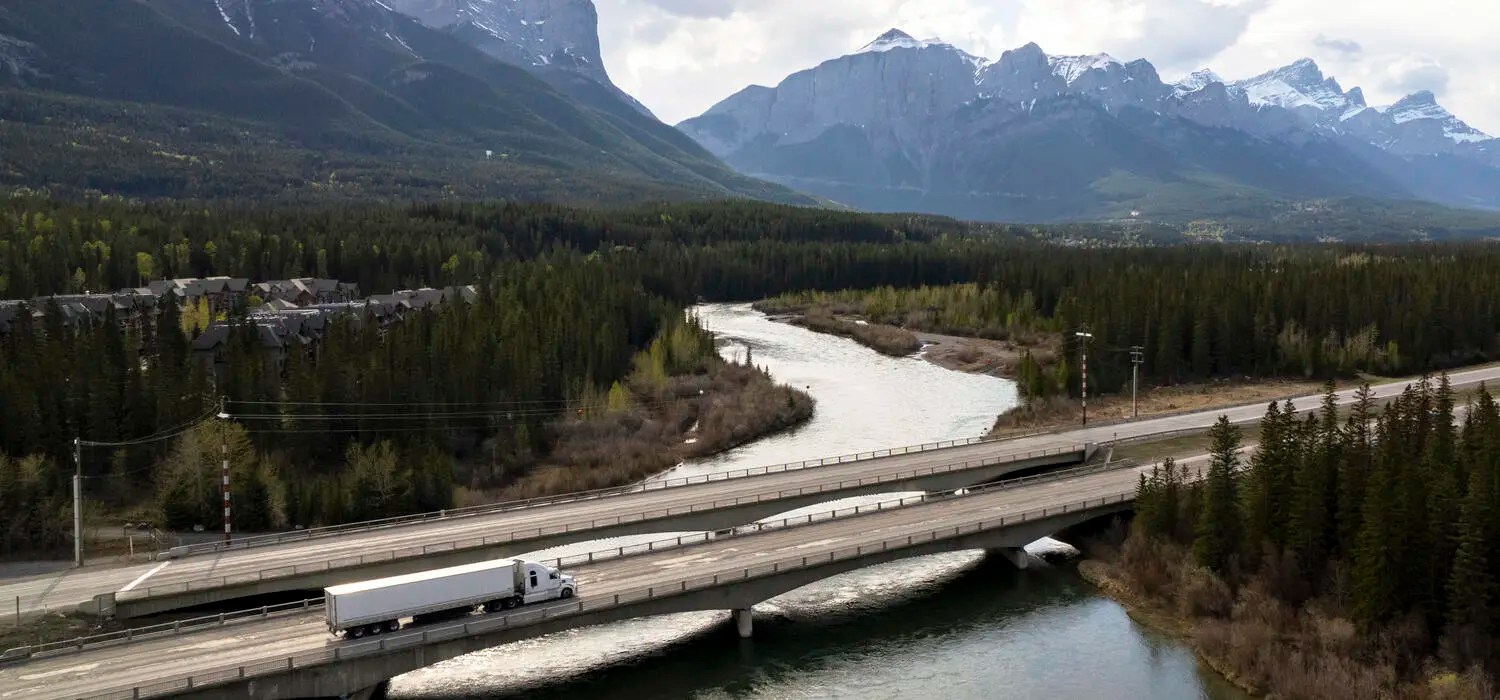
As bridges across Canada age and deal with increasingly unpredictable weather events, a Calgary-based professor is taking modernization into his own hands.
Muntasir Billah, a bridge engineer and associate professor in the Department of Civil Engineering at the University of Calgary’s Schulich School of Engineering, said that Canada’s bridges would receive about a C grade for lifespan and safety, among other factors, if he were to grade them today.
“We have a lot of bridges that are reaching their end of lifespan, so we cannot replace all of them together because of our budget constraint, and also we cannot retrofit all of them at the same time,” he told LWC.
“How we decide which bridges should be retrofitted and what is the best way of retrofitting them, that is a kind of a framework that I’m trying to develop. More precisely, a decision-making framework, so that the bridge owners or engineers can decide.”
His framework, titled the Resilience Informed Retrofit Design framework (RIFD), has received a five-year, $235,000 Discovery Grant from the Natural Sciences and Engineering Research Council of Canada.
The grant is intended to support the development and sustainability of a diverse, high-quality research base in the natural sciences and engineering at Canadian universities, to foster research excellence, and to strengthen the research training environment, according to the Government of Canada.
When looking at bridges specifically, resilience is determined by their ability to resume use after a major event such as an earthquake, a flood, or a vehicle collision.
“If we think about our city of Calgary, there are hundreds of bridges, and if one bridge is closed, then we see how much it affects our everyday commute, how much it affects our supply chain,” Billah said.
“We want to develop a framework so that we can strengthen our existing bridges so that we don’t have an unwanted bridge closure or detour for our commuters or any disruption to our supply chain.”
The framework will integrate operational, social, and economic aspects, Billah said, all to give individualized decisions on bridge futures as much context as possible.
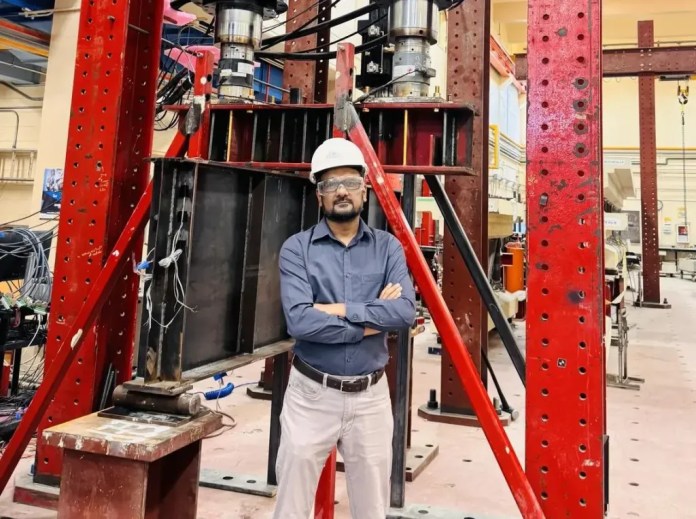 University of Calgary associate professor of civil engineering, Muntasir Billah. PHOTO BY TANVIR TUSHER
Five-year grant, long-term project
Day-to-day, Billah looks not only at bridges but also at overall infrastructure systems, climate change, and how other hazards affect existing infrastructure.
“We do a lot of experimental work. Whenever we come up with an idea, we do experiments in our structural engineering laboratory — we test some of the bridge components, then we develop finite element models based on our experimental studies in computer simulation,” he said.
“Then we analyze them, varying different parameters and try to see what is the best combination that can help us reduce the impact of these all different natural hazards.”
Each project has competing factors like cost, long-term performance, and safety, which are taken into careful account, Billah said.
“Whenever we are taking a set of bridges and then the cost of retrofitting, the priority to the community and a few other factors, that’s why we are calling it a multi-criteria decision analysis framework,” he said.
“As we do experiments, we’ll see which criteria are most important and also we’ll be engaging in discussion with different industry partners.”
Over the lifespan of the grant, success will be multifaceted, according to Billah.
“This is a long process to be included in the code because before it goes in, there of course needs to be a lot of validation, and five years is not enough,” he said.
“As we move forward, as long as we can develop this framework, get validated by industry professionals, that is what success would look like to us.”
Billah said that helping taxpayers’ pockets by reducing the needed cash to retrofit existing bridges would be another big plus.
Liked it? Take a second to support Kaiden Brayshaw – Local Journalism Initiative on Patreon!