
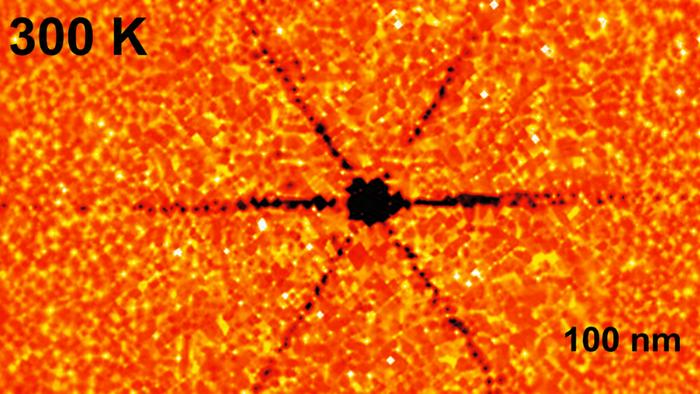
How can quantum technology be improved to enhance electronics? This is what a recent study published in Nature Physics hopes to address as a team of researchers investigated a novel method for heat management for quantum technology. This study has the potential to help scientists and engineers develop the next generation of electronics with efficient heat management.
For the study, the researchers introduced a novel method for improving a longstanding method called photon focusing commonly used for thermal management in electronics. Photon focusing involves using objects like mirrors to steer photons to a specific point. Until now, photon focusing has only been observed at cryogenic temperatures, but this new study demonstrates a first-time observation of photon focusing at room temperature. This was accomplished by using boron arsenide, enabling the photons to travel on a specific path while also enabling the heat to travel along the same path.
The primary motivation for this study comes from a longstanding conundrum regarding heat management and electronics. As electronics get smaller with quantum technology, the amount of heat density increases, thus increasing the need for heat management. However, this study could help bridge the gap between what temperature quantum technology could control its heat.
“This is a fundamental observation that enables us to think about thermal management in a new way,” said Dr. Yongjie Hu, who is a Professor of Mechanical and Aerospace Engineering at UCLA and a co-author on the study. “By enabling heat to be guided, focused and redistributed with nanoscale precision at room temperature, the discovery establishes a foundation for quantum thermal engineering.”
Going forward, the researchers aspire to scale up their prototype system that could lead to more efficient research & development. This includes focusing on specific applications where quantum technology could contribute.
What new insight into quantum heat waves will researchers make in the coming years and decades? Only time will tell, and this is why we science!
As always, keep doing science & keep looking up!
Sources: Nature Physics, EurekAlert!
Featured Image Credit: Image of the heat flow in boron arsenide. (Credit: H-Lab/UCLA)