
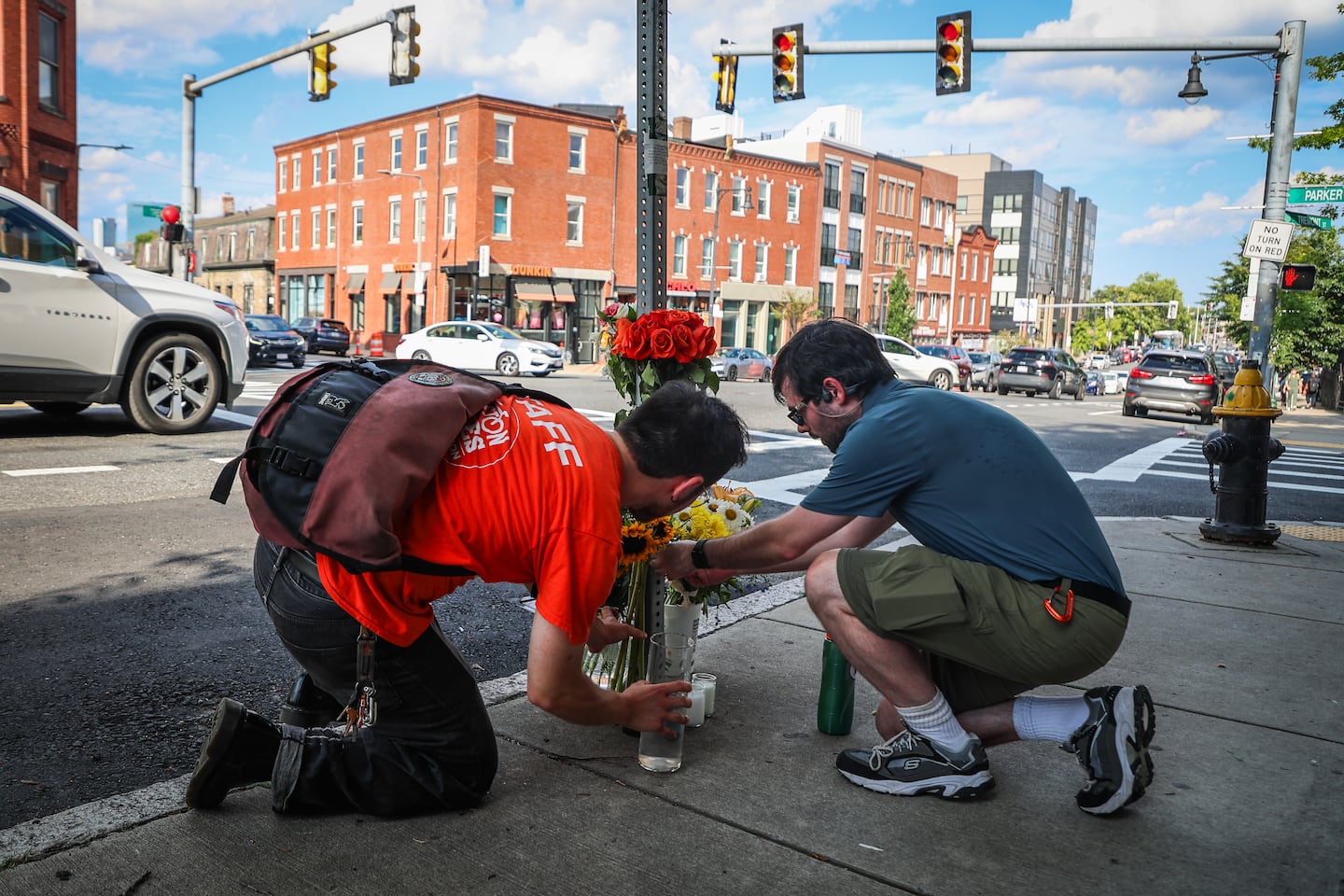
With the tragic, retraumatizing passing of Louisa Gag, it’s clear: The culprit is not lack of education. It is trucks. We have a truck problem in our neighborhoods.
An 80,000-pound metal multi-wheeled vehicle can kill in a fraction of a second. In that sense, it is a weapon. Firing a gun blindly into a crowd and claiming, “I couldn’t see,” would result in criminal charges. Operating a massive truck with blind spots should be held to the same standard. If you cannot see, you cannot go.
Get The Gavel
A weekly SCOTUS explainer newsletter by columnist Kimberly Atkins Stohr.
Accountability must extend to employers. Companies choose to send trucks into our densely populated neighborhoods without safety equipment. To prevent deaths such as Louisa’s, Minh-Thi’s, and Sidney’s, we must require companies to equip every truck with readily available blind-spot technology including cameras, sensors, mirrors, and lateral protective devices.
Where education falls short, technology will save us. Demand safer vehicles, demand accountability, and save lives.
Alexa Gomberg
Somerville
Mary Beth Ellis
Andover
Nguyen, 24, was a lifelong friend of Gomberg; Olson, 5, was Ellis’s daughter. Gomberg and Ellis are founding members of Massachusetts Families for Safe Streets.
Asking cyclists to share a single travel lane with motorists is asking for trouble
Cities that have reduced traffic deaths have focused on designing streets to prevent dangerous conflicts rather than relying on people to behave perfectly. An ordinary mistake should not become fatal.
Asking people biking to share a single travel lane with cars and trucks, as Paul Schimek does in his op-ed “The preventable blind spot trap killing Boston’s cyclists,” is not a durable safety strategy. It may work for confident cyclists, but it is not realistic for children, families, older adults, or anyone uncomfortable riding in fast-moving traffic. Safer design instead separates road users, places protections at intersections, and uses clear signals to avoid conflicts.
It would also be a mistake to make cyclists responsible for avoiding drivers who turn or change lanes across their path. Drivers must remain responsible for looking before entering another road user’s space. We would never tell pedestrians that using a crosswalk depends on anticipating every driver’s actions. Biking should be no different.
In Louisa Gag’s crash, reporting has indicated that the truck moved right to pass a left-turning vehicle and struck her while she was traveling straight. “Stay away from trucks” is not sound policy or sufficient advice when a truck can unexpectedly move into your path. Cyclists must be aware of truck blind spots, but our streets and policies must prevent these conflicts whenever possible.
Christopher Cassa
Cambridge
A false sense of security is dangerous. We should do more to educate cyclists.
Thank you for the excellent op-ed about blind spot accidents with right-turning trucks. As long as we don’t have licenses for cyclists, we should at least have some kind of safety education for them. Peter Schimek’s discussion of how these kinds of crashes occur is the kind of detailed explanation every cyclist needs.
As a longtime cyclist, I have encountered many different situations. I rode my bike from Somerville to Tufts Medical School for several years in the late 1970s and had to figure out for myself how to safely navigate city traffic. The bike lanes and improvements since then are an improvement, but they can give riders a false sense of security.
I am an advocate of cycling education. We are in such a vulnerable position compared with huge heavy vehicles. I am not a supporter of Bluebikes because they encourage people to ride who may not have thought about cycling as a dangerous activity — one that requires as much skill as driving a vehicle, if not more.
People with expertise in street design and safety could help create an informational pamphlet describing some of the most dangerous situations that could be distributed with every bike purchase and made available online. A simple multiple choice test with detailed explanations of the safest responses could provide essential education for riders. I’m sure many potential cyclists would love to participate in such a program.
Harriet Dann
Needham
Give up — biking in Boston will never be safe
After years of this absurd experiment to bike in a 400-year-old updated city, we need to stop inviting Boston’s best and brightest to get themselves killed bicycling here (“Louisa Gag’s death demands a full investigation — and an end to Wu’s slowdown on bike lanes,“ Editorial, July 17). I used to bike everywhere, but I’ve come to believe the experiment has failed. Too many people have died. They will keep dying. You can never make it safe.
Jeff Kevorkian
Middleton
‘Stay behind, not beside’ is sound advice
At the end of his op-ed, Paul Schimek urges cyclists that the way to avoid “the invisible trap of a turning truck” is: “Stay behind, not beside.” Would small signs at key intersections remind or educate cyclists of this?
I made a sign asking cyclists to heed those last four words and placed it at an intersection (cost: 35 cents plus tape). If the sign stays up only for a short time, it still may help spread the word. (Two cyclists I asked liked it.) Signs at bike path intersections could reach many cyclists.
I emailed a local radio station and the Ad Council asking that they consider a public service announcement with the message “Stay behind, not beside.”
Ralph De Gregorio
Arlington
‘How many drivers are super careful’?
As a driver of a car, I am well aware of the right-turn blind spot, so I double- and triple-check before making a right turn. I’m scared to death of hitting a cyclist I cannot see. As a cyclist, I’m super cautious at intersections of any vehicle that seems like it’s about to turn right because I know of that blind spot.
2Young2BOld
BostonGlobe.com
How many drivers are super careful?
Hanscome
BostonGlobe.com