
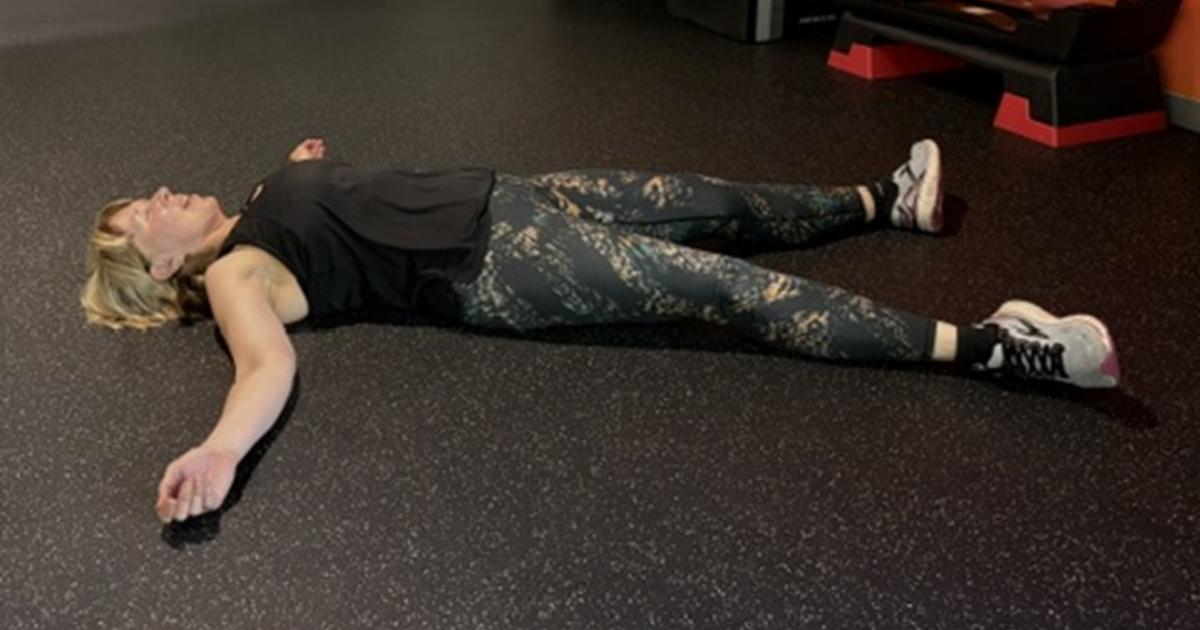
“IS this nearly over?” Those were the words tumbling through my mind as I puffed and spluttered and pushed myself to breathlessness.
It was week six and my final session with personal trainer (PT) Rebecca Clarke, whose task was to reach parts and get results my 20-year membership of a gym had dismally failed to do.
Yes, hands-up. I am one of those people who pay for a gym membership yet still don’t know a goblet squat from a Romanian deadlift. As for a farmer’s carry – I thought that was going from the farm shop to the car after a spot of rural retail therapy.
In my defence, my gym membership includes racquet sports, and I have been a club tennis player for two decades; I’ll happily spend a few hours a week on a tennis court, but the gym floor has been largely a no-go area.
Alas, I’m not getting any younger, and am less toned than a decade ago, so I decided to accept a challenge from Better Leisure in York to undergo six training sessions with one of their personal trainers.
Better Leisure centre at the Community Stadium, Huntington, York. Photo: NQ
Research shows that we lose muscle as we age – this can not only affect how we look on the outside, but on the inside too: our bone density can diminish, putting us at risk of osteoporosis or frailty in old age. Doing strength training can be part of the solution.
When paying for a gym membership, a personal trainer can seem like an extra indulgence, and an expensive one. Charges can vary, but can approach £50 a hour.
However, after my time with Rebecca, I can see why the sessions are worth it.
Firstly, you are committed to turning up – at least once a week! Also, if you want results, and to maximise the investment, ideally you need workout another once or twice on your own before your next session.
Secondly – and the reason I was particularly keen to get instruction – the PT can show you the correct technique and guide you as you start lifting weights, which guards against injury and builds confidence.
Thirdly – the PT holds you to account, not only for showing up, but for doing the entire workout and not skipping that last round so you can spend longer in the steam room (who me, never!).
Our 60-minute sessions took place at Better Leisure’s Huntington centre at the Community Stadium in York.
The gym was spacious with all the latest equipment.
Our sessions took the format of a warm up and then a variety of workouts with a specific focus, alternating between leg exercises such as squats and lunges, and upper body movements such as rowing, pull downs, push ups and bicep and tricep curls.
Maxine begins her warm up at Better Leisure’s gym at Huntington. Photo supplied
We finished each hour with mat-based core work to strengthen my back and stomach – essential to protect against injury.
It all culminated in a final session, where Rebecca weaved the workouts together and presented me with a killer challenge – and one that left me flat out on the floor!
It was mysteriously titled ‘AMRAPS’ – translated by Rebecca as: “As Many Rounds As Possible”. I felt scared!
After a warm-up, she set the stop watch on her phone to seven minutes and instructed me repeat three different exercises until the time was up.
I began on the ‘ski machine’, a deceptively simple-looking exercise where you pull down on two ropes and squat, dragging the ropes behind you in a ski motion. We set it to clock up ten calories (which took me about 40 seconds).
Heart rate elevated, it was straight on to some weight lifting – raising a bar weighing 12.5kg above my head 12 times.
For the third task, I was bent double, lifting a 12kg kettlebell off the floor, using alternate hands, for 16 reps. A real muscle burner.
Reporter Maxine Gordon doing a workout under the guidance of personal trainer Rebecca Clarke of Better Leisure. Photo supplied
And then I did these all again until the seven minutes were up.
There were two more rounds of ‘AMRAPS’,with three different exercises in each seven-minute slot, including slamming a 9kg ball into the ground 12 times over, stepping on and off a block carrying a 12kg weight, a dozen goblet squats, and ten press ups.
Towards the end I was tiring and getting a bit wobbly, losing the shape of some of my exercises.
But I was not done.
To finish, I had to go through each exercise – all nine of them – once more.
I honestly didn’t think I had it in me, and if Rebecca hadn’t been there, I am not convinced I would have kept going.
But that’s the secret weapon of having a PT – you can’t just give up and cut the workout short.
So I ploughed on, puffing and complaining, and struggling to smile for the photos through the sweat.
As I finished my last exercise – a press up – I rolled on to the floor, defeated physically, but buzzing inside.
I’d done it. I could do it. It felt great.
And armed with my workouts from Rebecca I had a blueprint to keep going – getting the most out of my gym membership at last.
Benefits of having a PT
Rebecca Clarke outlines the benefits of having a PT
Rebecca Clarke, Maxine’s personal trainer from Better Leisure for six weeks. Photo: NQ
ENLISTING the help of a PT can be a really effective way of training.
A complete newcomer to exercise or a gym environment can find it daunting.
Questions can go through your head – what if I’m not fit enough, what will everyone think of me, what if everyone else is super fit and looking amazing in their gym gear?
All of these thoughts are perfectly normal and the truth is that there will be people in the gym that are fitter than you and look different to you but most of them started with the same insecurities.
At Better UK we pride ourselves on the fact that on a typical day in the gym you will see a wide demographic of members ranging from seniors in their 80s right through to our junior members.
We also run schemes specifically for people with chronic medical conditions.
PTs don’t need you to be fit – a good PT should be able to train you not to need them.
Exercise is important at any age and contrary to popular belief it is never too late to start.
Exercise is medicine; it is critical in our longevity, helping us to age well and to stay on our feet and be active both physically and mentally for as long as possible.
The UK government guidelines for exercise suggest we exercise moderately for 150 minutes per week or vigorously for 75 minutes.
Within that, the recommendation is also that we are working on our strength through resistance exercises on two days per week.
It sounds complicated but it really isn’t – willingness to start is all you need.
To begin, doing something as opposed to nothing at all is plenty, and building up slowly to more intense levels of activity is a more sustainable way of doing things than putting on unrealistic expectations.
Check out the personal training section at better.org.uk to find out more.