

‘A rare opportunity’
The discovery may offer insight into binary systems composed of massive stars.
“This system provides a rare opportunity to reconstruct the complete evolutionary history of a massive binary — from the birth and interaction of two massive stars, through both supernova explosions, to the remnants they left behind,” said Miltiadis Michailidis, a postdoctoral fellow in Stanford University’s physics department and lead author of the study published on Tuesday in the journal Nature Communications.
“Although most massive stars are born in binary systems, no pair in which both stars have exploded as supernovae and left behind observable remnants has previously been identified,” Michailidis said.
Some massive stars are even born into stellar systems composed of three or more stars.
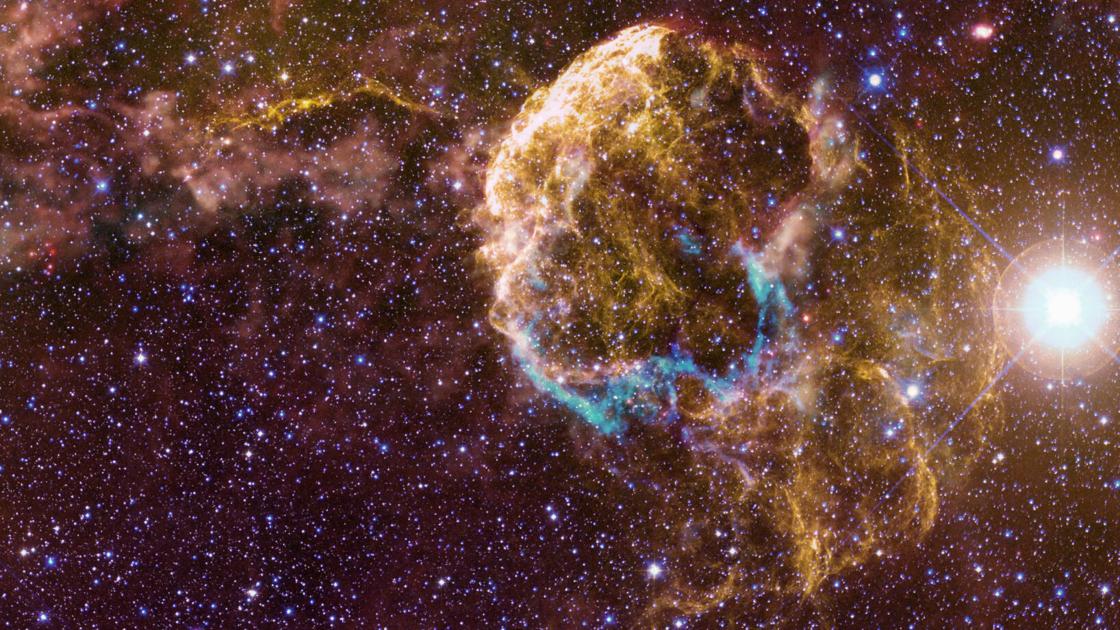
The two nebulas are expanding structures of hot gas, accelerated particles and shocked interstellar material left behind by the supernovas.
Massive stars live like some rock stars — born brilliant, party hard, die young. They live for several million years — a far cry from the lifespan of roughly 10 billion years expected for the sun.
“Systems like this one can provide direct observational constraints on how the evolution of massive stars is modified by the presence of a binary companion — one of the major outstanding questions in stellar astrophysics,” Michailidis said. “Until now, our understanding of these final evolutionary stages has relied almost entirely on theoretical models and numerical simulations.”
The star associated with the newly identified nebula is the one that blew up first, and the explosion sent its partner reeling. The researchers estimated that about 20,000 to 110,000 years elapsed between the two explosions.