
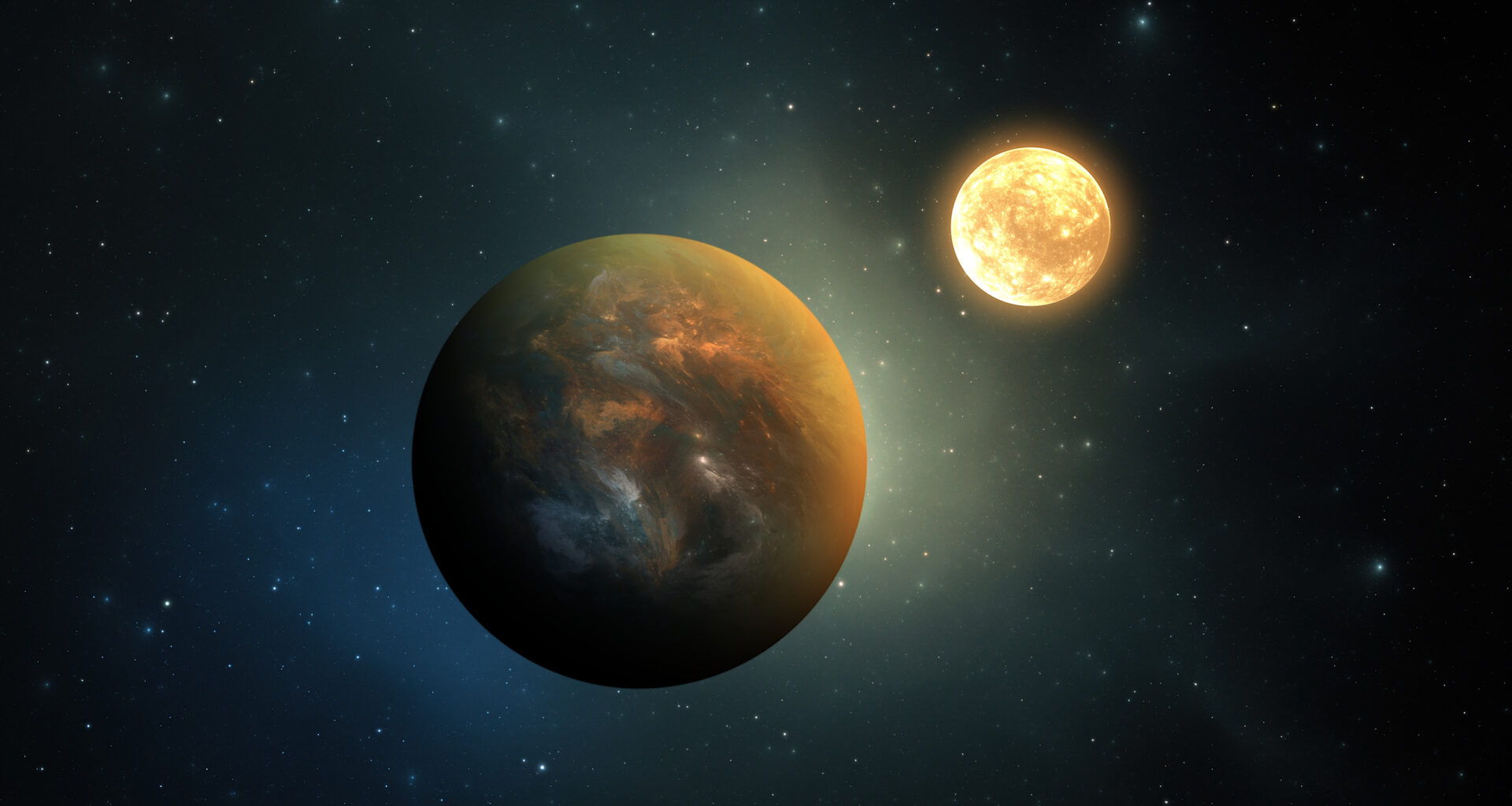
The nearest single star to the Sun hosts four rocky planets unlike anything in our own Solar System, and none of them appears capable of supporting life.
A new study suggests that the worlds orbiting Barnard’s Star are small, dry, and likely scorched by their close proximity to the star.

These are among the nearest planets beyond the Solar System, so their makeup hints at what rocky worlds in our neighborhood are like.
The method behind the work, reading a planet’s likely composition from its star’s chemistry, gives astronomers a way to judge distant worlds they cannot yet see.
Planets orbiting Barnard’s Star
Barnard’s Star sits just under six light-years away, a faint red dwarf that trails only the Alpha Centauri system as the Sun’s closest neighbor.
For more than a century it has tempted astronomers hoping to catch a planet in its grip. That hope has misfired before.
In the 1960s the astronomer Peter van de Kamp announced that Barnard’s Star wobbled under the pull of one or two giant planets.
He defended this claim for two decades until others traced the wobble to changes in his own telescope, not anything in orbit.
Four worlds in focus
The new work was led by Xander Byrne of the University of Cambridge’s Institute of Astronomy, who set out to describe the planets in detail.
All four fall between Earth and Mars in mass, a size range with no counterpart among the Sun’s own planets. The planets themselves were confirmed only recently.
A 2025 study confirmed all four planets by measuring the faint tug they exert on their star’s motion.
Each circles the star in a matter of days. Their orbits sit so tight that a year on the outermost world lasts under a week.
A strange recipe
Planets form from the same cloud of gas and dust as their star, so a star’s chemistry is written into the rock of its worlds.
Byrne’s team can infer the planets’ composition simply by studying the star’s light. One element stood out.
Barnard’s Star carries more than twice as much magnesium as silicon, an imbalance seldom seen elsewhere.
Because both elements harden into rock at almost the same time a planet forms, that lopsided ratio should carry into the planets themselves.
So much magnesium changes what the rock itself becomes.
Instead of being dominated by olivine, the mantles should be dominated by periclase.
On Earth, it appears only hundreds of miles down near the base of the mantle. On these worlds, the models place it through the whole mantle, top to bottom.
Built to be dry
That swap carries a cost. Periclase soaks up far less water than olivine, leaving these mantles able to hold under half the water Earth’s can.
The dryness is not lost oceans or bad luck. It was set by the planets’ chemistry from the start.
When the team modeled the largest planet, its mantle held only about half the water of an Earth-like world the same size.
Earlier studies had assumed that more magnesium always meant more water storage. This system sits past that point, where the trend reverses and the rock turns dry.
Locked and airless
Sitting so close to the star does more than dry the planets out. All four are almost certainly tidally locked, each keeping one face turned to the star.
This is the same way that the Moon keeps one face turned to Earth. One side is drenched in endless daylight while the other never sees the star at all.
None of them is likely to hold an atmosphere. The planets are far too close and too light to keep their air against the star’s radiation. “Your atmosphere just gets blown off,” Byrne said.
The models support that conclusion. The star’s radiation would strip away even a thick atmosphere of hydrogen and helium within two billion years, and probably much sooner.
Too old to stay active
The system is roughly ten billion years old, so any early air vanished long ago. A rocky planet can sometimes build a second atmosphere later, as volcanoes vent gas from its interior.
That escape route looks closed here. Barnard’s Star is more than twice the Sun’s age, so much of the radioactive material that once heated these worlds has already decayed away.
Their small size makes it much worse, letting them lose heat faster than Earth does.
The team estimates the planets now generate about half the internal heat Earth does, leaving mantles too cool and sluggish to drive the volcanic activity that might resupply an atmosphere.
A blueprint for discovery
At first glance, a system packed this tightly might seem unstable. Its planets could nudge one another into collisions or fling each other into space.
Yet the Barnard’s Star planets may be held together by orbital resonance, an arrangement in which their years settle into neat whole-number ratios.
This keeps the gravitational tugs regular rather than chaotic. The same trick steadies other systems.
It keeps the moons of Jupiter in line, and it binds the seven planets of TRAPPIST-1, another crowded family of small worlds around a nearby dwarf star, into a linked chain.
In Barnard’s Star’s case the inner three planets trace a rhythm close to a four-to-three beat. Systems built entirely from such tiny planets barely show up in the records.
Predicting unseen planets
Astronomers have found only two other systems with four or more sub-Earth planets, making Barnard’s Star part of a rare and little-studied class.
The biggest prize is the method. The team showed that a star’s chemistry can reveal the makeup of its planets, offering astronomers a powerful new tool for studying small, distant worlds.
“Larger planets are much easier to detect than small ones,” Byrne said. That approach now has a clear test ahead.
The next giant telescopes should be able to catch these planets’ faint light and test whether any holds an atmosphere, turning the study’s dry verdict from a prediction into a measurement.
The nearest rocky worlds beyond our Solar System appear to be scorched, airless, and hostile to life.
The study is published in Monthly Notices of the Royal Astronomical Society.
—–
Like what you read? Subscribe to our newsletter for engaging articles, exclusive content, and the latest updates.
Check us out on EarthSnap, a free app brought to you by Eric Ralls and Earth.com.
—–