
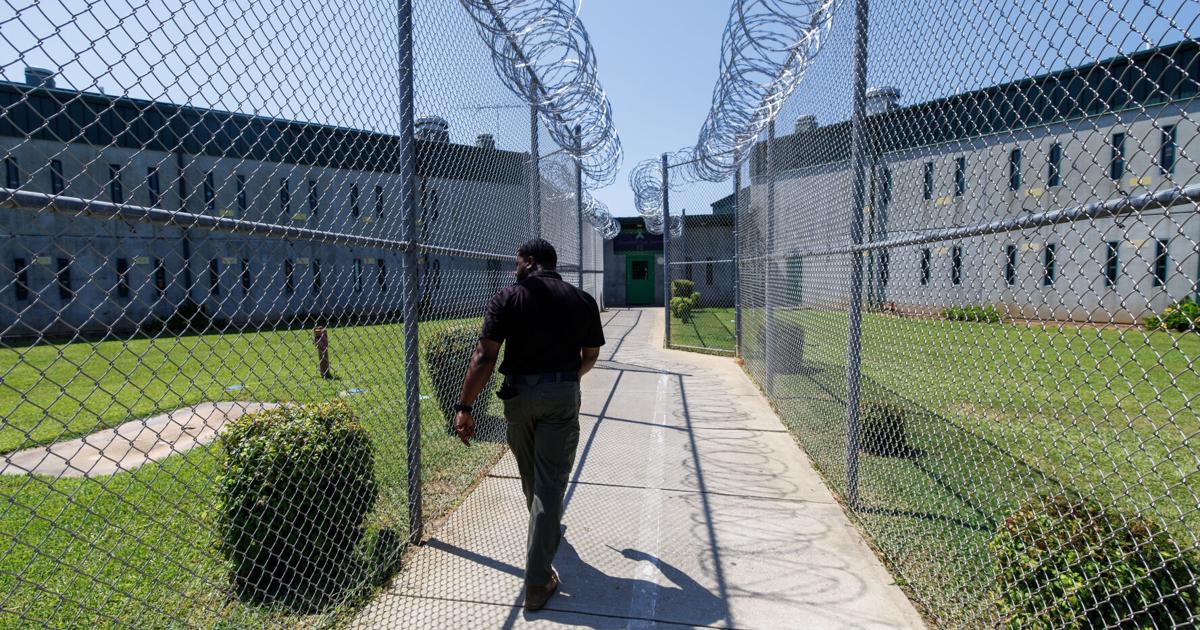
COLUMBIA — The cinderblock walls inside this prison psychiatric unit brim with bright colors, painted butterflies and messages of hope left in elegant scroll.
“Always believe in yourself,” one sign reads.
“Get out! Stay out! Succeed!” trumpets another.
“Difficult roads often lead to beautiful destinations,” says a third.
The buoyant aphorisms at Kirkland Correctional Institution might easily be dismissed as a cheery veneer masking the reality of lives confined by steel doors and razor wire. But they are not-so-subtle evidence of a marked transformation over the past decade in how the S.C. Department of Corrections treats its mentally ill inmates.
After a class-action lawsuit filed in 2005 exposed horrific conditions for the mentally ill in the state’s prison system, the department shoveled attention and resources into improving their care and quality of life. The agency, which had just one full-time psychiatrist at the time, significantly boosted its mental health staff, dramatically reduced the use of solitary confinement and added housing and treatment options that better suit individual inmates’ needs.
“I’d say it’s a seismic shift from where we were,” said former Corrections Director Bryan Stirling, who spearheaded these reforms before becoming U.S. attorney for South Carolina in 2025.
Challenges remain, but even the lawyer who mounted the class-action suit acknowledges progress in several areas. He and others see the effort by Corrections as a potential roadmap for county jails across the Palmetto State to follow in addressing their own struggles caring for the mentally ill.

An inmate reaches through an opening in a cell door in the Intermediate Care Services unit at Kirkland Correctional Institution in Columbia on Thursday June 26, 2025.
Grace Beahm Alford/Staff
Stuart Andrews, lead attorney on the prison lawsuit, said the attention afforded to mentally ill inmates “is by no means luxurious” in state prison but “necessary care is being delivered.” The same cannot be said of the state’s network of 54 jails. The level of care “is far worse in the counties,” he said.
The Post and Courier’s five-part Caught in the Cycle series revealed how defendants with psychiatric conditions often spend months in county detention centers awaiting treatment needed to restore their ability to stand trial. This leaves the jails struggling to care for — and control — people with chronic, complex and often unpredictable behavioral issues.
Since 2015, at least 102 mentally ill people have died in South Carolina jails from dehydration, suicide and other causes, according to a newspaper analysis of state, county and court records.
Legal experts say this predicament leaves the jails vulnerable to the same type of legal challenge that precipitated costly changes to the state’s prison system.
Jails and prisons have become de facto asylums in the decades since South Carolina embraced a national movement to shift patients from institutions into community care to avoid warehousing the mentally ill. Resources to support the initiative never fully materialized, resulting in a tattered safety net that left many in a crushing loop of emergency hospitalizations, arrests and confinement.
Some 5,337 inmates — nearly a third of the total state prison population — receive mental health care behind bars. About 8 percent of that group have severe mental illnesses; others may require less intensive care.
Behavioral health options inside the prison system now reflect this reality, with a goal of meeting inmates’ varying mental health needs. Some prisoners will require hospitalization, while others can function on a low dose of an antidepressant, for instance. The system needs to be able to assess, treat and pivot when necessary, said Dr. Chris Kunkle, its deputy director of behavioral health.
“It’s just really building capacity to treat everybody. We know … that we’re going to get everything that the street gets,” he said. “So we’re really just prepared for it.”
It wasn’t always that way.
A Department of Corrections staff member at Kirkland Correctional Institution exits the section of the prison housing Gilliam Psychiatric Hospital in Columbia on Thursday June 26, 2025.
Grace Beahm Alford/Staff
Locked away and forgotten behind bars
In the not too distant past, some observers characterized the state prison system as a chamber of horrors for the mentally ill. One judge castigated it as an underfunded, understaffed and broken system that violated the rights of mentally ill prisoners, exposing them to abuse, neglect and in some cases, death.
Travra Zanders
Grace Beahm Alford/Staff
Travra Zanders of North Charleston landed in this dysfunctional system in 2000 when he was sentenced to 12 years for a fatal shooting that he maintains was an act of self-defense. Zanders, 19 when he entered prison, was diagnosed behind bars with a mental illness after revealing that he heard voices in his head.
Zanders said he got into fights with other inmates, which led to long stretches in solitary confinement. Prison records show he spent a total of 750 days in restricted housing — two years and 20 days.
Alone in his cell, the voices grew louder. Care was sporadic and uneven.
“I can just remember being in the room all day,” Zanders recently told The Post and Courier. “I don’t like being on my own because of that.”
Zanders’ family barely recognized him when he came home after being paroled in 2009.
During Zanders’ stretch in prison, the Corrections Department had one full-time psychiatrist ministering to as many as 24,000 inmates. Corrections officials approached the University of South Carolina’s neuropsychiatry department and begged for help, one professor recalled.
Dr. Richard Frierson remembers agonizing over the decision with his colleagues. Would they be enabling an inadequate system by putting a Band-aid on it? But they ultimately agreed, viewing the job as missionary work — akin to entering a third-world country, he said.
“The people there were suffering,” said Frierson, who began working in the prisons in 2004 as a part-time psychiatrist. “The patients were suffering.”

This story was made possible by generous reader donations to The Post and Courier Investigative Fund.
To contribute, please go to postandcourierfund.com.
You can also send a check to the Spartanburg County Foundation, 424 E Kennedy Street, Spartanburg, SC 29302, and write “Post and Courier Investigative Fund” in the subject line.
The class-action lawsuit, filed a year later, exposed a constellation of issues, including numerous stories of mentally ill inmates being gassed and locked in solitary confinement for years at a time. The suit alleged that they were denied effective treatment and caged naked, alone and cold in makeshift crisis cells littered with rotten food, feces and other filth.
Some prisoners were serving more time than their original sentences — more time than their life expectancies, in some instances — due to repeated rule-breaking that landed them in solitary with extra years tacked on to their terms.
Unsurprisingly, mentally ill inmates made up a large percentage of those locked in solitary, said Andrews, the lawsuit’s lead attorney. And they weren’t let out for treatment, he said.
A corrections officer watches over a prisoner in a room at Gilliam Psychiatric Hospital at Kirkland Correctional Institution in Columbia on Thursday June 26, 2025.
Grace Beahm Alford/Staff
Change comes to Corrections
The class-action suit was still grinding through the courts when Bryan Stirling took over the corrections department in 2013. The agency had an additional half-dozen part-time psychiatrists by around this time. When Stirling discussed the case with the department’s attorneys, they expressed confidence that the agency could prevail at trial.
“And I said, ‘But is it the right thing to do?’” Stirling recalled. “Yes, we can win in court, but is it the right thing to do?”
The two sides reached a settlement in 2016 that called for the state to spend millions to upgrade the Department of Corrections’ mental health units and add staff. In the first three fiscal years, the agency spent nearly $9.4 million to boost staffing and $1.5 million on other initiatives — a down-payment on improvements that continued over the next several years, records show.
As a result of the reforms, seriously mentally ill offenders are no longer housed in solitary confinement for more than 30 days for disciplinary reasons. A step-down unit is available to get them out of solitary sooner if they manage their behavior. The number of inmates in restrictive housing, otherwise known as solitary, has dropped from around 1,800 when Stirling arrived to 593 as of this month. And the department now has 17 psychiatrists serving around 17,000 prisoners.
As of May 2025, the agency was in “substantial compliance” with all but six of the 58 benchmarks required under the 2016 settlement and was closing in on the remaining half-dozen, officials said.
A prisoner sits with with his head shrouded in a cell at Gilliam Psychiatric Hospital in Columbia on Thursday June 26, 2025.
Grace Beahm Alford/Staff
The Department of Corrections has grown better at recognizing and addressing inmates’ varying mental health needs, rather than leaving their care to untrained officers, said Andrews, the attorney.
Acute care for male inmates is provided at Gilliam Psychiatric Hospital, an 82-bed facility at Kirkland. Women are treated at a separate 12-bed inpatient unit in Lancaster.
Each patient at Gilliam has a team of providers assigned to them consisting of a psychiatrist, psychologist, counselor, mental health officer, activity provider and nurse. Patients receive an individual treatment plan upon admission that gets re-evaluated every week by their team.
Kunkle, the prison behavioral services director, said families are also invited to share background on inmates to help prison staff get a clearer picture of their needs.
An inmate reads “Man’s Search for Meaning,” while others watch a movie in a housing unit for prisoners with mental health issues at Kirkland Correctional Institution in Columbia on Thursday June 26, 2025.
Grace Beahm Alford/Staff
Kirkland, Broad River and Camille Graham prisons have special behavior management units and residential facilities for inmates with mental health needs, the largest of which houses 180 men. The residential treatment units function like dormitories, with a steady ration of required therapy and other programming.
On a visit to Kirkland last year, The Post and Courier observed this range of approaches in action.
In one of the secure housing blocks, reserved for those needing inpatient treatment, a man sat in silence on the edge of his bed, a blanket draped over his head. Nearby, a man could be seen through a tiny window dancing around his cell with toilet paper hanging from the glass. Here and in an adjoining unit, fellow prisoners trained as “inmate companions” help with cleaning, distributing food and talking with patients to keep problems from escalating.
Artwork, much of it created by inmates, covers a wall at Gilliam Psychiatric Hospital in Columbia Thursday on June 26, 2025.
Grace Beahm Alford/Staff
Posters hung throughout Gilliam, offering words of encouragement and instruction. One cautioned against building an “anger volcano.” Another offered coping skills. A third assigned different mental health disorders to Winnie the Pooh characters.
In a less restrictive housing unit next door, the atmosphere was lighter, more free-flowing — aside from a man shouting from a second-floor cell, demanding to be let out. The other inmates barely seemed to notice. One stood in the common area reading a weathered copy of “Man’s Search for Meaning,” psychiatrist Viktor Frankl’s 1946 book chronicling his experiences in Nazi concentration camps. A group of men nearby laughed and watched movies as they waited for lunch to arrive.
In a recreation yard outside, an inmate practiced his soccer kicks against a wall as three others played a game of pickup basketball.
An inmate kicks a soccer ball against a wall for recreation outside a housing unit for prisoners with mental health issues at Kirkland Correctional Institution in Columbia on Thursday June 26, 2025.
Grace Beahm Alford/Staff
Harold Ancrum of Beaufort County experienced prison before and after the reforms were enacted. He appears to be someone who benefited from the changes.
Harold Ancrum at Beaufort Waterfront park, Thursday, Nov. 6, 2025, in Beaufort.
Gavin McIntyre/Staff
Ancrum, 48, spent much of his adult life cycling between jails, prison and the street — rarely getting consistent treatment for his bipolar disorder while locked up. That changed after the lawsuit spurred reforms while he was serving a sentence for armed robbery.
This time around, Ancrum consistently took his medicine and found meeting with mental health staff to be helpful. He initially feared they were trying to kill him when a doctor ordered an injection, he recalled. But then he felt better.
“My problems went away,” Ancrum said. “I wonder why they didn’t give me the shot before.”
Ancrum left prison last year, has been keeping up with his treatment and is determined to make the most of his freedom.
“I can say now, all the things I been through, I actually made it,” he said.
Alan Hovorka contributed to this article.