
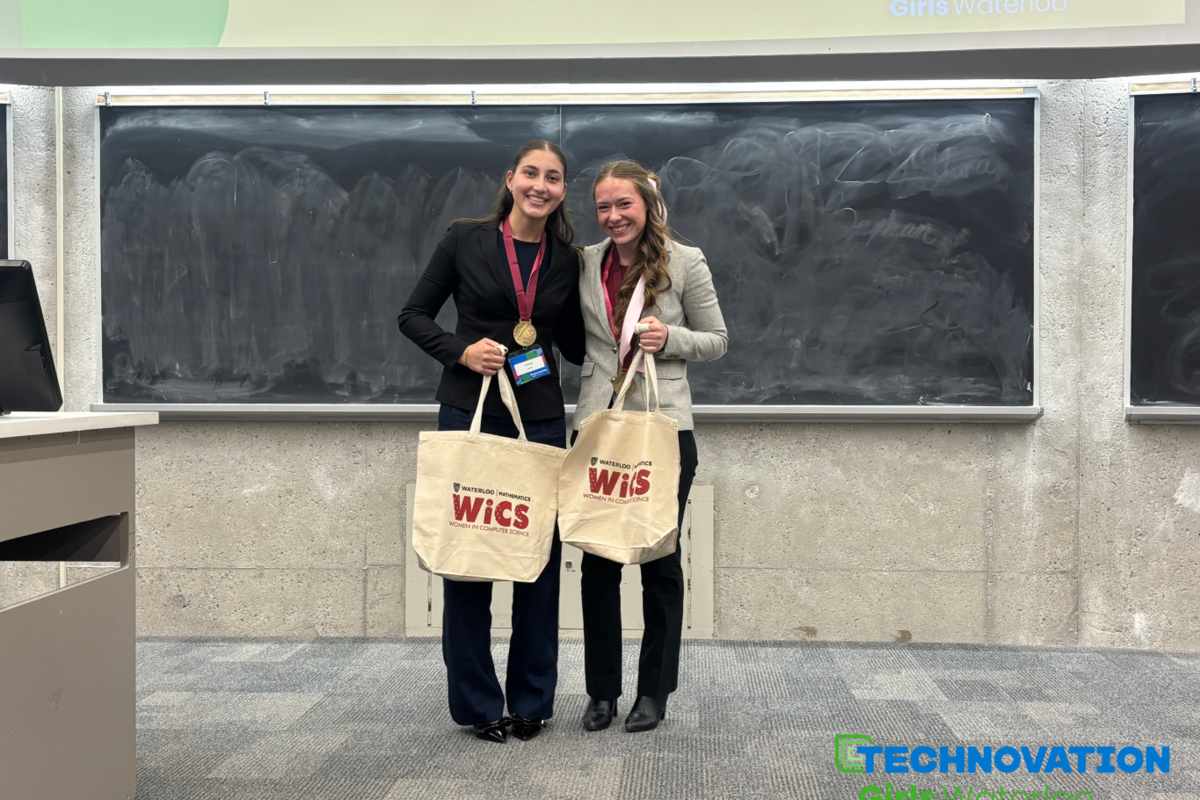
‘Now we get to meet people from around the world who have done the same thing and see where the app takes us,’ says local student
When Allie Homick first spotted a social media post about the Technovation Girls program, she had no idea it would lead to representing North America on the world stage.
Now, the recent Georgian Bay District Secondary School graduate and her teammate, Victoria Scorziello, are preparing to travel to Bengaluru, India, this October after becoming the first team from the University of Waterloo’s Technovation Girls chapter to qualify for the Technovation Girls World Summit.
“It’s honestly surreal,” Homick said. “When we started doing it, we never imagined we would make it this far. For me, it’s really been about learning — learning how to build an app, learning how to pitch it publicly and creating something that could actually help people.”
Their app, CareCompass, was inspired by a problem the pair knew all too well.
As teammates with the Barrie Sharks U18 AA hockey team, Homick and Scorziello regularly travelled across Ontario for tournaments, where injuries can quickly turn a weekend away from home into a stressful search for medical care.
“I remember one of our teammates broke her leg and another sprained her ankle,” Homick said. “When you’re in a different city, you don’t know which hospital to go to or which one has the shortest wait time.”
One incident stayed with the team.
“A teammate ended up sitting in an emergency waiting room for five hours with a broken leg,” she said. “That’s kind of why we built it.”
CareCompass allows users to compare nearby hospitals using emergency department wait times, travel time and available services, such as diagnostic imaging, maternity care and other specialized capabilities.
Hospital administrators can also update information such as equipment outages, helping patients make more informed decisions when every minute counts.
One feature was especially important to the pair.
“We really wanted it to be free,” Homick said. “Around health care, so many things already cost money. We have a public health-care system, so we wanted everyone to be able to access this information without having to pay for it.”
The achievement is even more remarkable considering neither student had previous experience developing apps.
“I didn’t understand any of the coding languages the project was built in,” Homick said. “We taught ourselves through online courses, mentorship and a lot of troubleshooting. Hundreds of hours of troubleshooting.”
Their determination impressed Professor Jo Atlee, founder of the Waterloo Technovation Girls chapter through the University of Waterloo’s Women in Computer Science initiative.
“More than 3,600 apps were submitted worldwide,” Atlee said. “After two rounds of judging, the competition was narrowed to just 15 finalist teams across three age divisions. Making it to the finals is a huge accomplishment.”
This year marks the chapter’s most successful competition season, with Homick and Scorziello becoming its first-ever World Summit finalists.
For Homick, technology has always been part of life.
Her father studied computer science at the University of Waterloo before founding his own technology company, and she grew up building Lego structures and experimenting with electronics alongside her two younger brothers.
She also credits an elementary school librarian with helping spark her passion.
“I started at Mundy’s Bay Public School, and Mrs. Morrow introduced me to robotics through the gifted program,” Homick recalled. “I remember building and programming this little robot. It seemed massive to me back then.”
When it came time to choose a university, Homick was researching Waterloo’s engineering programs when she discovered Technovation Girls through Instagram.
She immediately asked her hockey teammate if she wanted to join.
“I just said, ‘This sounds really cool. Do you want to do this with me?’ We kind of jumped into it.”
That leap of faith has now earned the pair an all-expenses-paid trip to India, where they will spend a week participating in workshops with technology leaders, networking with industry professionals from companies including Google, and presenting CareCompass before an international panel of judges.
The experience includes travel, accommodations and an educational stipend valued at approximately $10,000 per team.
This fall, Homick will begin studying mechatronics engineering at the University of Waterloo, but she says the greatest reward has been the journey itself.
“The main reason we did it was to learn and experience building something like this,” she said. “Now we get to meet people from around the world who have done the same thing and see where the app takes us.”