

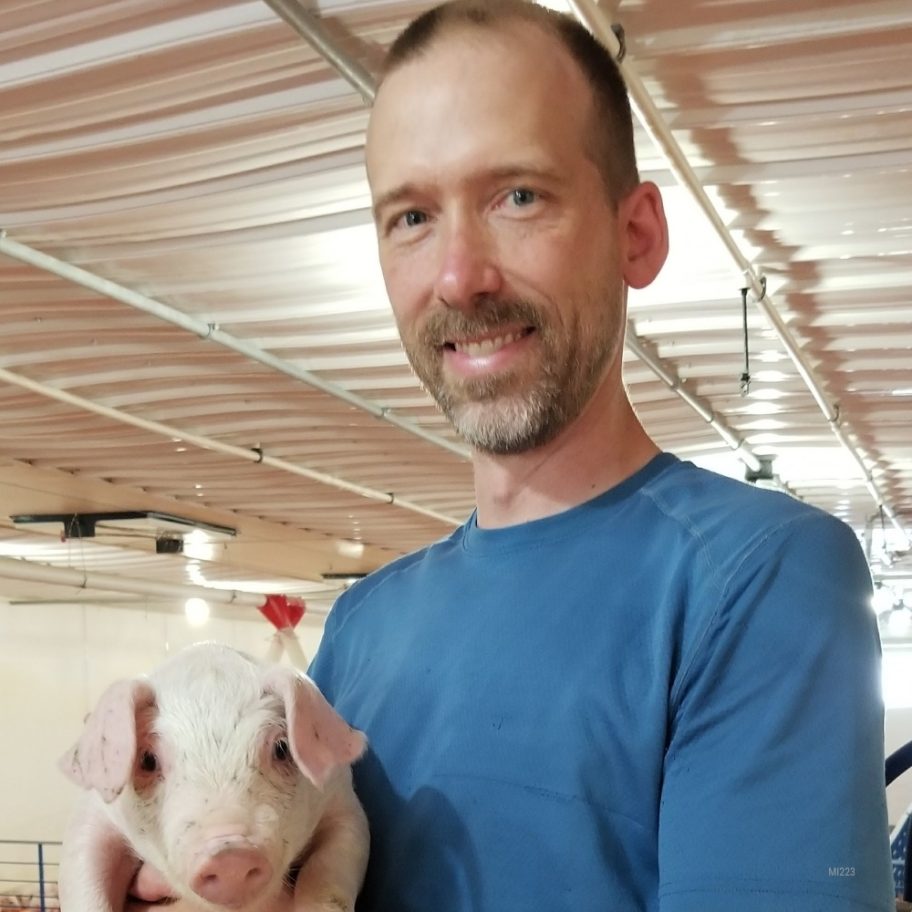
Mike Paustian
“We had a PRRS break earlier this year,” says Mike Paustian. “You try to manage it, to mitigate how bad it will be, but our current tools to manage it are not that great.”
If ever there was a moment where the realities of pig farming and the science of gene editing came together, it was this moment on Paustian’s farrow-to-finish farm in eastern Iowa. Not just because he experienced a PRRS outbreak, but also because, before coming back to the family farm 17 years ago, he worked as a microbiologist at the National Animal Disease Center and had been following the development of gene-edited PRRS-resistant pigs.
Porcine reproductive and respiratory syndrome, or PRRS, is endemic to pig herds around the world and it costs farmers both financially and emotionally.
“I first heard about the underlying technology, CRISPR, when I was in grad school,” says Paustian. “I’ve been following gene editing technology for a long time and thought it was interesting.”
When PIC announced the development of its gene-edited PRRS-resistant pig, Paustian was listening.
“I was very excited,” he says. “We’ve seen many, many times how a new advancement in the lab doesn’t always pan out in the field.” When he heard that PIC planned to commercialize the PRRS-resistant pig, he was cautiously optimistic.
A pig that works for everyone
Paustian agrees that PRRS needs a better solution. “For most farmers, it’s the number one boogeyman,” he says, adding that the disease always manages to get around existing management tools, from vaccines to biosecurity measures to diet management and more. “Other than finding a place to farm where there are no pigs in a 100-mile radius, PRRS is always going to be a threat.”
The gene-edited PRRS-resistant pig could change all that. “Producers talk about eliminating PRRS with the tools we have now,” says Paustian.
But elimination of PRRS may be a pipe dream, given the tenacity of the virus, its ability to rapidly mutate and replicate itself in unpredictable ways. “With this new tool, maybe we can actually do it,” he says.
Producer benefit is just part of the picture, he adds. Paustian feels that mistakes were made when GMO technology was first introduced – that the focus was too much on how it would help crop producers and not enough on what it meant for consumers.It led to distrust that the crop industry feels to this day.
“One of the big challenges in bringing this to market is explaining how gene editing technology is different from traditional GMOs,” says Paustian. “Consumers are making an emotional decision when they buy food.” When Paustian talks to other producers, he reminds them that to gain acceptance, the industry must emphasize the benefits of gene editing for consumers, not just for the industry.
Ultimately, it’s about aligning values between producers and consumers. Paustian says producers – indeed the entire pork industry – need to understand what matters to consumers if they want to put gene-edited pigs in their barns.
And while that’s not always as straightforward as it might seem (for instance, consumers say antibiotic use is important, but cost is still their number one purchase driver), just talking about the science is not enough. “People don’t care what you know until they know that you care,” he says. “They need to know you share their values.”
Future hopes for gene editing
Paustian believes there’s a lot riding on the introduction of PRRS-resistant pigs. “Acceptance of this technology is going to be an indicator for future gene-edited products,” he says.
“My hope is that this technology would allow us to accelerate the breeding process,” he says. “If we know what gene is responsible for a trait, we could accomplish what traditional breeding does, but faster.”
In addition to PRRS, he’d love to see gene editing tackle rotavirus. “Every time we test, we’ll find at least one strain,” says Paustian. “We’ve tried everything from vaccines to biosecurity, but it is a scourge of the post-weaning phase.
“Meat quality is another thing I think about,” he says. For decades, the market has focused on lean meat almost to the exclusion of anything else. But tastes are changing and that means producers need to make some changes to herd genetics, which can be slow. “Producers are paid on efficiency and growth, but consumers buy on taste,” says Paustian. “If we could identify the right indicators for meat quality, that would be helpful.”
He knows these are more far more complex targets for gene editing to solve for than PRRS was. But his point remains that how the PRRS-resistant pig is accepted by the industry and consumers will lay the groundwork for future uses of this important technology.
For now, commercialization of the PRRS-resistant pig holds vast promise for Paustian.
“I’m hopeful the PRRS-resistant pig is going to come to market,” says Paustian. Breeding cycles mean introduction will be measured and slow, but he hopes for a time when, if enough producers adopt the technology, the PRRS virus might even stop circulating altogether.
For more information about the development of PIC’s PRRS-Resistant Pig, visit the website PRRS-Resistant Pig.