
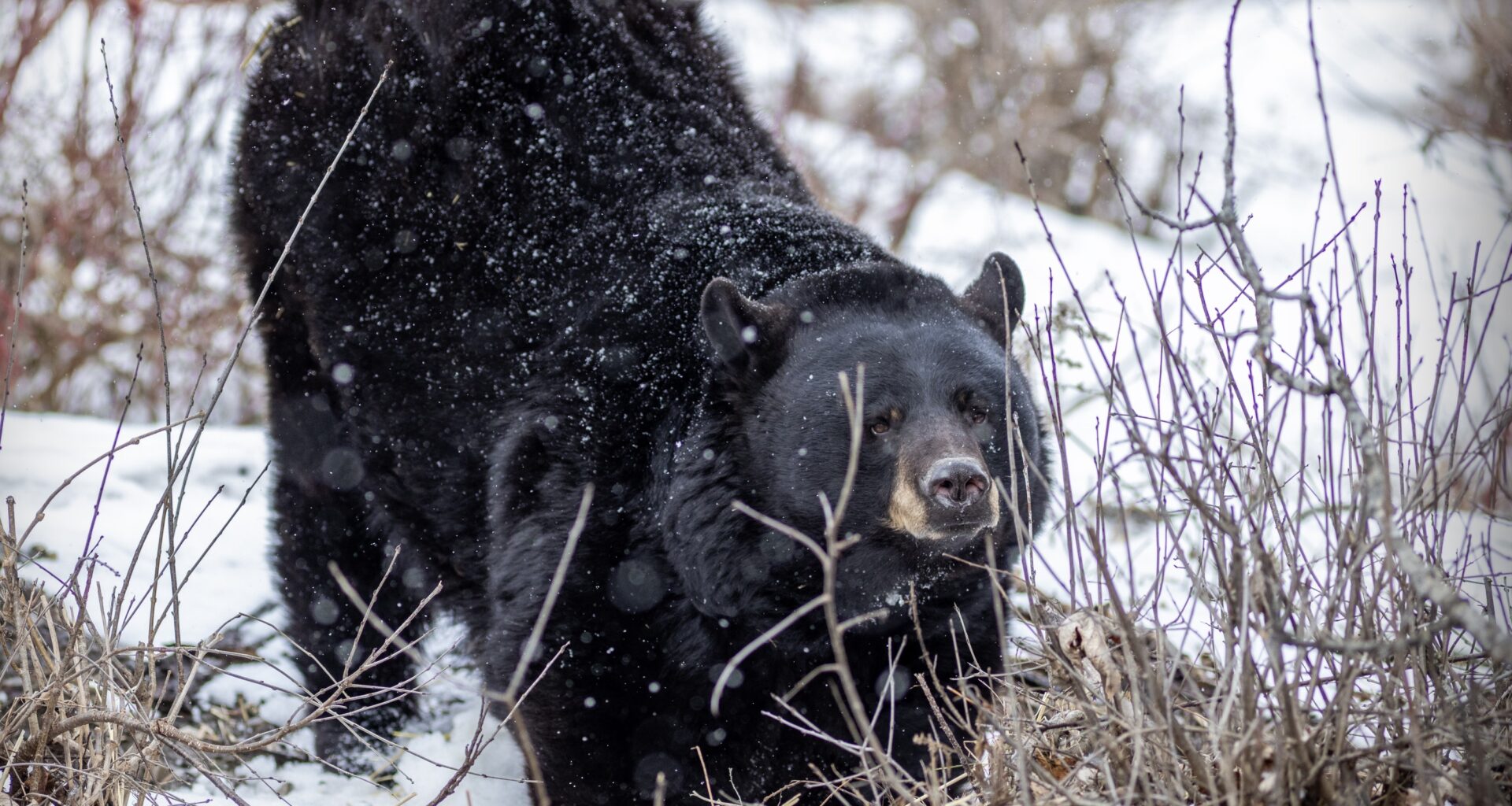
Black bear attacks are rare, typically defensive, and seldom predatory.
But if you are attacked by a black bear, according to the province’s designated bear expert, you must fight — quite literally — for your life.
“You’d want to defend yourself,” stressed Elizabeth O’Hara, the recently-crowned Provincial Bear Biologist who monitors black bear populations across the province.
Unlike what you’re advised to do with a grizzly, “don’t play dead,” she said.
“Fight back with everything you’ve got.”
Tragically, as a spate of fatal bear attacks in northern Saskatchewan indicate, everything you’ve got is not always enough.
Three killed in just over two months
On May 8, Hrishikesh Koloth, 27, was killed by a black bear while working at a uranium site 85 kilometres northeast of Points North Landing, in the province’s extreme north.
Koloth was an amateur mixed martial artist whom his brother called a warrior in a CBC interview.
“I’d just like to say he fought (the) bear,” Koloth’s brother told the CBC. “(The) bear didn’t attack him. He attacked the bear.”
On July 15 and 16, the bodies of retired Regina couple Jay and Deb MacDonald, both in their early 70s, were found near their cabin at McTavish Lake, approximately 90 kilometres north of La Ronge.
The Ministry of Community Safety confirmed that a bear was involved in their deaths, though details of their final moments have yet to emerge.
Those three fatalities from May to July equal half of Saskatchewan’s six bear-related human deaths on record.
O’Hara wouldn’t speak about the recent incidents, as the couple’s deaths are still under investigation.
On Friday, the Ministry of Community Safety confirmed that the investigation into Koloth’s death “is complete and there is no additional information available.”
O’Hara did offer possible explanations for the rise in attacks, plus methods to prevent attacks for which fighting is the sole — and sometimes insufficient — recourse.
Prevention is bear necessity
“There’s a number of things that can impact bear behaviour . . . whether that be environmental factors or human factors,” noted O’Hara.
One human factor, she emphasized, is improperly stored or cleaned food.
“They’re intelligent animals and they’re ruled by their stomachs, so they’re spending most of their time looking for food,” O’Hara said of black bears, Saskatchewan’s only confirmed bruin.
“The best thing that we can do to minimize our chances of an encounter with bears is making sure that we’re minimizing any human food sources that they can get into.”
Storing pet food indoors, properly managing garbage, and cleaning barbecues are preventative measures cited by O’Hara.
Natural factors for bear encounters concern cubs and territory.
“(The) majority of encounters with black bears are defensive in nature. So it’s typically happening when you’re coming between a bear and either it’s protecting its territory or a resource or its cubs,” O’Hara said.
But such encounters don’t usually result in bear aggression. It’s the “extremely rare” predatory encounters that do.
Saskatchewan’s black bear population is stable, O’Hara said, with some areas seeing more bear calls than normal and some less. Bear density is highest near the centre of the province, where the aspen parkland meets the boreal forest.
But even the sites with higher-than-normal densities are “all part of normal population fluctuations.”
Attack deterrents
“If you’re just encountering a bear, stay calm, don’t run,” advised O’Hara, who has yet to have a close call with the species she oversees provincially.
“(The) best thing you can do is sort of calmly back away slowly, make a wide detour, speak in a firm, deep voice, and make direct eye contact with the bear.”
If possible, back up towards cover, such as a vehicle or building, but do not climb a tree because “bears are excellent climbers.”
If the bear continues to approach, O’Hara added, you can try to distract it by throwing something like an article of clothing.
“And then, if you have bear spray on you . . . pull it out, and be prepared to use that bear spray.
“Bear spray has been found to be effective on all species of bears found in Canada, so that’s one of your best methods of defence.”
Right to bear arms
O’Hara declined to comment on the efficacy of firearms as bear deterrents, but the RCMP allows residents to carry non-restricted rifles and shotguns for wilderness protection.
Moreover, restricted long guns and handguns can be carried with a licence if you are a professional trapper or need protection from wildlife while working a different wilderness job.
Carriers must be sure of having proper permits in Saskatchewan because, per the Wildlife Act, “carrying a firearm in a locality where any wildlife may reasonably be expected to be found is, in the absence of evidence to the contrary, proof of hunting.”
It is not known if any of the recent victims carried bear spray or firearms.
Asked about the protocol for bears that have attacked or might attack humans, O’Hara deferred the answer to conservation officers, but noted that such animals are typically relocated or dispatched.
The two bears suspected in the three recent deaths were euthanized and taken for necropsy at Saskatoon’s Western College of Veterinary Medicine.
“Necropsies are typically the way that they get the 100 per cent confirmation that it was the bear involved in any incident,” O’Hara said.
Still, in a province where bears are not the only animals to attack, O’Hara stresses prevention from humans — the most dangerous species — above all else.
“There (are) provincial regulations that prohibit the feeding of bears, wolves, cougars and coyotes for that purpose, so they don’t become habituated to humans and become a potential danger.”
Editor’s Picks