
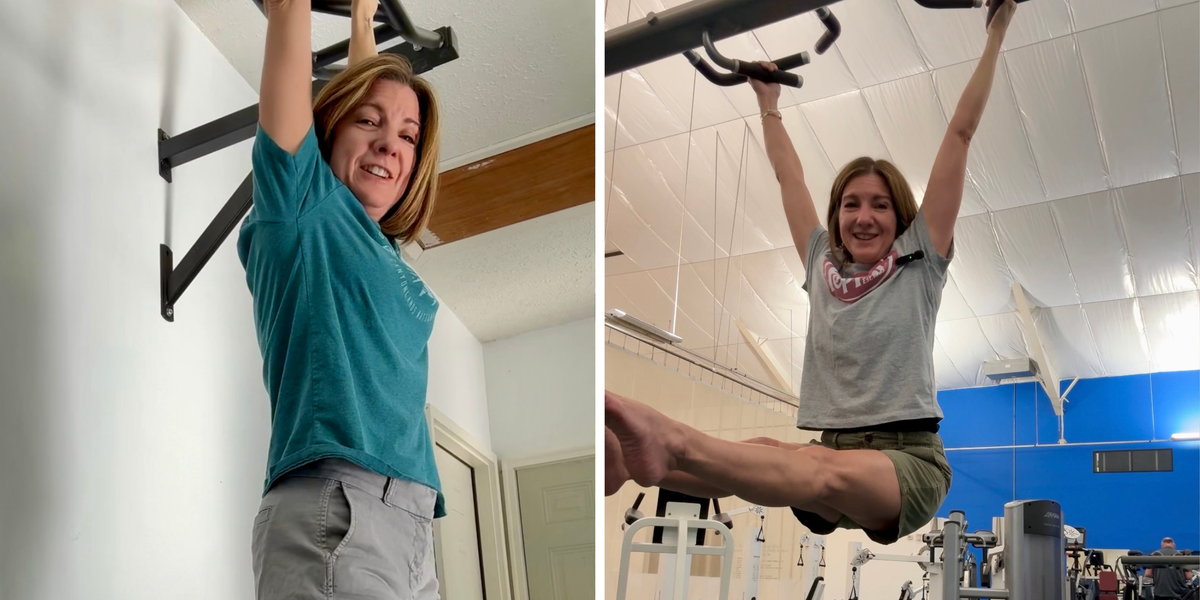
When 63-year-old April Nading decided to challenge herself to dead hang every day for a month, she did so with one goal in mind: decompressing her spine.
She’d been dealing with a tingling sensation in her leg and toes caused by an issue with her spinal discs for almost a year, so when a chiropractor she’d visited mentioned that dead hanging might help, she decided to give it a go.
One month on, and Nading has increased the amount of time she’s able to hang and decided to keep up her new habit – and it’s not just because her symptoms have improved. Here are a few of the changes she’s noticed over the course of her one-month challenge.
1. Her shoulders are more mobile
Before the challenge, Nading had a ‘slight pinch’ in her shoulder and left elbow, but by the end of the 30 days, all of that discomfort had gone. This is likely because dead hangs move the shoulders into flexion – a position they’re rarely in when we go about our day-to-day lives. This can lead to an improvement in overall shoulder flexibility and range of motion, which can help any niggles.
2. The tingling in her leg and toes has got better
While dead hanging every day for a month hasn’t completely got rid of Nading’s tingling, she says it’s definitely helped, which is one of the reasons why she wants to keep hanging every day.
‘I’m happy to report that after a month of dead hanging, the tingling in my leg is better,’ she says. ‘It’s not completely gone, but it’s not as intense or as frequent as it was before I started dead hanging, and I’m hoping it will keep improving with continued hang time.’
This is likely because of how hanging can relieve pressure within the spine, as strength and conditioning coach Andy Vincent previously told Women’s Health: ‘Hanging from a bar allows your spine to elongate with gravity, potentially relieving pressure on the vertebrae and discs,’ he explains. ‘This decompression can alleviate back pain and improve overall spinal health.’
Nading also says a ‘tweak’ she experienced in her lower back during some yoga poses also seems to have gone, which could be related to this spinal decompression.
3. She feels a lot stronger – and her muscles are more defined
Dead hanging can affect more than just your shoulders: in fact, it can work and build strength across your upper back and core too. This was one of the big benefits Nading noticed.
‘The more I did it, the stronger I got,’ she says. ‘Now I can hold for 90 seconds, and I’m a lot stronger than I was before I started. My arms are also more defined!’
This increase in her strength also applied to her grip; at the beginning of the challenge, she needed gloves to hold onto the bar, whereas by the end she could hold on without them for 90 seconds.
‘I do have callouses on my hands as a result of hanging – something I’ve never had in my life, and I’m actually kind of proud of,’ she adds. ‘Monkey bars have also gotten easier – I can swing from one bar to the next without pausing!’
How to do a dead hang
Want to start your own dead hang challenge? Follow the instructions below to get started.
Find or set up a bar.Grip the bar using an overhand grip (palms facing away from you). Your hands should be shoulder-width apart or slightly wider. It is usually more comfortable to go slightly wider.Don’t jump into the position; set up so that you can simply take your feet off the floor or a block if you’re tall enough, and get into position without too much swinging.Exhale fully to engage your core, squeeze your glutes, tuck your tailbone, and relax your shoulders. The aim is to keep your ribcage down and pelvis slightly tucked to prevent your spine from hyperextending, maintaining a steady breath and avoid exaggerated swinging – a little movement is normal.Hold the position until you feel your shoulders and neck beginning to tense excessively.
Of course, you’ll need somewhere to hang from, but a pull-up bar is relatively cheap to buy and is a helpful piece of equipment to have around if you want to build upper-body fitness.
P60 Wall Mounted Pull Up Bar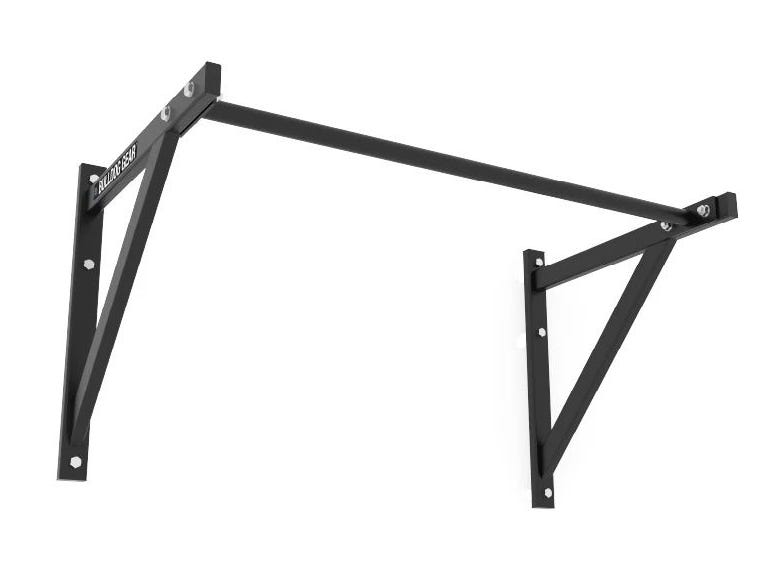 P60 Wall Mounted Pull Up Bar
One of our most frequently asked questions here at Women’s Health? How to build muscle and burn fat at the same time. So, we asked superstar trainer Oyinda Okunowo exactly how to do it. In this 4-week plan – created exclusively for Women’s Health COLLECTIVE members – you’ll get the workouts and nutrition guidance needed to help you on your way to better body composition. Tap the link below to unlock 14 days of free access to Oyinda’s plan and start training today.

Lauren Geall is deputy site editor for Women’s Health UK and Men’s Health UK. She graduated from Exeter University with a BA in English Literature before studying an MA in Magazine Journalism at City, University London. She’s been writing about health, fitness and wellbeing for over five years, with a total of seven years in digital journalism. Prior to her current role, she worked at Stylist as the acting health and fitness editor. As well as being a keen runner, Lauren is passionate about women’s sport and can often be found cheering on Arsenal Women at the Emirates or keeping tabs on the Red Roses’ latest win.