
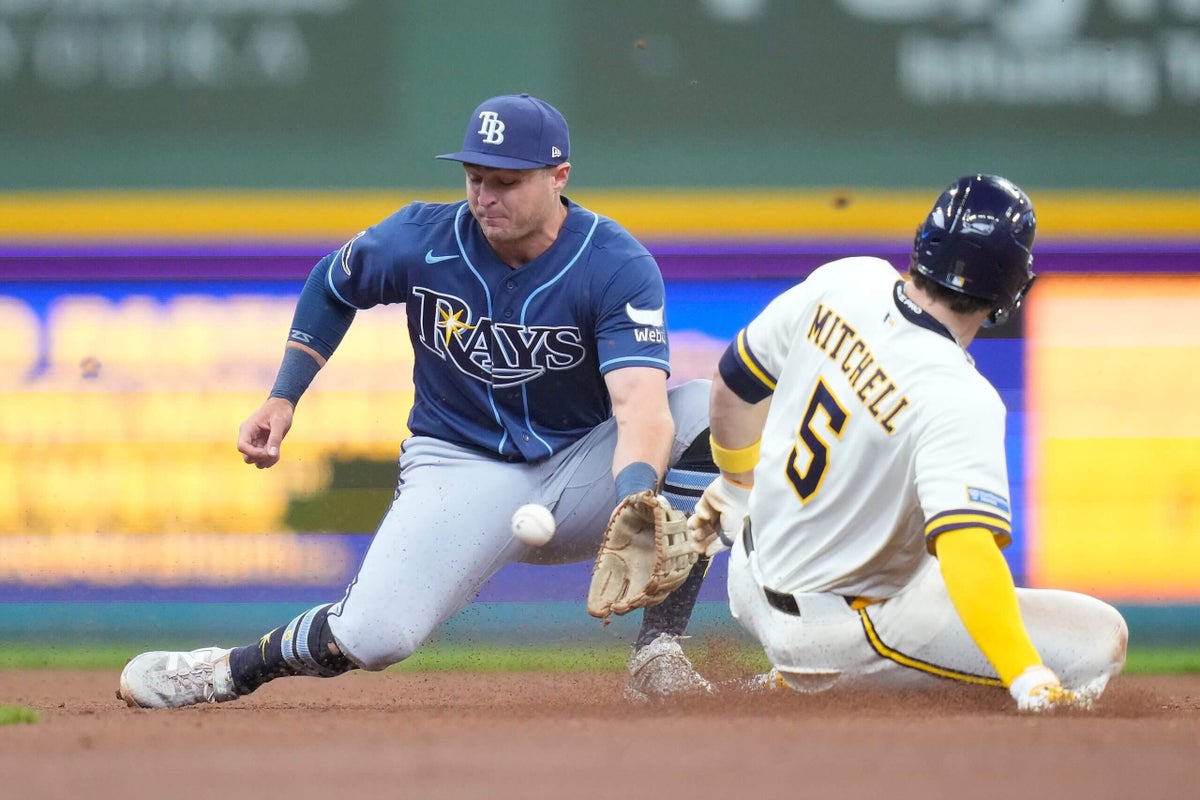
Contending teams bemoan the lack of sellers at the trade deadline, noting too many clubs are bunched together.
Wait, how is this possible?
Major League Baseball continues to insist the sport lacks competitive balance, and a salary cap is the only solution.
Playing right out in front of us, for anyone who cares to pay attention, is a season that defies the league’s argument.
Entering Tuesday’s play, 24 of the 30 clubs are within five games of a postseason spot, and 21 are within two games.
Oh, and the New York Mets, Toronto Blue Jays and San Francisco Giants — teams with the game’s second-, fifth- and 11th-highest luxury-tax payrolls, respectively — were among those more than three and a half games out.
How many players will the Mets trade by the deadline?
Ken Rosenthal and Johnny Sweet
Random, wacky outcomes — in a game, a season, a postseason — are not unusual in baseball. But the league, acting almost as if the results are preordained, keeps banging the competitive-balance drum, through its “Level the Playing Field” ad campaign on MLB.TV and elsewhere.
If fans “overwhelmingly support a salary cap and floor,” as the league says, they shouldn’t need additional convincing. Then again, when the on-field results don’t fit the off-field narrative, better to bombard the public with spurious arguments.
Which would you rather believe, the owners — whose primary motive is boosting their franchise values — or the competition you’re seeing in the standings? Competition that by the way, stems in part from the expanded playoffs the league introduced in 2022 to ahem, make more money.
Don’t get me wrong. I’ve written repeatedly about the necessity for the league and players’ union to address the revenue disparity between between big- and small-market teams. In February, I suggested a number of ideas on how to improve the plight of small-market clubs without resorting to a cap.
The game is experiencing a renaissance, in part because of innovations such as the pitch clock and the Automated Ball-Strike challenge system that commissioner Rob Manfred pushed and the union resisted. The owners’ insistence on a cap, however, almost certainly would result in a prolonged lockout, jeopardizing part or all of the 2027 season.
That is the last thing the sport needs. It also is the last thing the owners need. Disrupting the 2027 season — and alienating fans at a time when they can entertain themselves in exponentially more ways than they could during the 1994-95 strike — is not a great way to enhance franchise values. Nor is it a great way to enter negotiations for the sport’s next set of national television contracts.
But Manfred and the owners say: “Trust us. We know what’s best.” They exaggerate the spending gap between the top and bottom teams by including luxury-tax payments in the top teams’ payrolls. And they say, “Too many fans in markets across the game have too little hope that their team has a fair chance to win.”
Really?
The league loves to point that the 2015 Kansas City Royals were the last small-market team to win the World Series. Well, according to FanGraphs, three revenue-sharing recipients — the Milwaukee Brewers, Seattle Mariners and Tampa Bay Rays — were among the six teams that entered Tuesday’s play with the best odds of winning the Series.
The Brewers or Rays can increase those odds by trading for Tarik Skubal from the Detroit Tigers. The Mariners can do the same by acquiring Mason Miller from the San Diego Padres. None of those moves is particularly likely. Those teams generally do not swing that big. But a Brewers-Rays World Series would be the ultimate rebuke of the league’s position that the sport is broken.
An impossible scenario, you say? No one can beat the two-time defending champion Los Angeles Dodgers, whose 24.8 percent chance of winning the Series is more than double than that of the next-closest team, the New York Yankees?
Funny, the Dodgers lost back-to-back Division Series in 2022 and ‘23 to division rivals in smaller markets, the San Diego Padres and Arizona Diamondbacks. They should have lost in the DS again to the Padres in ‘24 after throwing a bullpen game while facing elimination on the road. And they needed a series of near-miraculous escapes to win the Series in ‘25.
The current Dodgers team, while sitting on the best record in the majors, is no lock, either. It is anchored by the league’s oldest position-player group, and still unsure about the availability of pitchers Blake Snell, Tyler Glasnow and Shohei Ohtani.
True, the Dodgers possess advantages no team can match. Ohtani, a unicorn of a superstar who is a one-man ATM (and was affordable in free agency to every other club on the kind of heavily deferred contract the owners want to eliminate). A local TV deal that shields a significant portion of the team’s rights fees from revenue sharing, thanks to an agreement the league and club made to avoid a fight in U.S. bankruptcy court after the current ownership took control from Frank McCourt.
The league’s plan for teams to share all local media revenue, contingent on the players agreeing to a cap, effectively would thwart the Dodgers’ TV advantage. But the players remain adamantly opposed to a cap. And when the league said it “will accept” the union’s opening proposal for five-year free agency for 30-year-old players, well, sure it would. But only under a cap that limits players’ earnings, which the union contends is not true free agency.
The season thus far has produced a number of delightful surprises. The Rays racing to the best record in the AL. The Chicago White Sox rebounding from three straight 100-loss seasons to lead the AL Central. The St. Louis Cardinals and Minnesota Twins competing after depleting their rosters through trades. The Washington Nationals and Pittsburgh Pirates ranking 1-2 in the majors in runs per game.
I’m not saying the playing field is as level as it could be. I’m just saying it’s a lot more level than the league would have you believe.