

Finding a dominant one-two punch at center is every NHL team’s dream. Elite centers are very difficult to acquire via trade or free agency and are valued at a significant premium compared to similarly skilled wingers.
With that in mind, we thought it’d be fun to analyze the state of every NHL team’s top-six centers.
A clear-cut ranking from No. 1 to No. 32 is a futile exercise because the margin separating a team with, say, the 10th and 16th best center duo is thin. It makes the most sense to sort them into tiers where the stratification is a bit more distinct. Within each tier, teams are not ranked in any particular order. To conduct this exercise, I leaned on a combination of statistics (point production, play-driving ability, defensive impact and more), context (linemate quality, age) and the eye test.
Teams are sorted into tiers based on their projection for 2026-27 — contract values do not matter, and we’re not factoring for future upside beyond this season. We’re also weighing the No. 1 center slot more heavily than the No. 2 spot; most teams would take a high-end 1C and a weaker 2C over a weak 1C and an above-average 2C.
Who’s the better power play QB: Quinn Hughes or Lane Hutson?
Scott Wheeler, Max Bultman and more
Tier 1: GenerationalEdmonton Oilers: Connor McDavid and Leon Draisaitl
This is a truly unrivaled duo.
McDavid is the undisputed best player in the NHL. He’s averaged 131 points over the last five seasons, and the way he can singlehandedly take over a playoff series is one-of-a-kind. McDavid has scored an absurd 134 points in 81 games over his last five playoff runs; the next highest-scoring player besides his running mate, Draisaitl, is Matthew Tkachuk with 81 points in 85 games over his last five playoff runs.
Draisaitl, meanwhile, has scored at a 100-point pace or higher for six consecutive seasons, a feat no active player besides McDavid can claim. He’s a top-five center in the NHL in his own right.
They’ve come up short twice against Florida in the Stanley Cup Final, but it’s hard to blame them for that because the organization has failed to surround them with a championship-caliber supporting cast, which makes it easier for the Panthers to key in on them.
Tier 2: EliteColorado Avalanche: Nathan MacKinnon and Brock Nelson
MacKinnon was so dominant last season that it was a shock that the Avalanche didn’t reach the Stanley Cup Final. He hit 127 points, drove a whopping plus-58 goal differential during his five-on-five shifts and finished top-five in Hart Trophy voting for the fourth year in a row. MacKinnon’s combination of game-breaking speed, elite puck skills, man strength and outrageous shot makes him look like a video game character on the ice.
Behind MacKinnon, Nelson is an excellent second-line center. Nelson scored 33 goals and 65 points in the regular season and was recognized as a Selke Trophy finalist. It was a well-deserved honor because he drove a commanding 58 percent of scoring chances and 61 percent of goals despite handling the most five-on-five defensive zone starts of all Avalanche forwards and difficult matchups.
Nelson struggled in the playoffs with only three points in 13 games, but putting that aside, he still projects as an elite 2C for next season.
Florida Panthers: Aleksander Barkov and Sam Bennett
This might be a tad too high for some people’s taste, but hear me out. Sure, if we strictly look at point totals and regular-season results, Barkov and Bennett wouldn’t quite deserve to rank this high. However, there’s so much they do beyond the boxcar stats, and their elite playoff track record has to be a major consideration as well.
Barkov is a top-five center in the NHL based on his all-around impact. He’s produced 1.15 points per game since 2021-22 (a 95-points-per-82-games pace), which ranks seventh-best among all centers in that span, but what truly separates him is his status as the best defensive forward on the planet. Barkov is a three-time Selke Trophy winner. He’s been on the ice for only 1.64 goals against per 60 at five-on-five since 2023-24, which is by far the best mark among all first-line centers. Barkov also deserves credit for limiting McDavid to only eight five-on-five points across two Cup Final series in 2023 and 2024.
There will be questions about whether Barkov will need time to shake off rust after missing all of last season recovering from ACL and MCL surgery, but his dominant performance leading Finland to gold at the World Championships this summer should reduce those concerns.
Bennett is coming off a 26-goal, 58-point campaign. More importantly, he’s a Conn Smythe winner with a proven clutch gene, as he’s scored 51 points in 62 games across his last three playoff runs. It’s why he got the nod to play for Team Canada at the 4 Nations and Olympics. Bennett is also one of the most physical players in the league. You can argue that he’s dirty and gets away with too much, but there’s no denying that his antics and gamesmanship are effective nonetheless.
Tier 3: High-endNew Jersey Devils: Jack Hughes and Nico Hischier
The Devils are the only team besides Edmonton that boasts two top-20 NHL centers.
Hughes is an electric game-breaker, scoring 1.22 points per game since 2022-23, which translates to a 100-point pace per 82 games. He’s exceptionally dynamic and creative. The problem for Hughes has been durability — he’s failed to hit the 65-game mark in three consecutive years and missed the 2025 playoffs. He needs to stay healthy for an entire year and get back to the kind of 99-point campaign he had in 2022-23 when the Devils last looked like a high-end team to re-establish himself as a true franchise player. It’d also help if Hughes could improve the dreadful 34.8 percent faceoff rate he had last season.
Hischier is a 1C-caliber player in his own right. He flirted with the point-per-game mark for three consecutive years between 2022 and 2025, before a “down” year in 2025-26 when he still hit 66 points. On top of that, he’s also an elite defensive driver.
If Hughes and Hischier stay healthy and perform at their best, they have a chance to be every bit as good as the duos in the “elite” tier.
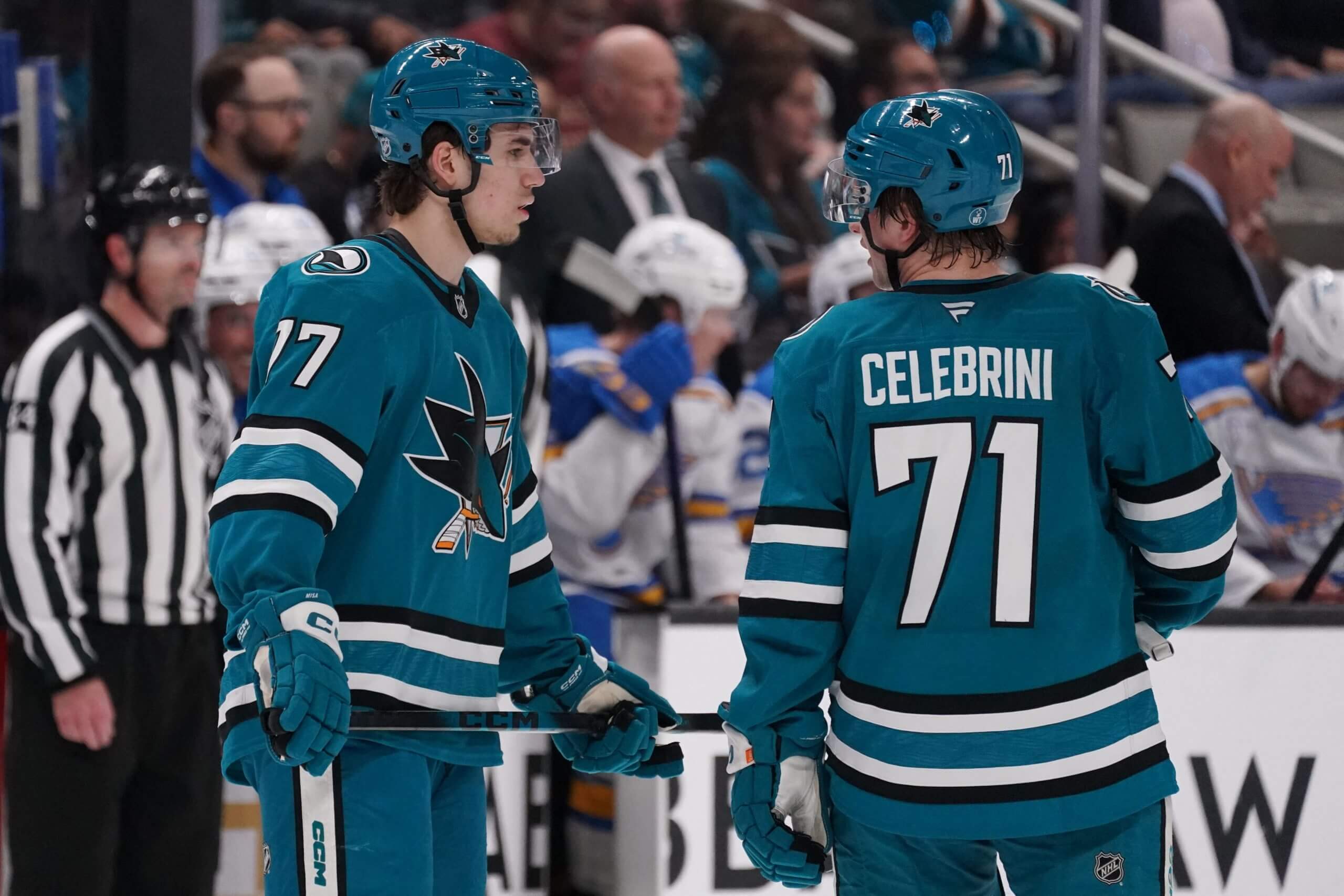
Michael Misa has major breakout potential next season, while Macklin Celebrini has plenty of runway to improve on an already elite season. (David Gonzales / Imagn Images)
San Jose Sharks: Macklin Celebrini and Michael Misa
Celebrini was already an MVP-caliber player last season when he exploded for 115 points, which was 56 more than the next highest-scoring Shark. The scary part is he was only 19 last season, meaning there’s still plenty of runway for him to improve.
However, part of the reason I rated the Sharks so high is that I’m very bullish on Misa’s breakout potential for next season.
Misa, the No. 2 pick from 2025, scored 18 points in his last 35 games (a 42-point pace over 82 games) despite averaging only 13:09 of ice time per game. He flashed high-end skill and scored 1.88 points per 60 at five-on-five last season, which is an above-average top-six rate. Misa is an advanced play-driver for his age too, as the Sharks were break-even in shots and actually generated slightly more high-danger chances than they surrendered during his five-on-five shifts. With increased ice time, age-related growth and his elite potential, Misa could comfortably clear 50 points and perform like a league-average 2C next season.
Couple that with one of the best players on the planet in Celebrini, and you get one of the best center duos in the NHL.
Toronto Maple Leafs: Auston Matthews and John Tavares
At his peak, Matthews is a unicorn as a 60-goal scorer who also plays Selke-caliber defense. But after scoring at a 105-point pace over 82 games from 2021 to 2025, he slumped to only 27 goals and 53 points in 60 games last season.
I’m bullish on the odds of Matthews bouncing back at a franchise 1C level next season — his track record of elite performance is very long, and the coaching change should be a benefit, especially if it means less extreme defensive deployment.
Tavares, meanwhile, isn’t nearly as strong of a play-driver as he was during his prime, but his offensive production is elite for a 2C. He scored 71 points last season, and it wasn’t just empty-calorie power-play points — 39 of his points came at five-on-five, which ranked 16th best among all centers.
There’s some uncertainty with this duo between Matthews’ down year and Tavares’ age/defensive play, but if the former rebounds, they’re going to be a force.
Vegas Golden Knights: Jack Eichel and William Karlsson
Eichel is one of the best 200-foot centers in the NHL. The 29-year-old hit the 90-point mark for a second consecutive season. He has breathtaking control of the flow of nearly every game he plays in because of how smooth and deceptively quick he is as a puck carrier, along with his elite playmaking vision. His long reach and disruptive stick-checking also make him an excellent defensive presence, as he finished top-10 in Selke voting again.
Karlsson was limited to only 14 regular-season games because of injury, which created issues at the 2C spot for Vegas. We saw the likes of Brett Howden and Mitch Marner take turns at 2C because Tomas Hertl isn’t a strong enough five-on-five driver to be a full-time 2C.
Karlsson has historically been one of the league’s best shutdown centers, so we’re giving him the benefit of the doubt with this projection. However, if injuries continue to be an issue or if age-related decline starts to hit, it will weaken Vegas’ 2C slot, which would cause this duo to tumble down the rankings.
Dallas Stars: Wyatt Johnston and Roope Hintz
The Stars are blessed with two legitimate 1Cs.
Johnston exploded for a career-high 45 goals (tied for fifth best among all NHLers) and 86 points last season. He’s already one of the most deadly power-play weapons in the NHL, and having just turned 23 this offseason, it still feels like he could take another step in his all-around game. Johnston isn’t quite dynamic and productive enough at five-on-five to be viewed as an undisputed superstar in the NHL yet — he actually scored the fewest five-on-five goals and points since his rookie year — but he’s knocking on the door and is clearly an above-average 1C.
Hintz has put up 0.89 points per game over the last four years, which translates to a 73-points-per-82-games rate. His elite speed and puck-carrying ability are indispensable to the team — the Stars looked lost at five-on-five in the playoffs without him — and his defensive game is high-end and underrated.
Carolina Hurricanes: Sebastian Aho and Logan Stankoven
Aho is well-established as a top-15 center with the consistent ability to score 80 points in addition to strong defensive results, but the real difference compared to years past is the emergence of Stankoven.
Carolina had issues at the 2C in previous years following Vincent Trocheck’s departure, but Stankoven has finally filled that critical need. The 23-year-old drove one of the best second lines in the NHL alongside Taylor Hall and Jackson Blake. Stankoven erupted for 11 goals and five assists in 19 playoff games en route to the Stanley Cup, and his impact was greater than his point production all season, shown by his crooked possession and play-driving numbers.
Tier 4: Above-averageTampa Bay Lightning: Brayden Point and Anthony Cirelli
This duo had the potential to rank in a tier higher than this, but we had to knock them down after Point’s worrying down year.
Point looked like a shadow of himself for all of last season, scoring just 18 goals and 32 assists in 63 games, along with only one point in seven playoff games, amid an injury-plagued campaign. However, it’s not just about the lack of production; his play looked concerningly ordinary and not nearly as dynamic as it used to be.
The Lightning will be hoping he can bounce back next season with a cleaner bill of health, but for now, we have to view Point more like an average 1C rather than the elite player he used to be.
Cirelli, on the other hand, is elite for a 2C role. He’s an excellent defensive stopper, and his offense has ticked up over the last two years.
Ottawa Senators: Tim Stützle and Dylan Cozens
Stützle has scored exactly one point per game over the last two years, which ranks 12th best among centers who’ve played at least 100 games in that span. He has game-breaking speed and top-notch rush-attacking instincts, and it’s been a treat to watch his two-way game mature over the years, including a massive improvement in the faceoff dot. I wouldn’t quite consider him a top-10 center, but he’s certainly top 15.
Cozens has blossomed into a high-end 2C with a fresh start in Ottawa. He was near a point-per-game producer for the Senators down the stretch in 2024-25, and hit 28 goals and 59 points in his first full season in Canada’s capital. Cozens has very desirable traits beyond just his offensive production as a 6-foot-3 right-shot center who excels in the faceoff circle (won over 53 percent of his draws last season).
Utah Mammoth: Logan Cooley and Vincent Trocheck/Nick Schmaltz
It might be a hot take to have Utah this high, but it’s because I believe Cooley is in store for a monster breakout season. Cooley looks like a game-breaker every time I watch him play with his lethal speed and skill, especially with the rush chemistry he’s built with Dylan Guenther. And considering he just turned 22, he’s in the age bracket where many players take the leap into stardom.
Cooley scored 2.3 points per 60 at five-on-five last season, which ranked 14th-best among NHL centers. His overall point totals and momentum were interrupted by a serious leg injury that limited him to only 54 games. Assuming he stays healthy next season, I’m expecting Cooley to break out as a point-per-game star.
Offseason acquisition Trocheck or Schmaltz project to slot in as the 2C. Both represent proficient options for the job. Schmaltz is coming off a terrific 74-point season; there’s an argument to be made that he’s possibly more effective on the wing, but he played down the middle for most of last season.
Trocheck, meanwhile, racks up points at an excellent rate for a 2C (0.75 per game over the last two years, which translates to a 62-points-per-82-games pace), is elite at faceoffs and it’s noteworthy that his offensive production didn’t dip at all in the second half even after Artemi Panarin’s departure, which proved that he wasn’t just riding the coattails of a superstar linemate.
Tier 5: Middle of the pack (Star No. 1 center but a below-average 2C)Pittsburgh Penguins: Sidney Crosby and Ben Kindel/Tommy Novak
With his 21st consecutive point-per-game or better season, Crosby is showing very few signs of slowing down. Sure, he’s no longer a perennial MVP contender, and his defensive metrics have dipped in recent years, but he’s still a top-10 center in the league.
Evgeni Malkin spent slightly more time on the wing than at center last season, according to CapWages. Colleague Josh Yohe penciled Malkin, who will turn 40 at the end of July, in as a full-time winger for next season. It’s a sensible transition considering his slowing foot speed and defensive play.
However, it does leave the Penguins’ 2C spot a bit weak. There’s a chance that Ben Kindel, who scored 35 points in his rookie campaign in addition to very impressive two-way metrics, breaks out and fills the role well, but that’s a lot to ask out of a 19-year-old sophomore. Novak is the other 2C candidate, but he’s closer to a third-line-caliber player.
Montreal Canadiens: Nick Suzuki and Jake Evans/Oliver Kapanen
After scoring 101 points and winning the Selke Trophy, Suzuki has cemented himself as one of the best centers on the planet. However, the gaping hole at 2C is hard to ignore.
Kapanen spent most of the regular season in that role and had a solid rookie campaign with 37 points. But he fell out of favor by the time the playoffs arrived, as he went pointless in seven postseason games, while averaging a measly 8:20 of ice time.
Evans took over 2C responsibilities later in the playoffs. He punched above his weight class, and there’s a lot to like about him as a speedy, hard-working defensive player, but he’s eclipsed the 30-point mark only once in his career.
Let’s see if top center prospect Michael Hage could be a contender for that role when he presumably signs his entry-level contract in the spring at the conclusion of the NCAA season.
Anaheim Ducks: Leo Carlsson and Mikael Granlund
Carlsson is on the cusp of becoming an elite player. He’s a buttery smooth playmaker, boasts a 6-foot-3, 208-pound frame, has added explosive speed and high-level finishing ability to his offensive arsenal, and has high defensive potential, too.
Granlund is a good player, but he’s a bit of an empty-calorie point producer. He racks up points (41 points in 58 games last season), but doesn’t actually win his even-strength matchups because he’s a poor play-driver, especially defensively. The Ducks had a minus-five goal differential during Granlund’s five-on-five minutes, which marked the third time in the last four years that he’s been on the ice for more goals against than goals for. Tack on some age-related risk with Granlund turning 35 in February, and I rate him as a below-average 2C.
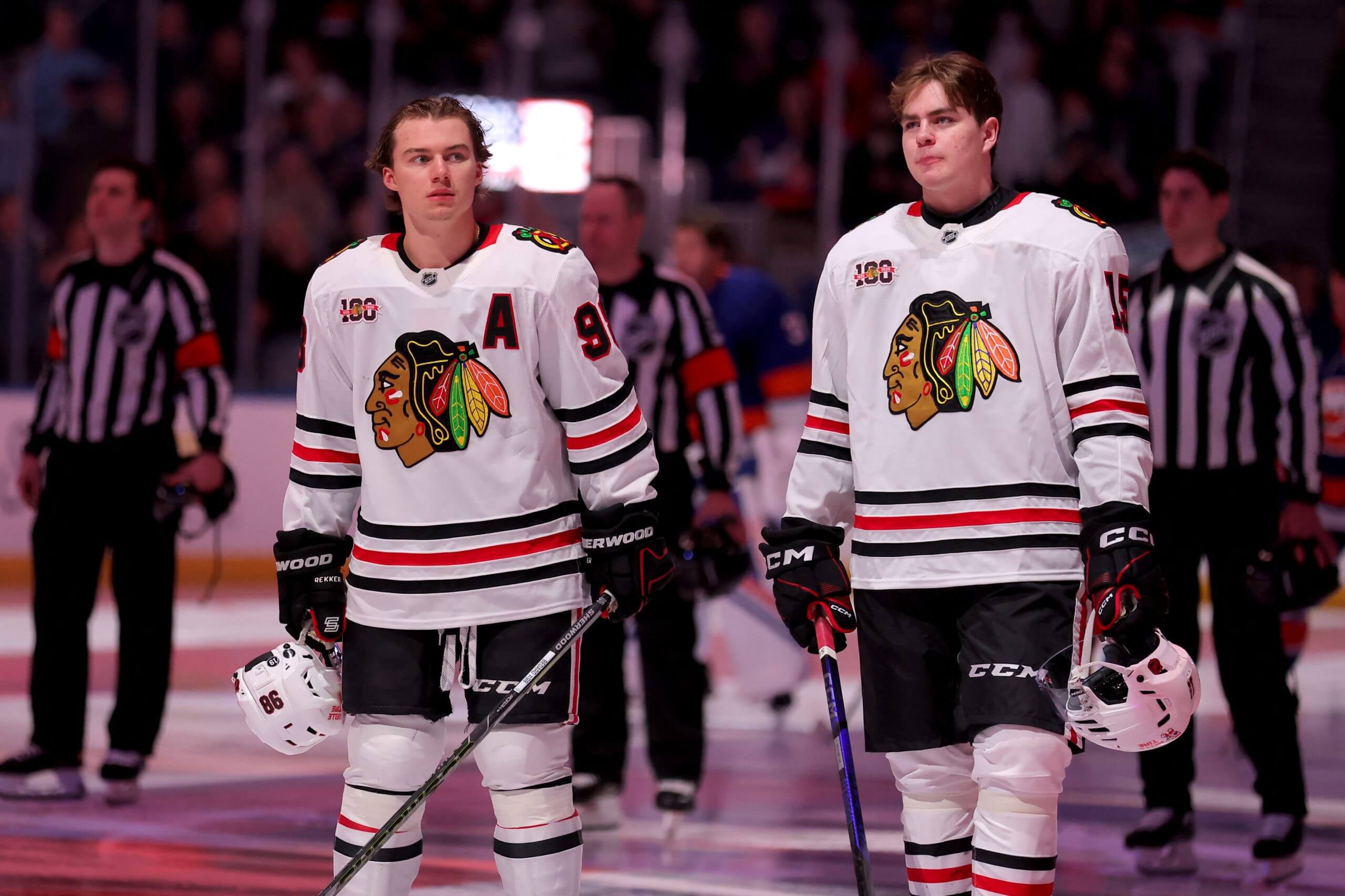
There are still a couple of questions surrounding Connor Bedard next season, while Anton Frondell looks to make an impact as a rookie. (Brad Penner / Imagn Images)
Chicago Blackhawks: Connor Bedard and Anton Frondell
Bedard was third in the NHL in points (44 in 31 games) until suffering a shoulder injury. He wasn’t quite the same after the injury, but his play up until that point reaffirmed his superstar potential. Bedard also deserves extra credit for being saddled with some of the worst linemates of any 1C in the NHL — André Burakovsky and Ryan Greene were his most common wingers last season. With that said, another shoulder injury and soft defensive metrics mean there are still a couple of questions surrounding Bedard next season.
Frondell’s rookie impact is tough to predict. He showed promising flashes down the stretch with nine points in 12 games, and you can’t rule out the possibility of him being a league-average 2C or better right out of the gate. However, it’s also true that his underlying numbers were rough in that small sample size: Chicago controlled less than 40 percent of shots and had a minus-60 scoring chance differential during Frondell’s five-on-five shifts across those 12 games. I expect him to score a good chunk of points, but like many 19-year-olds, he’s probably going to find it difficult to drive play and win his matchups.
St. Louis Blues: Robert Thomas and Mason McTavish
Thomas is one of the most underrated 1Cs in the NHL. He’s averaged 1.07 points-per-game (an 88-point pace) over the past three years, is high-end defensively and is strong in the faceoff circle. He’s easily a top-15 center in my books.
McTavish, on the other hand, has a lot to prove next season. His pedigree and offensive tools are legit (he’s only a year removed from scoring 52 points as a 22-year-old), but he owns some of the worst defensive metrics in the NHL, is a very poor skater and is coming off a disappointing campaign in which he lost the 2C role. McTavish has the potential to take a meaningful step, especially because a contract dispute last fall forced him to miss training camp, which put him behind the eight ball, but for now he’s a below-average 2C.
Winnipeg Jets: Mark Scheifele and Viggo Björck/Adam Lowry
Scheifele is coming off a career-best 103-point season, and while his defensive metrics remain a weakness, there’s no question that he’s a star No. 1 center. Where the conversation gets really fascinating is the 2C role.
Björck is an elite prospect who will eventually solve the Jets’ longtime 2C woes, but the question is how quickly he can fill that role. Colleague Murat Ates believes Björck is going to get that chance as soon as next season. I love Björck and his impressive showing at the World Championships proved that he might be NHL-ready out of the gate, but it’s unlikely that he’s going to be a top-50 NHL center as an 18-year-old rookie, which is the level required to be considered an average 2C or better.
Tier 6: Below-averageNew York Rangers: Mika Zibanejad and J.T. Miller
Zibanejad authored an excellent bounce-back season with 34 goals and 78 points, but he probably ranks somewhere in the 20s if we rate the best centers in the NHL, which makes him a low-end 1C.
The 33-year-old remains an elite power-play weapon, but his five-on-five impact has slipped in recent years. Zibanejad has scored fewer than 2.0 points per 60 at five-on-five for three straight seasons, and the Rangers conceded slightly more shots, chances and goals than they generated during his minutes for a second consecutive season.
Miller struggled mightily in his first full season as a Ranger. He scored only 1.58 points per 60 at five-on-five, which is a third-line rate; his foot speed is slowing; and the team was outscored by 15 goals with him on the ice at five-on-five. His overall point totals look respectable (53 in 68 games) because of his power-play production, and you could certainly do a lot worse than Miller as your 2C, but at 33, it’s fair to wonder if he can win his matchups as a top-six center.
Washington Capitals: Dylan Strome and Pierre-Luc Dubois
Strome has found a lovely fit in Washington over the last four years (68 points per season average), but nobody is mistaking him for a top-20 center in the NHL. His defensive metrics are quite weak, and his matchups are far more sheltered than your typical 1C — he only spent 27.5 percent of his minutes against “elite” competition according to PuckIQ, which ranked eighth among Capitals forwards.
Dubois, on the other hand, is at least an above-average 2C. He missed all but 29 games in 2025-26 due to injury, but the year before, he scored 66 points and handled difficult defensive matchups very well.
Detroit Red Wings: Dylan Larkin and Andrew Copp
The Red Wings were already short a top-six center, and that’s before Larkin’s trade request.
Larkin is an excellent player, but he’s never hit the 80-point mark in his career, and his five-on-five scoring is inconsistent — he scored just one five-on-five goal from Jan 1 until the end of last season. He’s a slightly-below-league-average 1C.
The bigger hole is at 2C. Copp and J.T. Compher aren’t top-six caliber centers, and their younger pivots, such as Marco Kasper and Nate Danielson, are far away from reaching that level, too.
New York Islanders: Bo Horvat and Brayden Schenn
Horvat is a low-end 1C. He’s a terrific all-around player with top-notch goal-scoring ability, size, elite faceoffs, and reliable defensive play, but he’s produced at a 65-points-per-82-games pace over the last three years, which simply isn’t star-caliber.
Mathew Barzal spent a large chunk of last season at 2C, but after the Schenn acquisition, the former shifted back to the wing. Schenn would be best suited as a 3C at this stage of his career rather than as a 2C; he only scored 39 points last season, his play-driving metrics have declined, and he turns 35 in August.
Columbus Blue Jackets: Adam Fantilli and Sean Monahan/Charlie Coyle
Fantilli hasn’t taken the leap to stardom yet, as he fell just shy of the 60-point mark last season. And as is the case with a lot of young centers, his defensive metrics need to eventually improve as well. Fantilli’s tools and upside are special, though. He took a notable step forward as an offensive play-driver, even though the point totals didn’t reflect it because his shooting percentage fell last year. I’d bet on Fantilli to break out this coming season, but there’s obviously still a lot of ground for him to make up before he can be considered a league-average or better 1C.
Monahan’s offensive numbers crashed to only 36 points last season, with Coyle forced to pick up the slack in top-six duties. Coyle was a very good 2C last year, scoring 58 points and driving excellent defensive results. However, for most of his late 20s and early 30s, he’s been an ideal 3C rather than a bona fide 2C. Last year was the exception, but there’s a decent chance he could modestly regress in 2026-27.
Buffalo Sabres: Josh Norris and Konsta Helenius/Noah Östlund/Jiri Kulich
The Sabres were the toughest team to rank because there’s uncertainty around who their actual top-two centers will be. That starts with Tage Thompson: He played most of last season at center, but he finished the playoffs on the wing. That isn’t the first time that Lindy Ruff has moved Thompson, who is below-average defensively at center and a liability in the faceoff circle, to the wing.
If Thompson was slotted at center, we would have ranked the Sabres top-six duo a lot higher than this, but colleague Matt Fairburn is projecting that Thompson will play on the wing.
Norris is a great player, but he isn’t a 1C, and his durability has long been an issue, which could force Thompson back to the middle at some point.
Buffalo’s 2C job has a few candidates. Helenius and Östlund both flashed a lot of promise and could be ready for top-six duties. Kulich, who was limited to only 12 games because of a blood clot, is an option as well. One of these three should emerge as a competent 2C, and if not, the underrated Ryan McLeod could always adequately fill that role as well.
If we strictly looked at Norris/Helenius as a duo, the Sabres would arguably deserve to drop a tier, but I’d be surprised if Thompson stays on the wing for the entire season. I had to at least factor him in as a possible part-time 1C option when slotting Buffalo.
Vancouver Canucks: Elias Pettersson and Marco Rossi
Vancouver lacks a true 1C, but it at least has two bona fide top-six caliber centers, which distinguishes it from the teams in the tier below this.
Pettersson’s defensive impact is still high-end, and he deserves some slack because he was saddled with inferior wingers — Evander Kane, who may not even get an NHL contract for next season, was stapled to the top line for most of the year — but Pettersson ultimately produced only 51 points. He’s skating slower than ever and has lost his dynamic rush-attacking skills.
Rossi is a solid 2C. He isn’t every team’s cup of tea as a 5-foot-9 center with average speed, but his results are hard to argue against as he scored 60 points in 2024-25 and produced at a 57-points-per-82-games rate last season.
Tier 7: Major weaknessNashville Predators: Ryan O’Reilly and Matthew Wood/Mavrik Bourque
O’Reilly turned back the clock and recorded 74 points last season in addition to his customarily robust defensive metrics. At 35, though, it’s fair to wonder if he can repeat that kind of performance in 2026-27. In any case, he’s a fringe 1C at best, who would ideally be a 2C on a contending team.
Nashville’s 2C spot will be really fascinating to track. Wood had a successful rookie campaign, scoring 17 goals; he split time between wing and center. One of him or Mavrik Bourque (who has mostly played wing in the NHL but is a natural center) could break out and eventually be a competent 2C. Chances are, though, there will be flashes of promise mixed with some growing pains because of how inexperienced they are as NHL centers.
Minnesota Wild: Joel Eriksson Ek and Danila Yurov
Eriksson Ek is an underrated all-around player, but he would ideally be the 2C on a Cup-contending team rather than a team’s best center. The 29-year-old Swede has mostly fluctuated in the 50-to-low-60s point range over the past four years. He’s more valuable than his raw point totals would indicate because he’s also a top shutdown defensive player, but you’d want your 1C to have more offensive pop.
Making matters worse is that the Wild don’t have a true 2C either. Yurov had a decent rookie season, with 27 points in 73 games, and there’s some remaining upside considering his two-way IQ, but his quiet playoffs proved that he’s got a significant way to go before being a true top-six-caliber center.

Trevor Zegras and Christian Dvorak don’t give the Flyers an elite top-six center duo. (Robert Edwards / Imagn Images)
Philadelphia Flyers: Trevor Zegras and Christian Dvorak
Zegras broke out with a career-high 67 points last season. I love his creativity and skill, and I believe he still has another level he can reach offensively, but I don’t buy that he’ll ever be considered a bona fide 1C on a playoff team. For starters, he spent more time on the wing than he did at center last season, according to CapWages. Zegras is dreadful in the faceoff circle (34.1 percent) and his defensive play leaves a lot to be desired.
Dvorak would ideally be a 3C rather than a full-time top-six player. He hit a career-high of 51 points last year, but before that, he had never cracked the 40-point mark in his NHL career.
Boston Bruins: Pavel Zacha and Fraser Minten/Elias Lindholm
The Bruins have lacked a true 1C since Patrice Bergeron’s retirement.
Zacha performed impressively last season, hitting the 30-goal mark. And it’s noteworthy that he accomplished that feat while barely playing alongside David Pastrnak. With that said, Zacha is clearly a 2C-caliber player rather than a bona fide No. 1. He’s never hit the 70-point mark in his career, and he isn’t a very robust play-driver. The Bruins controlled only 45 percent of expected goals during his five-on-five shifts last season.
Minten or Lindholm will likely be Boston’s other top-six center. Minten enjoyed a solid breakout season with 35 points. He’s young enough that he could certainly take another step, but I’m not sure how much untapped offensive upside he truly has. He has always been billed as a reliable, defense-first center, and sure enough, if you look under the hood, he didn’t have the best offensive play-driving numbers last season, benefited from a near-15 percent shooting clip and went pointless in six playoff games. I’m not quite ready to anoint him as a top-six-caliber center.
Lindholm, on the other hand, is clearly a 3C-caliber player. He brings a lot of defensive value, but he simply can’t drive offense the way he used to, and even the 48 points he scored last season are inflated by all the time he spent playing with Pastrnak.
Los Angeles Kings: Quinton Byfield and Erik Haula
Is this the year Byfield finally breaks out as a true No. 1 center? Byfield has been stuck in the 49-to-55 point range the last three years. With Anze Kopitar gone, it’s sink-or-swim time for him as a 1C. Byfield has flashed enough promise that I could see him breaking out next season, but there’s a good chance that improvement would only take him to the 65-ish point range, which would still be below league average as a 1C.
Behind Byfield, the Kings are facing some uncertainty. Colleague Eric Stephens floated the idea of Adrian Kempe shifting to center. It may be worth a try, but the odds would be stacked against that working. Kempe hasn’t played center since really early in his career, and it didn’t go well at the time. We rarely see players successfully make this positional shift this deep into their careers.
Haula, Alex Laferriere (he’s a winger but played some center last season) and Scott Laughton would be the Kings’ other internal center candidates, which doesn’t inspire much confidence.
Seattle Kraken: Matty Beniers and Chandler Stephenson
Beniers is outstanding defensively, but he’s averaged 43 points per season over the last three years. His offensive game is very far away from a 1C level — he’d be best suited as a high-end 2C, but the Kraken don’t have anyone else who can challenge for the 1C job yet.
Stephenson has been a 50-point player for a while, which sounds good, but he’s an empty-calorie point producer who drags the team down as a two-way liability. Stephenson’s defensive metrics were some of the worst in the league, with Seattle controlling an alarming 32.1 percent of high-danger chances during his five-on-five shifts. That’s the worst mark among all NHL forwards who played at least 600 five-on-five minutes last season.
Tier 8: Zero top-six caliber centersCalgary Flames: Morgan Frost and Mikael Backlund
The Flames are patiently rebuilding, and made smart trades to ship out veteran top-six centers Elias Lindholm (they drafted Matvei Gridin with that pick, who looks like a top-six NHL forward, and also got Hunter Brzustewicz) and Nazem Kadri, so their low placement on this list shouldn’t be seen as a criticism of management in any way.
With that said, if we strictly look at next season, it’s clear that their one-two punch down the middle is the weakest in the NHL by a fair margin. Every team in the tier above at least had one player who’d be considered a top-50 center in the NHL, but the Flames lack that.
Frost took a step forward with 22 goals and 43 points, but he’s ultimately a middle-six center, especially when you factor in that his matchups are relatively sheltered. Backlund still handles very tough defensive duties quite proficiently, but at 37 and having cracked the 40-point mark just once in the last three years, he’s a third-line-caliber center.